Here Comes My Career

I’ve been having a thing with my high school English teacher.  She was quite the babe back in the late 60s at Vicksburg High and I was maybe her pet, but nothing ever progressed then like you read about now.  I went looking for her to find a discerning reader for my new blog.

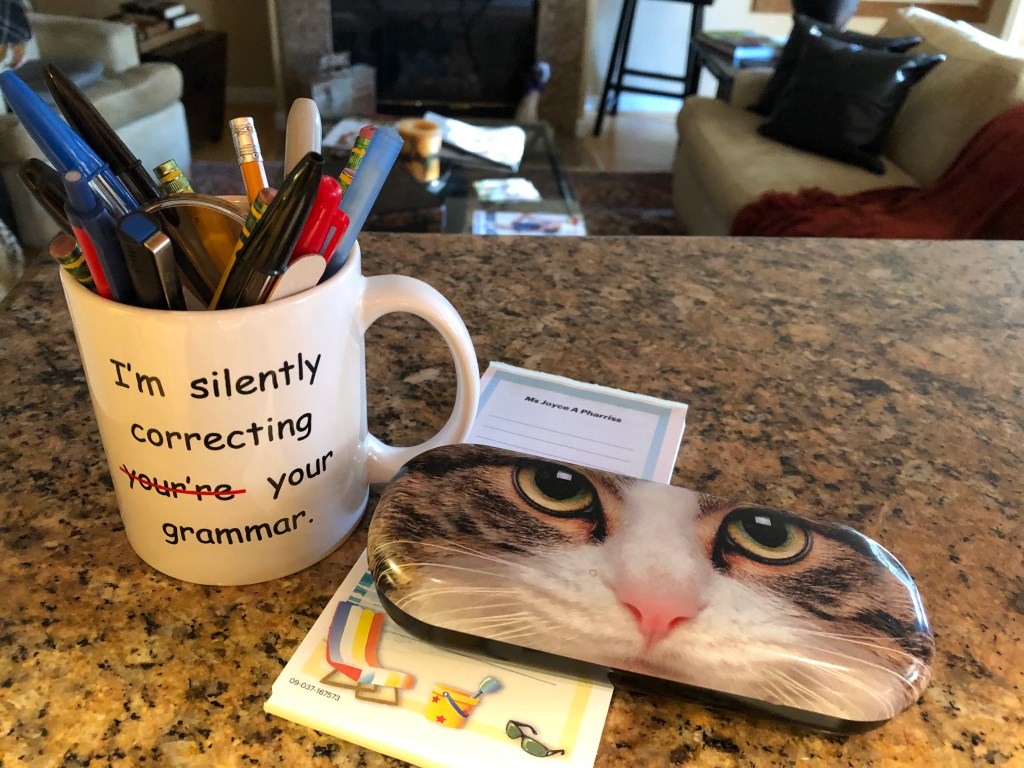
Also, I had come across a stack of my high school essays with her red ink all over them, even though there was usually an “A” on the front. Who better to judge whether I’d made any progress in 50 years?  My snoop program found but one person with that name, right there in California where her pharmacologist-research scientist husband had whisked her midway through my senior year.  Emails bounced back, but one of those real actual letters did the trick. She emailed me back, and we’ve been swapping ever longer messages ever since.  This is bragging material to my high school buddies, who all liked (and feared) her too.  But having an email relationship with your old English teacher gets you a whole bunch of new essay assignments.  She swears she’s given up red ink grading, but you know the expectations are there, if only from a glance at her coffee cup.
She seems not to mind my verbose offerings, unlike some of my email friends. In our last exchange, she mentioned that her high school boyfriend and roommate of 22 years has been talking about having his sore, swollen knee ‘drained.’ She wondered what I thought of this.  She learned early on in our correspondence that I’m a rheumatologist, and was smart enough to know what that meant.  I’d sent her a picture of me and my mentor Bill from 1987 presenting a poster on some more radical knee interventions (pasted in in about a paragraph), so she was curious about this knee drainage thing and also about my opinions of rice in arthritis, stemming from a bizarre invitation I had forwarded her asking for my contribution to a scientific journal on rice science.  I’d offered that the main role of rice in arthritis treatment is to heat it up in the microwave and place it on the aching joints.  She asked if she owed me for the consultation.

What happened went from there.  She’d touched a nerve.

I let my California license lapse last year when I decided I couldn’t justify the $820/2 yr renewal fee.  So this recent consultation is gratis, but mind you is coming from a source no longer certified by your state.

As Andy Breckman sings “Here comes my career” https://www.youtube.com/watch?v=FOiqDqfFvjM, so stand back

Draining joints was my thing.  After appropriate cleansing and local anesthesia, you take a 21-18 gauge needle (3-5 mm), poke it into the swollen joint, drain any fluid there (saving it for analysis if a diagnosis is uncertain), then usually pushing back in some corticosteroid or rooster comb extract.  Knees usually have some fluid, smaller joints less likely.  I easily did 10,000 over the course of my career, probably more.  I was the go-to guy for teaching others how to do this, and the guy they called in when no one else could get it.  I conducted courses at national meetings, and was asked to write chapters about it in several textbooks (1-5).  But I did more unique things than that.  That handsome dude with me in the picture I sent you was my Chief of Medicine Bill Kelley’s first trainee at Duke and had set himself in Chicago after bailing on academic medicine at U of I.  Might as well show him right here, he and I standing by our poster at the 1987 American Rheumatism Association regional meeting in Chicago. 

We eventually published results of the trial (6).  He got orthopedist at Northwestern Dave Stulberg to teach him how to do arthroscopy, then set out to see how it could be used in arthritis patients.  Kelley, also a rheumatologist, thought that was a good idea, and picked me to go spend some time with Bill Arnold and learn it.  I thought he picked me for my smarts, which everyone was saying were considerable.  Years later, I had Kelley’s son Mark as an intern on my service.  Mark said his dad had picked me for my height, “because orthopedists respect size”.  Kelley later confirmed that to me face to face.  So that meant right after buying a house and sticking my fiancée Kathy in it, I had to go live in Lincoln Park for a year and drive home on weekends. 

We endured, and got married in October after I came back for good.  Once I got going (it took about 6 months for the orthopods to stand down), I became hot shit for a while.  Nobody in academics was doing this at the time so I got to show the way.  I thought I figured a few things out, published (7-11), taught courses around the country, lectured abroad, and got job offers from Mayo Clinic and University of Alabama (which I turned down, of course).  I helped show the way in use of smaller “needle scopes” which could be done in procedure units, avoiding the O.R.  Towards the end of the 90s, obstacles began to pile up.  Some well done controlled trials showed arthroscopy really wasn’t doing anything in osteoarthritis of the knee (OAK), the drugs for rheumatoid arthritis got so much better that the knee situations  an arthroscope might help grew uncommon, and we really couldn’t figure out much from the biopsies of the joint lining (synovium) we were doing under arthroscopic guidance.  It didn’t help when I cut through an important nerve in back of a patient’s knee while cleaning it out, an easy lawsuit to win and she did.  The department decided not to renovate my equipment when it started breaking down and for the last two years, ending in 2002, I had to rely on the O.R. and just didn’t generate enough business to justify continuing, and I was shut down.  Needless to say, I panicked for a while.  I’d achieved tenure 10 years earlier, so I wasn’t really worried about my job.  But I had lost that great thing that made me unique

Oh, that joint lavage thing was supposed to duplicate what some thought was the main effect of arthroscopy, in which saline is flushed through the joint to clear out debris and provide a clear view.  We’d just stick a 14 gauge (8mm) needle into a knee, fill it with saline and then rinse-wash-repeat until a liter had passed though.  Prospective trials, done more rigorously than the one Bill and I had communicated, showed the intervention conferred no benefit beyond sham and that was that.  Bill still thinks there’s something to it.  Some docs overseas still do it for certain situations. I wrote a commentary in Nature (Rheumatology) in 2007 regarding its use in inflammatory arthropathies like rheumatoid arthritis, where it actually may be effective (12).  But I sadly tossed out all my special needles when I cleaned out my office last year.

I kept doing some odd invasive procedures no one else did: needle muscle biopsy (13) and minor salivary gland biopsy (lip biopsy), mainly done to support a Sjögren’s Syndrome diagnosis.  I taught a lot of fellows how to do the latter, and one of them, Sara McCoy in Wisconsin, had me join her to teach a workshop at our national meeting last year.  They asked us to do it again this year.

There’s one more thing: ultrasound.  Radiologists have been doing this to sort out joint problems for years, and some of the pioneering work was done by U of M people.  All through the 90s, I was itching to get involved, but our radiologists showed me no love.  In 2001, our Division hosted Marina Backhaus from Berlin, who was showing rheumatologists all over the world how they could do their own ultrasound and coming up with stuff the radiologists had missed.  I befriended her big time, not because I was sucking up to advance my career, but because I genuinely liked her.   Kathy too.  We took her to the Ohio State football game and had her over for family Thanksgiving.  I was unable to find a picture of her at any of those proceedings.  We we’re probably having too much fun to take pictures.  But here she is in Leeds, UK, mid June 1999 for an arthroscopy course I was helping to teach.  That’s my great scopy buddy, friend and hero Staffan Lindblad of Stockholm with a forgotten but nevertheless attractive French rheumatologist in the foreground.

She continued her rise into the academic stratosphere, but she’s still good for a hug whenever I bump into her at a meeting.  She convinced my Chief that rheumatologists getting into ultrasound is a good idea, and they found $100K to buy a machine.  I scored a big 3 year award (my only one like that ever) that carved out some time in which I could seriously teach myself and in about 3-4 years the chief of musculoskeletal radiology said I was good to go.   His deal was I could do all the ultrasound I wanted, but could bill for it only when guiding procedures.  That was pretty much what I wanted it for anyway, so o.k. by me.  And it was neat how ultrasound could turn a difficult tap in to a piece of cake.  Easier on the patients, too, as there’s less struggling.  In 2007 the American College of Rheumatology convened a Task Force on the use of ultrasound in rheumatology.  A lot of rheumatologists had started picking up the procedure as the machines got better, smaller, and cheaper, but a few were using it for some iffy indications.  The group elected me chair, a shock to me at the time, and we set out all divide-and-conquer eventually producing a white paper I mainly wrote and finally in 2010 pushed Arthritis Care and Research to publish (14).  The ultrasound club is way bigger than the arthroscopy club ever was, and I hardly occupy the same position of prominence.  I’ve had the satisfaction of training several fellows in the procedure and managed one cute publication about a maneuver during ultrasound that is now taught as standard practice (15). 

Maybe one of the best consequences of ultrasound is that it’s gained me one of my best friends.  In 2014, shortly after my accident, the NIH decided it would be a good idea if we could assemble a cadre of people at all the centers studying the synovium who could biopsy that synovium under ultrasound guidance.  The folks doing this best were at two institutions in London.  The NIH didn’t know when they invited me that my right hand was useless from my December bike accident.  My Chief encouraged me to go anyway and even secured NIH approval for business class fare because of my “disability”.  Off we all went.  My hand was good enough to take a stab at some of the things they were teaching us. 

There was a tall, blonde (two of my weaknesses) good looking lady there from St. Louis.  Barnes.  That’s her just to my right. 

She became an intern the year after I left but she’d heard some stories.  We knew so many of the same people, and often had the same opinions about them.  We had 2 dinner “dates”, one at the famous Ronnie Scott’s Jazz club in Soho we needed to take a rickshaw to find there to see the blind and spectacular Diane Schuur.  Deb and I have been fast friends since, her Jeff liking my Kathy and all of us becoming best of friends and compatible traveling companions.  We’ll be meeting up in Chicago next weekend (done as of this post: 3/6-8/20), taking separate trains, for a weekend of jazz, eating, and drinking.  And, oh, the NIH sponsored group did produce (16).

It’s all been procedures so far.  I talked my way into getting one of the major rheumatology texts to have me do a chapter on just procedures, which made it into another edition and is probably my prettiest work (16).  They have someone else write it now, but it’s the same pictures. But I’ve spent most of my time over the past 36 years being with patients, not invading them.  But every doctor does that, right?  My patients have been my sustaining force.  It is a great privilege to be in a profession that provides the opportunity for so much giving and for so many distractions from your own innate selfishness.  If I ever came home irritated and pissed off, it was because something in the system kept from getting done something I’d wanted for my patients.  You’re supposed to remain professional, maintain barriers, and not become friends with your patients.  I found that so hard to do, and never really succeeded.  Even towards the end, I insisted keeping the computer off to the side so I could sit face-to-face with my patients.  I hear that’s no longer possible.  If so, I’m really glad I’m out.  But I’ll always cherish the time I spent with them.  It was a pretty good 40 years (36 at UofM). 

References

  1. Arnold WJ, Ike RW.  Specialized procedures in the management of patients with rheumatic diseases, in Cecil Textbook of Medicine, JB Wyngaarden, LH Smith and JC Bennett, Editors.  Nineteenth edition.  1991, WB Saunders: Philadelphia. p. 1503-1508.

2.         Ike RW.  Therapeutic injection of joints and soft tissues, in Primer on the Rheumatic Diseases, JH Klippel, Editor.  Eleventh edition.  1997, Arthritis Foundation: Atlanta. p. 419-421.

3.         Ike RW, Arnold WJ.  Specialized procedures in the management of patients with rheumatic diseases, in Cecil Textbook of Medicine, L Goldman and JC Bennett, Editors.  Twenty-first edition.  1999, WB Saunders: Philadelphia. p. 1487-1491.

4.         Ike RW. Therapeutic injection of joints and soft tissues, in Primer on the Rheumatic Diseases, JH Klippel, Editor.  Twelfth edition.  2001, Arthritis Foundation: Atlanta. p. 579-582

.

5.         O’Rourke KS and Ike R. Minimally invasive procedures. inPractice Rheumatology 2015.  Available at: http://www.inpractice.com

6.         Ike RW, Arnold WJ, Rothschild EW, Shaw HL and the Tidal Irrigation Cooperating Group.  Tidal irrigation versus conservative medical management in patients with osteoarthritis of the knee: A prospective randomized study.  J Rheumatol 1992;19:772‑779.

7.         Ike RW, Fox DA.  Arthroscopy in rheumatology training programs associated with NIH-multipurpose arthritis centers: Results from a survey of program directors. Arthritis Rheum 1993;35:1329-1331.

8.         Ike RW, O’Rourke KS.  Detection of intra-articular abnormalities in osteoarthritis of the knee: A pilot study comparing needle arthroscopy with standard arthroscopy.  Arthritis Rheum 1993;36:1353-1363.

9          Ike RW.  Arthroscopy in rheumatology: a tool in search of a job.  J Rheumatol 1994;21:1987-1989.  Editorial.

10.       Laing TJ, Ike RW, Griffiths CE, Richardson BC, Grober JS, Keroack BK, Toth MB, Railan D, Cooper KD.  A pilot study of the effect of oral 8-methoxypsoralen and intraarticular ultraviolet light on rheumatoid synovitis.  J Rheumatol 1995;22:29-33

.

11.       Ike RW, O’Rourke KS.  Compartment directed physical exam of the knee can predict articular cartilage abnormalities disclosed by needle arthroscopy.  Arthritis Rheum 1995;38:917-925.

12.       Ike RW.  Arthroscopic lavage of the knee with or without corticosteroids versus joint aspiration—which is best?  Nature Clin Pract Rheumatol 2007; 3(6):320-1.

13. O’Rourke KS, Blaivas M, Ike RW.  Utility of needle muscle biopsy in a University rheumatology practice.  J Rheumatol 1994;21:413-424.

14.       Ike R, Arnold E, Arnold W, Craig-Muller J, Kaeley G, McAlindon T, Nazarian L, Reginato A.  Ultrasound in American rheumatology practice.  Arthritis Care & Research 2010; 63(9):1206-19

15.       Ike RW, Somers EC, Arnold EL, Arnold WJ.  Ultrasound of the knee during voluntary quadriceps contraction: a technique for detecting otherwise occult voluntary quadriceps contraction: a technique for detecting otherwise occult effusions. Arthritis Care & Research 2010;62(5):725-9.

16.       Mandelin A, Homan P, Shaffer A, Cuda C, Dominguez S, Bacalao E, Bridges SL, Bathon J, Atkinson J, Fox D, Matteson E, Buckley C, Pitzalis C, Parks D, Hughes L, Geraldino L, Ike R, Phillips K, Wright K, Filer A, Kelly S, Ruderman E, Morgan V, Abdala-Valencia H, Misharin A, Budinger GRS, Bartom E, Shilatifard A, Peabody T, Pope R, Perlman H, Winter D.  Transcriptional Profiling of Synovial Macrophages using Minimally Invasive Ultrasound-Guided Synovial Biopsies in Rheumatoid Arthritis.  Arthritis Rheum 2018;70(6):841-54

17.       Ike RW.  Minimally invasive procedures, in Rheumatology, MC Hochberg, J Silman, JS Smolen, ME Weinblatt, and MH Weisman, Editors.  Third edition.  2003, Harcourt Health Sciences: London. p. 245-252.
masks

You know from my 4/16 post “who was that masked man?” how I feel about masks for the general public in a corona-poor environment. So when our Governor Bimbo came out and declared masks for all in public, I had to go out and get one. No report on its filtering capacity

wifey’s turn

My sweetheart is pretty amazing. Not only is she tall , athletic, and beautiful, but she has one more advanced degree than me, is a “push-hard” doctor (PhD), unlike her “muddle through” (MD) husband. As a senior scientist for NASA, she helped put together the space station and plan missions to Mars. She’s now a beloved teacher of scientific writing who won teacher of the year award from her school last December. She has 30 IQ points on me so I have to watch it all the time. She does not suffer fools gladly, so when one of our church fellowship group suggested we read a little screed out of Apple News on communicating to others whom you think might be misinformed about coronavirus or (gaack) climate change https://apple.news/ArBdW2tW7RkyauRZe12ALmQ, she felt moved to get out of bed early today and write this:

I disagree with the article and here’s my thought process.

Few lay people actually have the knowledge to judge what is “wrong” when it comes to the actual science of COVID-19 or the medical care that is being derived from the science, so any of these discussions are simply speculations by masses of folks who have neither the facts nor the scientific background to understand the nuances that differentiate the “right” from the “wrong”.

Are there issues of a less nuanced scientific nature related to COVID-19?  Sure, and these clearly can be and are understood by intelligent people with less of a science background.

Some examples:

We know that chloroquine works as a drug to combat the virus because it has worked, saving many lives, some of which were on the very precipice of death.  Wow, that President Trump is a genius!

We know that chloroquine doesn’t work as a drug to combat the virus because it hasn’t worked, and many lives have been lost under its treatment, some of which were rather early in the development of the disease.  Wow, that President Trump is an idiot!

The reality?  We don’t know if hydroxychloroquine will work or not when we treat a patient with it.  We have pretty good information on the mechanism by which it works, but even that knowledge isn’t necessarily going to give us certainty about its veracity as a treatment.  Welcome to medicine.  Most of us have been exposed to this tiny flaw in the medical field and Bob has been playing the “let’s try this” side of medicine on his patients for years.  Those crazy drugs have even been known to change their minds and stop working after having been effective for years.

President Trump was correct when he saw evidence of hydroxychloroquine success and made the statement “this has the potential to be a game changer.”  Hydroxychloroquine does have that potential.  So do many other drugs.  Doesn’t make President Trump the reincarnation of Elijah.  Nor does it make him Jezebel.

I am always a fan of discussion and debate, particularly on scientific topics (as opposed to the suggestions we often hear about putting “Climate Deniers” in jail, but more on that later).  There is a great deal of merit in listening to others, in trying to understand other views, scientific or otherwise.  I am always amazed at how heated and emotional these debates between scientists can get, since science is reputed to be so dry.  By the way, I stand guilty as charged in this regard, being arguably the most emotional scientist on the planet.  But, as the late senator Patrick Moynihan once said, “Everyone is welcome to his own opinion, but not his own facts.”  In a world where anybody can put any nugget of information into the social media and, with repetition and a little marketing, this nugget oddly becomes a fact, the difference between fact and opinion gets blurred.  This is made all the more complex when the very people who do understand the science and the medicine disagree about the interpretation of the data (which isn’t quite the same as disagreeing on facts, but from the outside, it sometimes appears that way).

A slightly less scientific right or wrong:

Bob and I were in Busch’s the other day and the woman at the checkout (wearing a cute little mask with red peppers on it) informed us that the governor of Michigan has decreed that everyone must wear a mask of some kind in order to go out in public.  When I replied that this was the dumbest thing I had heard in a long time (clearly not having read the article Rhonda sent out), the woman retorted, “the governor just wants us to be safe.”  This is usually about the time that the head of the “most emotional scientist on the planet” explodes.

There is nothing safe about any of the masks that any of the folks wandering around Busch’s were wearing.  In fact, they may be detrimental.  The virus we are wearing masks to protect ourselves from is so tiny, it is beyond imagination.  Bob’s description that, if a human hair were as wide as a football field is long, the COVID-19 virus would be the size of a soccer ball provides a pretty good mental image.

Wearing a bandana or a painter’s mask is like replacing the screens in your windows with butterfly netting and making the assumption that you are still protecting yourselves from gnats. Even a surgical mask won’t work.  The “N-95” masks are so-named because they are rated to stop 95 % of particles smaller than a tenth of micron.  That means that these, the best masks we’ve got, still allow 5% of particles to get through.  Have any of you ever seen what folks in these virus labs actually wear?  They make space suits look casual.

The governor is doing 2 tried and true political things that are also guaranteed to make my head explode.

1.  She’s doing “something”.  Doing something is not the same as doing something useful.  The governor could line 40 people up outside her mansion and shoot them, thereby guaranteeing that they will not die of COVID-19.  It’s doing something, it’s just a really bad something.

2.  She’s empowering people to help themselves.  Except she’s not, because not only do they not work, but masks constrain your own breathing.  Almost anyone who has ever worn a mask for any reason knows the feeling of sneezing inside the mask.  The less said about that, the better…

Her bottom line is to “keep us safe” and make people feel better.  You know what would make me feel better?  Being able to host a fellowship meeting.

I must confess that the author lost her argument with me as soon as she mentioned the non-sense of the 97% of scientists blah, blah climate change, but that is a topic for another day.

smoke ’em if you got ’em?

Back on March 19, I posted “smokin’ corona” (https://wordpress.com/block-editor/post/theviewfromharbal.com/326).  Inspired by meeting some old girlfriends outside the hospital by the bus stop for a “break”, I had to wonder if their habit of periodically bathing their lungs with toxic tobacco smoke might even be protecting them from Mr. corona.  Ultimately I concluded alas no.  Patients with preexisting lung disease do worse once the virus gets hold of them, which stands to reason.  There is also a little molecular hanky panky going on, with the lungs of chronic smokers showing greater expression of a receptor for the MERS coronavirus (1).  Presumably the same thing goes on with COVID-19.  But the “more smokers are dying” data comes from China where 25% of the population smokes (maybe 50% of the men), so if 9% of those dying smoke compare to 4% of the survivors, does that mean much? (2)  In Europe, it doesn’t appear that smoking associates with worse outcome from coronavirus infection (3). Yet aren’t the smokers the ones with the crapped out lungs just waiting their doom?

The French have dared to say it: “pas si vite (not so fast)”. https://news.yahoo.com/france-testing-whether-nicotine-could-prevent-coronavirus-163120850.html.  They examined outcomes of COVID-19 infection at one of their top hospitals.  Of 343 severely affected patients and 143 patients with milder symptoms, 5% smoked.  The French do love their tabaç, with 35% of them smoking regularly.  Not as big as the Chinese, where over 50% of the men smoke (women not so much).  Data from a March New England Journal study found 12.6% of 1,000 infected were smokers. Do you detect an underrepresented population?

So let the trials begin!  One of the first will involve nicotine patches, which I predict will fail miserably as they totally avoid the pulmonary maelstrom where Mr. corona meets Mr. human.  There’s so much in the plume arising from your lit cancer stick, who knows who the active soldier might be.  Already warnings clang not to let this be an excuse to light up https://news.yahoo.com/coronavirus-people-warned-not-smoke-153142264.html

Nobody’s asked Dr. Fauci about it yet.  Even before this, British docs had been lamenting how the social isolation and boredom would get Brits lighting ‘em up all over, reversing decades of social education convincing them this was a bad thing to do.

Kathy and I probably won’t do anything with this.  I’ve not smoked (tobacco) since college.  Kathy chain smoked her way through college, winning 6 varsity letters and All-American honors in swimming (backstroke).  It took commitment to a dedicated stop smoking program once she hit Ann Arbor, and her breath was sweet by the time I met her.  But to my girlfriends at the bus stop, I take it all back and quote my title: “smoke ‘em if you’ve got ‘em”

references  

  1. Seys LJM, Widagdo W, Verhamme FM, Kleinjan A, Janssens W, Joos GF, Bracke KR, Haagmans BL, Brusselle GG.  DPP4, the Middle East Respiratory Syndrome Coronavirus Receptor, is Upregulated in Lungs of Smokers and Chronic Obstructive Pulmonary Disease Patients.  Clin Infect Dis. 2018 Jan 6;66(1):45-53. doi: 10.1093/cid/cix741.

2.         Vardavas CINikitara K.  COVID-19 and smoking: A systematic review of the evidence.  Tob Induc Dis. 2020 Mar 20;18:20. doi: 10.18332/tid/119324. eCollection 2020.

3.         Lippi GHenry BM.  Active smoking is not associated with severity of coronavirus disease 2019 (COVID-19).  Eur J Intern Med. 2020 Mar 16. pii: S0953-6205(20)30110-2. doi: 10.1016/j.ejim.2020.03.014. [Epub ahead of print]

4.         Patwardhan P.  COVID-19: Risk of increase in smoking rates among England’s 6 million smokers and relapse among England’s 11 million ex-smokers.  BJGP Open. 2020 Apr 7. pii: bjgpopen20X101067. doi: 10.3399/bjgpopen20X101067. [Epub ahead of print]

.

.

how clean?

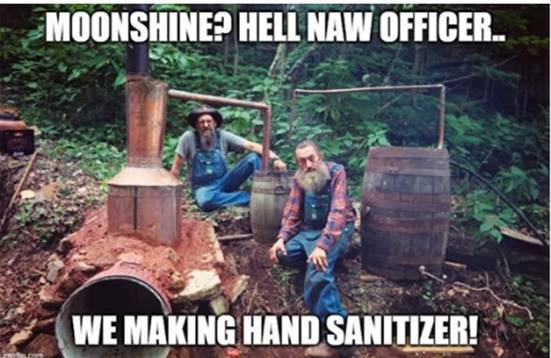
Distillers from all over the country are converting their operations from making perfectly good and much needed booze into making hand sanitizer.  I’d first heard this as a joke, directed at entrepreneurs converting their operations into COVID-19 activities.

I first became aware of it when my favorite whiskey distiller, Traverse City Bay Whiskey, sent me an email announcing proudly they’d shifted their operations fully to the production of hand sanitizer.  Later that day, I was unable to find their product (not hand sanitizer) on the shelves of my local grocery store.  I’d cut way back on my sippage of their product, but had enjoyed vast quantities back in ’15 as it was the only thing to cut back the pain from my brachial plexus injury.  Maybe that’s how I got on their e-mail list.

But this is really getting out of hand, clean as we want them to be, as it were.

https://www.foxnews.com/media/distiller-donates-6100-gallons-of-hand-sanitizer-to-hospital-that-saved-daughter

https://www.mlive.com/news/muskegon/2020/04/muskegon-distilleries-convert-spirits-to-sanitizer-during-coronavirus-outbreak.html

https://www.catholicmessenger.net/2020/04/distillery-responds-for-demand-for-hand-sanitizer/

https://sf.eater.com/2020/4/6/21210289/seven-stills-distillery-hand-sanitizer-coronavirus

https://www.masslive.com/food/2020/04/beer-nut-element-brewing-distilling-making-hand-sanitizer.html

https://www.ocala.com/news/20200319/marion-county-distillers-to-turn-alcohol-into-hand-sanitizer

https://www.daily-chronicle.com/2020/03/19/whiskey-acres-to-distill-hand-sanitizer-for-local-hospital-workers-first-responders/afol5n8/

https://www.thedenverchannel.com/news/national/coronavirus/distilleries-across-the-nation-pivoting-operations-to-make-hand-sanitizer

https://www.wsj.com/articles/distillers-turn-whiskey-and-gin-into-hand-sanitizer-11585049650

https://www.clickondetroit.com/all-about-ann-arbor/2020/03/20/ann-arbor-distilling-co-turns-spirits-into-hand-sanitizer-for-ann-arbor-community/

https://sf.eater.com/2020/4/6/21210289/seven-stills-distillery-hand-sanitizer-coronavirus

https://www.kristv.com/news/coronavirus/south-texas-distillery-turns-vodka-into-hand-sanitizer

https://www.forbes.com/sites/larryolmsted/2020/03/17/hand-sanitizer-from-craft-distillery-could-be-useful-trend/#27f30d4418d8

And this is not a complete list! Even Anheuser-Busch is doing it!  Will they use it to keep the hairy hooves of the Clydesdales corona free?  Will we be ever more free from Mr. corona if we take home product of these misguided ventures and fill our bathtubs to be ever free of the evil germ?  For me, I feel much better about confronting the pandemic day to day if I can sip the unadulterated product of these ventures that have perfected the reaction by which yeast takes carbohydrates into CH2COOH.  Yes, you can divert that into making pure alcohol into which we might baste our hands (soap and water works better), but how much of this stuff do we really need?  And once this whole thing is over, to which all trends project, what do we do with all this hand sanitizer?  Perhaps nerds are working already on finding ways to make the stuff back into something drinkable.  The Iowa corn farmers would object if we could find a way to put it into our gas tanks.  Me I want my whiskey back.  My hands are plenty clean, thank you.

remdesivir

In my March 22 blog post, describing each of the drugs the Chinese had been using to treat COVID-19, I mentioned the agent remsdesivir, which works by acting as a nucleotide analog of adenosine (remember the 4 letters of the language of God: ATGC https://www.amazon.com/Language-God-Scientist-Presents-Evidence/dp/1416542744/ref=sr_1_1?crid=149QA07AXVVM1&keywords=the+language+of+god&qid=1584884234&sprefix=the+langua%2Caps%2C179&sr=8-1), taken up into the new RNA being made by the virus which can not then be translated and direct the manufacture of new virus proteins, a slick little chemical vascectomy for Mr. Corona.  In the lab, it’s been shown to suppress the replication of a number of RNA viruses, including the coronaviruses responsible for SARS and MERS.  In late January 2020, remdesivir was administered to the first US patient to be confirmed to be infected by SARS-CoV-2, in Snohomish County, Washington, for “compassionate use” after he progressed to pneumonia. He was cured.

Well now in my own old medical school on the south side of Chicago (class of ’79), for which I never tire of showing its awesome crest

they’re deep into a trial comparing a 5-day course with a 10-day course of this drug in COVID-19 infected patients. The U of C is only one of several cooperating centers, but chose to talk about preliminary results Thursday https://www.statnews.com/2020/04/16/early-peek-at-data-on-gilead-coronavirus-drug-suggests-patients-are-responding-to-treatment/. They’ve enrolled 128 patients so far, only two have died, fever goes down rapidly and patients get out of hospital in about 6 days. The drug was developed to treat Ebola. Maybe it’ll save us from the COVID-19 that’s still hanging around

1919

In looking for something else in Journal-Lancet, the long defunct journal of the South Dakota State Medical Society, I came across this article in the 1919 volume, written by Dr. Morton Field of Northfield, Minnesota. The Spanish Flu epidemic was still raging and he decided to treat some of his patients with quinine. Lo and behold, it helped. In the paper, he also observed that those patients being treated with aspirin did poorly, which he blamed on the excessive acid load to his patients’ systems, which is one of the things that happens with high dose aspirin. He aimed to keep the patients’ urine pH neutral, even adding urea to get there. I don’t know if this became standard practice. I don’t recall reading about it in John Barry’s excellent 2005 book The Great Influenza. I don’t think President Harding called quinine a “game changer”. But even in medicine, everything old can be new again. And Dr. Field may be on to something with that pH thing. One thing quinine, hydroxychloroquine, and chloroquine do is accumulate in the endoplasmic reticulum, a transport system within the cell were virus replicate, and raise the pH, making it less comfortable for Mr. flu and Mr. corona. You can read further details on my March 20 post “How Plaquenil might work”. Of course, there are many other things the quinine derivatives do.

The aspirin thing is interesting to me in light of concerns, yet to be fully substantiated, that COVID-19 patients taking non-steroidal anti-inflammatory drugs, like ibuprofen (Motrin), do worse. Again, many chemical and immunologic effects from these drugs, but one thing they all do is suppress fever. Fever is an evolutionarily primitive but important and effective component of the host response to any infection. Cold blooded animals infected in the laboratory will take themselves to the warmest possible part of the cage in an attempt to raise their body temperature. Animals deprived of access to the warm areas die at much higher rates than those allowed to roam. So if, God forbid, you get sick with COVID, let your body burn as it tries to kill off that virus.

I took a screenshot of Dr. Field’s paper. Let’s see how it looks:

Who was that masked man?

The rare times I’m out and about these days, I don’t see too many smiles.  I don’t think that’s because everyone is terribly depressed, but people are anxious and many if not most are covering up their faces for protection from dreaded Mr. Corona.  But does this make any sense, or are people just clinging to a security blanket that happens to hang from their ears?

What are they up against?  The naked coronavirus is about 120 nanometers (0.12 microns) across.  The virus escapes the cells it’s infected and destroyed enveloped in some of that cell’s membrane, making particles that can be twice that size.  A thick beard hair is about 50 microns in diameter.  So if your beard hair is as wide as football field, Mr. Corona checks in as a soccer ball at midfield (a little over 8 1/2 inches).  So this is a tiny sucker you’re trying to stop.

This link provides a good guide as to what’s out there (manufactured)  for masks https://healthcentricadvisors.org/wp-content/uploads/2017/04/3_MaskEnomics_Poster_2012.pdf

Masks are rated for their ability to stop 0.1 micron particles.  The much prized n95 mask is rated to stop 95% of such intruders, and it goes down from there.  Note how some of the more commonly seen masks aren’t even rated.

No one has published the pore size of the common bandana, but you see them everywhere.  The CDC has even issued directions for homemade masks https://www.cdc.gov/coronavirus/2019-ncov/prevent-getting-sick/diy-cloth-face-coverings.html.  The CDCs lack of confidence in bandanas is illustrated by recommendations you include a coffee filter.

From my reading, these things mostly prevent you from spewing your germs to others.

So maybe wearing a mask in public is a sign of good citizenship, like washing your hands frequently.  You’ll be keeping any disease laden droplets you happen to cough up to yourself and not sharing them with others.  Thank you for your consideration.  But don’t expect it to prevent the reverse.  You’ll need an n95 or at least an ASTM Level 1-3 for that.  But unless you’re a doc or nurse in an ER or ICU, you’re not swimming in an environment full of little Mr. Coronas, and really don’t need that kind of protection.

So take off that bandana and fold it up for your back pocket where it belongs.  And give us a smile.  We need more of that.  This thing is coming to an end.  Let’s start to celebrate and get ready for when we really can.