Bend me, shape me

Andrew Ripps and his Bendcare company have risen from COVID and will conduct another “Summit” in Colorado Springs, at the luxurious Broadmoor, next week.  I was so moved by the summit I attended in January, I set about to compose a response, which I’ve sat on till now.  I’m getting it out now, as the new summit will almost certainly leave me with new impressions.  I’m particularly interested in what the ever foreword-thinking Dr. Ripps will have to say about rheumatology practice in the world of coronavirus, especially how you can still make money, a mission at which my own Division has miserably failed.

Thoughts on the Bendcare Summit, US Grant Hotel, San Diego 1/17-19/20

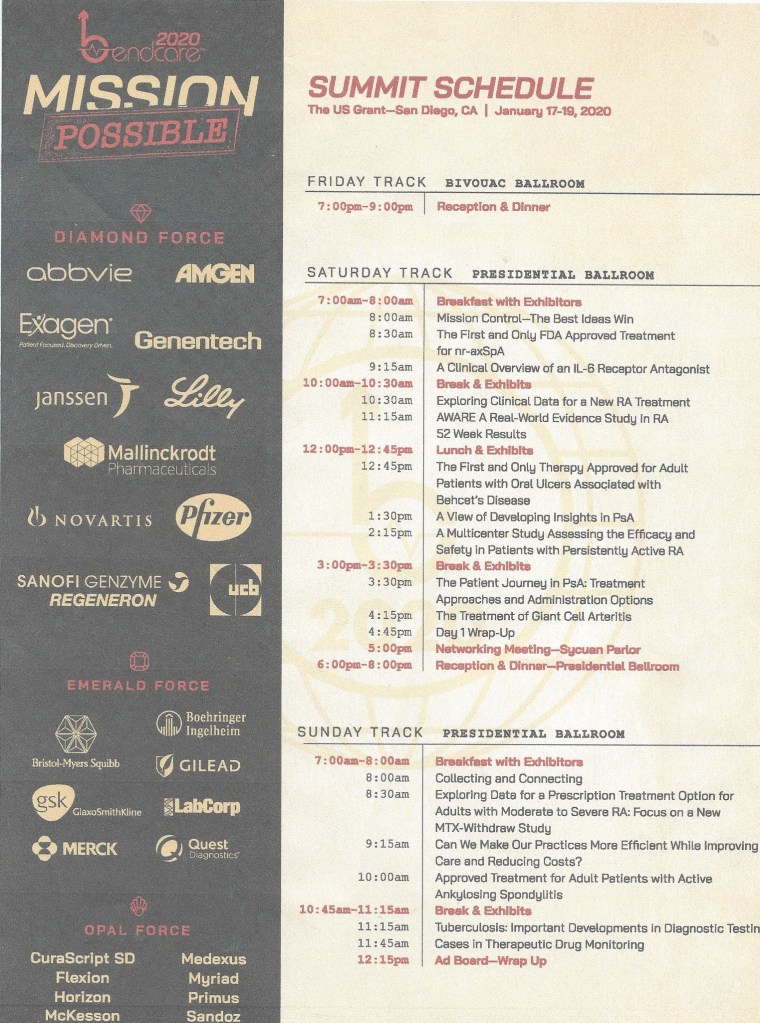
The invite came out of the blue.  On a cold day in early November somebody named Michael Prondecki wants to fly me to San Diego in January and put me up at a luxury hotel to participate in the first of the year “Bendcare Summit” with 80 of my peer “top Rheumatologists” from around the country.  Few other details, but there’s CME involved and he’s not asking me to talk.  To San Diego in January could easily be added “my San Diego”, e.g. LaJolla, with a chance to revisit some of the fun of those 3 months Kathy and I spent there 3 winters ago on my UCSD sabbatical.  I quickly emailed Ken Kalunian, my friend and UCSD host, to ask if these guys were legit.  When his affirmative answer came, I could no longer sit through the ever more boring seminar at the Ford school to rush home to my computer and accept my invitation while making further flight and AirBnB plans.  I’d texted Kathy during the seminar and she was all in.  Turns out Prondecki had been peppering me for months with invites to other great locations.  I think it was the San Diego that got my attention.

Set we were soon for a DTW-SAN Friday 1/17, two nights at US Grant’s son’s hotel, then 3 nights at an AirBnB near LaJolla’s rocky and wondrous Windnsea beach.  It turned out to be even more of a trip than that, which I’ve written about earlier in this blog. (https://theviewfromharbal.com/2020/01/17/way-too-early-on-a-friday-morning-january-17th-a-pre-travelogue/, https://theviewfromharbal.com/2020/01/21/brady-in-pb/, https://theviewfromharbal.com/2020/01/22/another-hard-day-in-lj/)

Although it seemed to take forever on the twisty-turny limo ride from SAN to the US Grant, we got there, got checked in, were challenged by the ice machine situation (see https://theviewfromharbal.com/2020/01/29/ice-at-the-us-grant/), but got spruced up enough to go to the welcoming walking dinner/reception.  I didn’t recognize a single face.  Most of us were older.  Kathy and I struck up conversations with a few, particularly an outdoorsy guy with a pony-tail from Minneapolis (all of us escaping the cold), as we wandered from table to table stuffing and drowning ourselves.  My fear of being found out as clinically inactive (I wasn’t retired yet) never materialized, and by the looks of some wandering about, it was clear many were ever looking forward to the 8th of each month.

Morning brought entry into the big meeting room, with mounds of sumptuous breakfast fare surrounding the meeting tables, the whole roomed rimmed by colorful displays of the supporting pharmaceutical companies, each manned during breaks by the attractive personable female (and some male) representatives of each respective company.

 There was to be no scrambling for seats, as all participants were assigned a place.

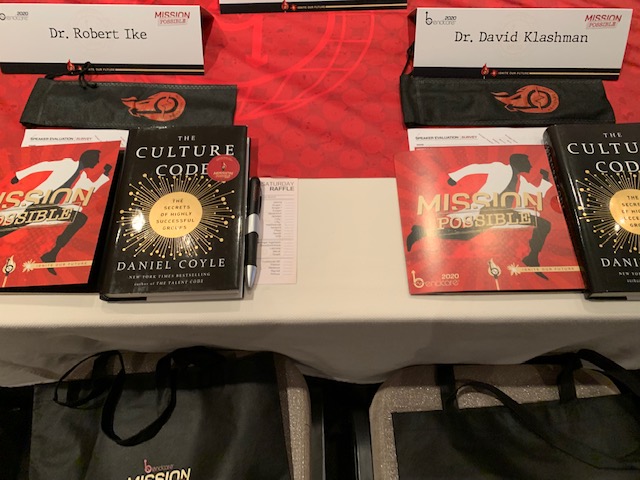
There I was, seated next to the Klash.  He was one of my dear friend and all-time scopy buddy Ken Kalunian’s first fellows who had joined me on several mastheads.  We’d known each other a long time and kept in touch.  Currently in private practice in Torrence, he was intently into this stuff as he desired to transform his practice but was being held back by some more conservative partners.  Spread before us were several tchotchkes, including a program folder with an actual phonograph record inside, a book we should all read (but I haven’t yet: Daniel Coyle’s The Culture Code), a pen that is also a USB drive, pretty cool, a penlight that shone the Bendcare logo like Batman’s searchlight, and in that mysterious red and black leather container, a reusable metal straw complete with cleaning brush.  Taking care of the earth is so cool nowadays.  The retro angle pervaded, from the references to the old “Mission Impossible” (not the Tom Cruise remakes), to the rotary phones and old desks in the projections and old-looking phonograph record players on each desk. For us at this Summit, it was “Mission Possible”, transforming our practices with Bendcare’s assistance. We were all in this together.

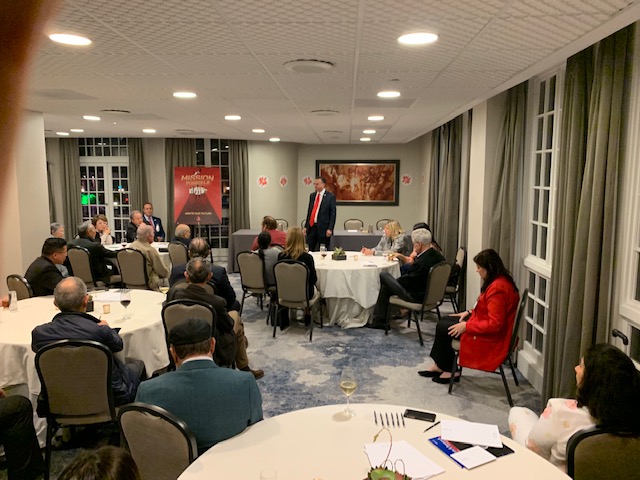
Some assembled agents take their briefing:

The program began with a wild animated feature that sought to portray each of us a superhero fighting against those forces that made clinical rheumatology less fun, less lucrative, and less satisfying to our patients nowadays.  Who wouldn’t buy in to a program that would do that?  Dr. Ripps himself, who made his original fortune organizing the first boutique practices, a pharmacist by training, stepped up with some rousing general comments.  His aim was to achieve “healthier healthcare”.  Finishing by saying we should all “kill, crush, and destroy” those forces impeding us, he had us in a lather that would last all weekend.

The program which followed could have come from any general rheumatology CME course.  All speakers were seasoned and adept veterans of such presentations.  Each speaker dealt faithfully from their deck of stylish, detailed, industry-provided slides.  Some speakers went off-script to varying degrees with one, Dr. Wells, displaying the zeal of an old time gospel preacher for a most entertaining show.

Punctuating interest in the program, at least among the male participants, was the gorgeous young woman who introduced each speaker: pretty, pouty and petite, her straight long black hair flowed all the way down the back of her snug red dress as her luminous eyes flashed across the darkened room, seeking out the uninvolved.  She also had the duty of passing around the microphone in the Q&A after each talk.  She used the empty chair next to me to rest the large padded cube of a microphone she would toss about to participants who had questions for the speaker.  At times, she would rest herself in that chair, holding the microphone in her lap as I silently sighed my wish I could be that microphone.  I’m sure the prospect of sidling up to her encouraged audience participation.  Ripps sure knows what he’s doing.

Not just at breakfast, but at lunch and dinner too, in front of the displays, tables bearing silver vessels laden with food more beautiful and delicious than the drug reps it displaced would appear.  I approached lunch with the ravenous appetite of someone who had been digging ditches all morning rather than sitting and listening to talks.

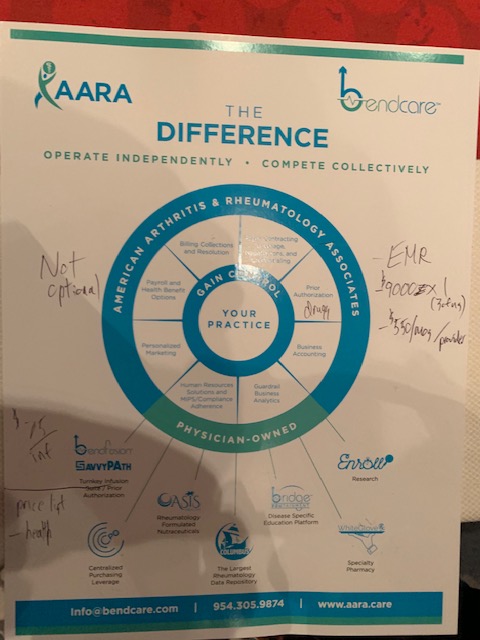
By mid-afternoon, Klash had cracked the code. He’d actually sat down with one of the Bendcare folks to see what their deal was all about.  He produced for me this mandela.

Bendcare offers all sorts of bundled services.  You actually buy in by joining American Arthritis and Rheumatology Associates (AARA, don’t try to find ’em on the net), a parent corporation.  Costs $3000 up front, then $550/mo.  Bendcare makes most of its money on your data, which I’m too much of a boomer to understand.  But they have the biggest base of patient outcomes data of anyone in the world.  Must be important to somebody.

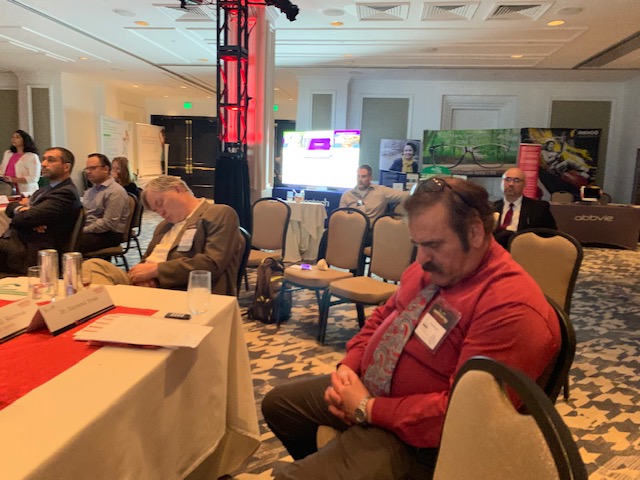
As the afternoon wore on, more and more of the participants opted for 65o  and sunny San Diego over our dark ballroom and presentations from slide decks.  The crowd was so sparse by mid-afternoon that we all got a text message before the 3 o’clock break pleading us to return for the day’s remaining speakers.  My break was highlighted by a lively conversation with a pretty blonde, 6’ plus 4” heels, drug rep (I forget the product), followed by a reminder I was really loved when I caught my wife working away at an outdoor table at the fish house across the way, kitty corner from the hotel, having taken the time to order a beer for me before I arrived.  I still tore myself away to finish the afternoon.  Not all the participants fared so well in the late afternoon sessions.

In the “happy hour” that supervened between session and dinner, Ripps started to get down to the nitty gritty of what it meant to sign up with Bendcare.  The room was well populated with converts, if not too well stocked with booze, who stood up and testified how their practices had changed for the better.  Questions from the curious were entertained, and a lot of us trickled out to sit at the hotel bar where we actually had to pay for our drinks but could at least talk to each other.

Dinner was a lively affair, with fired up participants flying all over the place with full plates and drinks, gabbing away.  My friend and colleague Elena was there and we plotted how we could break free of the U, start our own practice, and make millions with Ripps’ help.  Ripps was circulating and I sought him out to shake his hand and thank him.  I offered that he was helping to alleviate the rheumatologist shortage by enticing the disgruntled retired to reenter the workforce with the prospect of facing a more friendly environment under his wing.  He liked that.

Sunday was a half day to be endured until Mike Prondecki handed you your check.  Ripps’  IT guy took the stage and tried to explain how big data is so important.  Still not getting it.  But Bendcare offers an EMR far more friendly than EPIC.  I’m all for that.

Kathy and I were itching to get up to La Jolla so we could attend services at La Jolla Presbyterian (https://ljpres.org/), the incomparable Pastor Cunningham presiding.  Yes, we were looking forward to the better part of a week on Windnsea Beach, but we really did want to go to church.  So no AS update or TB for me.  Mike was kind enough to slip Kathy my check anyway.  There’ll be more of these Summits.  They allow you two a year, and they’re all in fabulous locations https://www.bendcare.com/summits/, returning participants encouraged.  You rheumatology docs out there with any sort of interest should sign up.  They’re not selling Florida timeshares.  Just hope, and we all could use a dose of that.

So Bendcare is o.k. by me.  If I do get back to work by starting a new private practice, I’ll be leaning on them heavily.  Long as they love me, it’s alright. https://www.youtube.com/watch?v=gO35iRn67i4

six feet?

It always used to be ten, that being the length of the pole with which you wouldn’t want to touch the ugly girl in school.  But ever since the CDC started making announcements in February about what we need to do to protect ourselves from COVID-19, it’s been six feet we’re to be kept apart, 2 good arm’s lengths of a pretty tall person.  WHO, lording over the rest of the world, mandates only 3 feet of separation (a meter, 39.37 inches, actually).  But where are they getting this stuff?  Well, it turns out they’re not totally making this up.

The obvious notion that respiratory illness is spread by droplets containing the bug emitted by the infected person dates to an 1897 report by Carl Flügge, a German bacteriologist and hygienist.  Engineer William Wells of Harvard reported in 1934 on the travel of droplets containing the most important respiratory pathogen of that day, tuberculosis. He used a very simple calculation to conclude that large droplets travelled about 3 feet but no more than 6 feet before falling to the ground.  He also discovered that small droplets were too light to succumb to gravity so could travel even further.  This informed the WHO’s guidelines.  The CDC leaned on more recent research, conducted after the 2003 SARS outbreak (COVID-19’s full name is “SARS-CoV-2”; it’s a very closely related coronavirus).  16 investigators coordinated by the CDC, but flung as far as Singapore, Taiwan, China and Thailand, looked at passengers who had acquired SARS on 3 long distance flights carrying known infected patients (https://www.nejm.org/doi/full/10.1056/nejmoa031349).  One flight carrying 315 passengers from Hong Kong to Taipei contained one passenger who only got sick later and did not infect anyone else.  In a flight from Hong Kong to Beijing, surprise, it was riskier to sit close to a SARS patient, with 8 of the 23 passengers who were seated in the same row as the patient or in the three rows in front of him becoming infected, as compared with 10 of the 88 passengers who were seated elsewhere (relative risk, 3.1; 95 percent confidence interval, 1.4 to 6.9). It is notable that 56 percent of the passengers who became infected were not seated in the same row as the index patient or in the three rows in front of him.  Of course, there’s no better place to promulgate an airborne infection than the cabin of an airplane with its pressurized non-circulated air. In a flight that followed from Hong Kong to Taipei, 4 of the infected passengers from the previous flight were among the 246 aboard.  Of 166 later interviewed, only one got sick (fever and cough) but tested negative for SARS. But there’s your 6 foot rule.

Dr. Bourouiba of The Fluid Dynamics of Disease Transmission Laboratory at MIT found that a good cough or sneeze can propel droplets as far as 23-27 feet (https://jamanetwork.com/journals/jama/fullarticle/2763852).  Yikes!  And that cloud can stay airborne for quite a while, even wending its way through air circulation systems.  More reason to get outdoors as much as possible.

Just last month, 6 authors on behalf of the COVID-19 Systematic Urgent Review Group Effort (SURGE) published in Lancet (https://www.thelancet.com/journals/lancet/article/PIIS0140-6736(20)31142-9/fulltext) “Physical distancing, face masks, and eye protection to prevent person-to-person transmission of SARS-CoV-2 and COVID-19: a systematic review and metanalysis”.  They identified 172 observational studies across 16 countries and six continents. Transmission of viruses was lower with physical distancing of 1 m or more, compared with a distance of less than 1 m; protection was increased as distance was lengthened.  Face mask use could result in a large reduction in risk of infection, with stronger associations with N95 or similar respirators compared with disposable surgical masks. Eye protection also was associated with less infection.

So, yep, getting farther away and putting up barriers seems to help protect.  But only this guy is really safe:

Sad state.  Me, I’m for as many to get infected as soon as possible to build up that herd immunity.  In the meantime, let me propose a couple of theme songs for this issue:

It’s a cliché by now, but stay safe.

head Doc

Anthony Stephan Fauci, M.D., Head of the National Institutes for Allergy and Infectious Diseases (NIAID), is a hero to many. Not me. But once upon a time he was. Just as I was entering Rheumatology (’82), Fauci had been publishing the results of his breakthrough treatment of the rare, sexy, and serious rheumatic disease polyarteritis nodosa. In affected patients, medium sized arteries, like the coronaries that supply the heart or the renals that feed the kidney, would become inflamed, often block up, and sometimes rupture, with sheer misery from the ongoing systemic inflammatory response followed by organ failure and death all too commonly. Corticosteroids could dampen the inflammation, but the doses needed were so massive as to leave the patient wracked with the complications of steroid excess: profound weight gain, weakened muscle, bones and skin, diabetes, hypertension, and susceptibility to infection. Fauci added an old chemotherapy poison – cyclophosphamide (Cytoxan), derived from mustard gas (yes, think WWI) – which knocked back the blood vessel inflammation much more effectively. Docs had been doing this now and then for 2 decades, but Fauci had the patients and organization of the NIH behind him, culminating in a nice New England Journal paper (N Engl J Med 301:235–238, 1979 https://www-nejm-org.proxy.lib.umich.edu/doi/full/10.1056/NEJM197908023010503). The “Fauci regimen” is still used for vasculitis, although some newer biologics, like rituximab, have begun to replace it. Many articles followed and there was a slim book with coauthor Thomas R. Cupps that became the bible for treating vasculitis.

I’ve never met Dr. Fauci, but I must have heard him speak. He used to be everywhere in rheumatology. But my friend Deb from Barnes has. She’s 4 years behind me so we never overlapped as house officers. As a 4th year medical student from Louisville, she rotated for a month at the NIH. Dr. Fauci was her main attending. Deb found him to be an excellent teacher, but was “intimidated by his intellect”. Deb towered over him (she’s 5’10” to his barely 5’7″), and couldn’t help but notice how he was turned out sartorially. In the NIH of the early 80s, everyone “dressed like janitors”, except for Deb’s attending. He showed up to work every day in a fresh 3 piece suit, his Phi Beta Kappa key on proud display. I guess dressing for success worked, as not long after that he left the world of vasculitis and jumped on the AIDS bandwagon. Immunosuppression – doing it and dealing with the complications – was what he was all about anyway, so why not look at it from the virus’ point of view? He quickly was placed at the top of his new institute – NIAID, funded for 2020 to the tune of $5.89 billion – and is into his fourth decade on the job. His training and experience is in immunology not infectious diseases, although he certainly bumped up against viruses in his time with AIDS. I wish they would trot out his boss – the esteemed future Nobel Prize winner and head of the NIH Francis Collins, once of U of M and a serious, devout and thoughtful doctor.

Once of my favorite writers – Victor Davis Hanson of Stanford’s Hoover Institute – has a piece today that begins with his take on Dr. Fauci. The whole piece also gets into presidential politics and racial issues (https://amgreatness.com/2020/07/05/an-industry-of-untruth), but I paste in below just the section on Dr. Fauci and coronavirus.

Viral confusion

Unfortunately few in authority have been more wrong, and yet more self-righteously wrong, than the esteemed Dr. Anthony Fauci. Given his long service as the director of the National Institute of Allergy and Infectious Diseases and his stature during the AIDS crisis, he has rightly been held up by the media as the gold standard of coronavirus information. The media has constructed Fauci as a constant corrective of Trump’s supposed “lies” about the utility of travel bans, analogies with a bad flu year, and logical endorsement of hydroxychloroquine as a “what do you have to lose” possible therapy.

But the omnipresent Fauci himself unfortunately has now lost credibility. The reason is that he has offered authoritative advice about facts, which either were not known or could not have been known at the time of his declarations.

Since January, Fauci has variously advised the nation both that the coronavirus probably was unlikely to cause a major health crisis in the United States and later that it might yet kill 240,000 Americans. In January, he praised China for its transparent handling of the coronavirus epidemic, not much later he conceded that perhaps they’d done a poor job of that. He has cautioned that the virus both poses low risks and, later, high risks, for Americans. Wearing masks, Fauci warned, was both of little utility and yet, later, essential. Hydroxychloroquine, he huffed, had little utility; when studies showed that it did, he still has kept mostly silent.

At various times, he emphasized that social distancing and avoiding optional activities were mandatory, but earlier that blind dating and going on cruise ships were permissible. Fauci weighed in on the inadvisability of restarting businesses prematurely, but he has displayed less certainty hedged about the millions of demonstrators and rioters in the streets for a month violating quarantines. The point is not that he is human like all of us, but that in each of these cases he asserted such contradictions with near-divine certainty—and further confused the public in extremis.

In terms of how the United States “fared,” it is simply untrue that Europe embraced superior social policies in containing the virus. The only somewhat reliable assessments of viral lethality are population numbers and deaths by COVID-19, although the latter is often in dispute.

By such rubrics, the United States, so far, has fared better than most of the major European countries—France, Italy, the United Kingdom, Spain, Sweden, and Belgium—in terms of deaths per million. Germany is the one major exception. But if blame is to be allotted to public officials for the United States having a higher fatality rate than Germany, then the cause is most likely governors of high-death, Eastern Seaboard states—New York, New Jersey, Massachusetts, and Connecticut in particular. They either sent the infected into rest homes, or did not early on ensure that their mass transit systems were sanitized daily as well as practicing social distancing.

New York Governor Andrew Cuomo, more than any other regional or national leader, is culpable for decisions that doomed thousands of elderly patients. He did not just suggest long-term-care facilities receive active COVID-19 patients, but ordered them to take them—knowing at the time that the disease in its lethal manifestations targeted the elderly, infirm, and bedridden.

Then in shameful fashion, after thousands died, Cuomo claimed that either the facilities themselves or Donald Trump were responsible for the deaths. In truth, in the United States, the coronavirus is largely a fatal disease in two senses: the vulnerable in just four states on the Eastern Seaboard that account for about 12 percent of the nation’s population but close to half of its total COVID-19 fatalities, and/or patients in rest homes or those over 65 years old with comorbidities.

Why are there currently spikes in cases among young people in warmer states and those of less population density in late June? No one is certain. But one likely reason is that millions of protestors for nearly a month crammed the nation’s cities, suburbs, and towns, shouting and screaming without masks, violating social distancing, and often without observant hand washing and sanitizing—most often with official exemption or media and political approval.

The period of exposure and incubation is over, and the resulting new cases—for the most part asymptomatic and clustered among the young—are thus no surprise. Still,  what is inconvenient is the rise in these cases—given that the Left either had claimed its mass demonstrations would not spread the disease, or, if they would, the resulting contagion was an affordable price to pay for the cry of the heart protests.

Perhaps, but the real cost of four weeks of protesting, rioting, and looting was to undermine the authority of state officials to enforce blatant violations of the quarantine. Obviously, if some can march with impunity in phalanxes of screaming, shoulder-to-shoulder protestors, while others are jailed as individuals trying to restart a business, then the state has lost its credibility with people and they will simply ignore further edicts as they see fit. Now what adjudicates quarantines are the people’s own calibrations of their own safety.

Mismanagement of the virus? There have been four disastrous official policy decisions: sending patients into rest homes; allowing millions en masse for political reasons to violate state mandates on masks and social distancing; retroactively attempting to reissue quarantine standards that their advocates and authors had themselves earlier de facto destroyed; and consistently issuing pandemic alerts solely on the flawed basis of new positive cases, without distinguishing those who were asymptomatic, or who were infected and recovered without ever being tested, or who were asymptomatic and tested positive for antibodies, or who were only briefly ill, recovered, and by no means still a case-patient.

Plaquenil yay!

Sorry if I seem to be getting lazy by just posting other’s articles. I’ve posted several times about Plaquenil and Mr. Corona. Me, if I were on the front lines, I’d be taking it just like President Trump is. But this study, conducted by our neighbors at Henry Ford in Detroit, didn’t focus on that aspect. What is it that people have against old, cheap, available and safe?

https://justthenews.com/politics-policy/coronavirus/trump-touted-covid-19-drug-hydroxychloroquine-works-according-new-study

Those whining lupoids and rheumatoids are just going to have to share. We’ve got a life-and-death pandemic here. Plus cook up those vats, Sanofi-Aventis, Covis and Concordia!

masks, criminy

I’ve written about this before. But this is getting ridiculous, bordering on false religion.

Scott Morefield in Townhall today weighed in quite thoroughly and intelligently https://townhall.com/columnists/scottmorefield/2020/07/03/the-most-powerful-argument-against-forced-universal-masking-that-you-wont-read-in-the-establishment-media-n2571794

Hall and Oats sang it well

Happy Independence Day. Be

I’ve found the link goes to an article in which half of a key paragraph is blocked out by an advertising bar I sure couldn’t purge. So here’s the unadulterated text:

Anytime things go from widely disputed to sudden, virtually-overnight national “scientific consensus,” it’s probably a good idea to be a wee bit skeptical. So it goes with the forced universal masking issue. We’ve obviously run quite the gamut on this, from being told not to wear them at all while the pandemic was at its peak — and everyone and their neighbor was crowding and swapping moisture particles in Lowe’s and Walmart aisles across America — to the now almost cultlike, lockstep message from politicians, the media and every leftist still too frightened to come out of their basement that not wearing masks in every possible setting is pretty much the equivalent to stabbing grandma in the heart. 

It’s all a farce, of course — absurd theater forced upon us by people who would have probably believed in witches a few centuries ago. Now that the Karen-caucus has managed to browbeat most Republican lawmakers and even President Trump into some degree of at least verbal submission, they apparently expect the rest of us rubes to take their word for it and follow along. They think if they condescendingly say the words “I wear the mask to protect you and you wear the mask to protect me” enough, everyone will mindlessly obey. And if you don’t, they want to use the force of law to punish you severely.CARTOONS | HENRY PAYNEVIEW CARTOON

No, the ongoing, relentless, unceasing crusade to force every American to wear masks to “stop the spread” of coronavirus isn’t about to end anytime soon, if ever. Even with deaths declining, they keep the pot stirred up with panic porn about spikes in new cases and hospitalizations in southern and western states. Nevermind the fact that the so-called “surge” in hospitalizations in Texas turned out to be, as Fox News medical correspondent Dr. Marc Siegel noted, mostly people getting “elective” surgeries that had long been delayed due to coronavirus. So yeah, if you’re a dishonest media hack I guess you could call those “coronavirus-related.” However, the reality isn’t what the media panic-inducers want to convey, which is probably why you thought the hospitals were getting filled with actual, life-threatening COVID-19 cases until you read this.

As far as whether or not masking actually works to “stop the spread” of coronavirus, I can point to studies (assuming – and this is a big assumption – that Big Tech allows them to remain online), and the masking proponents can as well. We can go back and forth on the potential long-term dangers posed by non-medically trained people wearing, breathing through, touching and constantly fiddling with veritable Petri dishes for several hours a day (I’m right, they’re wrong, but whatever …). We can even debate whether forced-masking is truly an infringement on personal freedoms (it is) or discuss the validity of the view, popular among many go-along-to-get-along Christians these days, that masking is somehow the key to “loving your neighbor” (it’s not).

Does masking work? (Maybe.) How well? (Hard to say.) Is it 100 percent safe? (Doubt it. Even assuming you’re getting enough oxygen, how can breathing in your own germs all the time be ‘safe’?) Does God say one must put on a face diaper to properly “love your neighbor”? (LOL Uh, no.) Should freedom-centric societies force it on their citizens who aren’t obviously sick? (Hell no!) Certainly, we can argue over any of those issues and maybe never come to an agreement. I’ll admit it has become a politicized issue. Either position can sound convincing when considered without looking at the other side, and people generally have by-and-large made up their minds before even weighing the other side of their own view.

However, what most advocates ignore is one key observation that makes forced universal masking an insane and unnecessary policy choice in most situations, and that is this: even if masking worked, wasn’t dangerous at all and was not seen by millions as a pernicious tool of social control, I see no valid reason why we would want to stop the spread of the virus at this point. 

There, I said it. The most powerful argument against universal masking is that it could in fact work to slow the spread of coronavirus. Please stay with me. I’m not saying we shouldn’t protect those who are vulnerable to the virus. Had we properly protected those in nursing homes, for example, we could have saved half the people who actually have died from this thing. Nevertheless, the facts are these: the virus is spreading at a rapid rate, but deaths have not spiked and have even decreased. The average age of those who are getting it is significantly younger than it was two months ago. And we’re not sure about this yet, but it also seems to have mutated into a weaker version that is more transmissible but less lethal than the version we saw in April.

The fact is, for all the suffering COVID-19 has caused among the elderly and immunocompromised, the actual death rate currently stands at less than half a percent and is declining rapidly as antibody studies come to light. The CDC recently estimated that 10 times the known cases have likely had the disease already and recovered. That’s probably a lowball estimate, but it equates to upwards of 10 percent of the U.S. population. As young people spread this seemingly milder version around while older folks take precautions, we’re ever closer to reaching herd immunity, which one recent study said can be attained with as little as 43 percent contracting the disease. That may still be a few months away, but in all honesty, it could be our only way out of this. They keep talking about vaccines, but no successful coronavirus vaccine has ever been produced and there’s little reason to think it will be now, nor that anything they roll out this quickly will be truly safe anyway. 

So, if we aren’t overwhelming hospitals and people aren’t dying in droves, community spread is actually a good thing, especially when most cases are either mild or asymptomatic. Yes, it would take several months to get any degree of herd immunity, but that would surely be better than living forever like we’ve been living the past three months, no? What’s the alternative, living with this virus on the prowl for years, even decades? Masks forever? Endless, rotating shutdowns? The end of mass gatherings and sports? And if Democrats win, God forbid, an ever-encroaching police state hellbent on using this virus to torment us and our liberties until their Bolshevik dreams become a reality?

Dr. Scott Atlas, a senior fellow at Stanford’s Hoover Institution and the former chief of neuroradiology at Stanford University Medical Center, also made the case during a recent Fox News appearance: “We like the fact that there’s a lot of cases in low-risk populations because that’s exactly how we are going to get herd immunity, population immunity. When low-risk people with no significant problem handling this virus, which is basically 99% of people, get this and they become immune … they block the pathways of connectivity to more contagious, older, sicker people.”

Truly, is there any logical reason why those who are elderly, immunocompromised or even frightened about the virus couldn’t wear a mask that really protects them, like an n95, and let everyone else live their lives? Like it or not, herd immunity could be our only way out of this mess, our only way back to any sense of normalcy. The quicker that arrives, the safer those truly vulnerable to this epidemic will be.

t

empties

As our neighbors the Oldanis and us stood six feet apart from each other in their front yard several sunny afternoons ago, we couldn’t help but gripe a little bit.  None of us is really like that, and we’re all managing to have a pretty good time these days despite COVID.  Beer helps, as it always does, and the Oldanis enjoy their brew almost as much as Kathy and I do.  But such behavior has consequences, not just the calories that would accumulate if we didn’t walk everywhere.  No, it’s a space problem: the ever enlarging corner of the garage where the empties go.  By Governor Whitmer’s Executive Order 2020-21 (COVID-19) https://www.mlive.com/public-interest/2020/03/read-michigan-gov-whitmers-entire-coronavirus-stay-at-home-order.html

can and bottle returns were among those commercial activities suspended as she determined that they are not necessary to sustain or protect life.  You can still buy booze in our state, thereby sustaining and protecting our lives, to be sure.  But our empties have sure piled up.  As of May 28,  Michiganders are sitting on about 500 million returnable cans and bottles worth $50 million https://www.mlive.com/news/2020/05/michiganders-pile-up-50m-in-unredeemed-can-bottle-deposits.html.

Tom had a solution.  I’ll tell you about it in a little bit.  But first more about the empties.

Of the 10 states with bottle return programs, only Michigan shut down its program completely.

Come June 15, Michiganders will be able to start taking their bottles and cans back https://www.msn.com/en-us/sports/more-sports/michigan-reopening-bottle-returns-starting-june-15/ar-BB14Tsrd.  Of course, there will be restrictions: only 250 containers ($25) per day per person, and returns can only be to bottle return facilities housed at the front of the store or in separated areas and serviced by reverse vending machines, meaning they require little person-to-person contact.  The stores selling you the beer and pop have of course been keeping all those dimes.  What happens to that?  It turns out that stores always collect more deposits than they redeem.  The Department of the Treasury requires them to keep track.  There’s even a term for that difference, the “escheat”.  And guess who gets most of that?  The state snags 75% to spend on “environmental programs” while they let the poor store owner keep the rest, a token of appreciation for handling all those empties.  That $50 mill may seem like a big number.  But there was nearly $394 million in deposits charged and $350 million collected in 2018, the latest publicly available numbers.

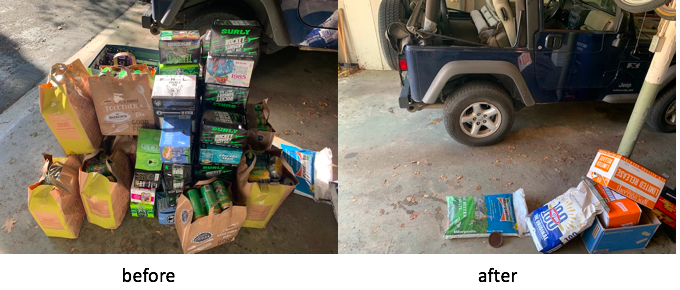
Here are the numbers for the Ike/Clark household.  As of this morning, we’ve accumulated 704 cans and 39 bottles.  236 are 16 ouncers, and the total capacity of all the containers is 9,860 ounces.  Figuring the IPAs we favor have about 200 calories per 12 ounce serving, or 164,333 1/3d since the can ban.  That’s 1264 beer calories a day for each of us.  Being that my jeans still fit like it was March 23, and my sweetheart looks the same, that’s a lot of walking.  Putting numbers to the garage space problem, my neatly arranged stack occupies 24 square feet of floor space.  But space is not flat.  Reaching a height of 3 ½ feet, that’s 84 cubic feet.  To compare, a conventional full size kitchen refrigerator, which is almost twice as tall as my stack, runs about 53 cubic feet.

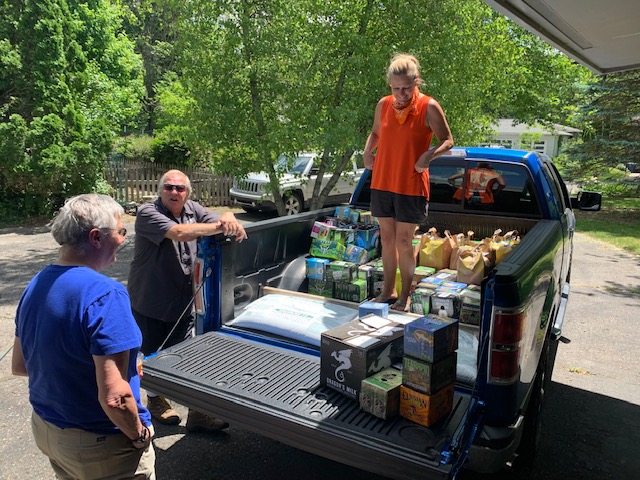
The Oldanis have a different pastime: horses.  Not riding, but caring for them.  Their son, Keegan, now a Nebraska sophomore, began to volunteer at the local horse rescue shelter at the advice of his sister Kaelan, a recent UofM aerospace engineering grad.  He and his parents now go at least weekly to Starry Skies equine rescue and sanctuary www.starryskiesequinerescueandsanctuary.com, one of the largest equine rescues in Southern Michigan where they divert equines from the slaughter pipeline, from abuse cases, or from police seizures.  Sometime during the shutdown, someone at Starry Skies got the idea of converting those piled up empties into cash for the horses.  So they accept donations of empties, planning to sit on them until the Governor rescinds order 2020-21.  Payday is a little over a week away . Early afternoon today, Tom and Kara loaded up their truck and off it went.

Now I and especially Kathy, who has always been fond of space, which after all is the final frontier.   Kathy and I saw it as way to free up 84 cubic feet are reveling in our reclamation.

I know we could have been $75 richer had we just waited 9 more days.  But now we have a little more space right now and the horsies are going to get a little more help.  I think we made out o.k.  We’re having a beer to celebrate.

goodbye Sue

Sue Moore of Vicksburg died suddenly and unexpectedly May 27 at the 82. She was editor and publisher of the South County News.

Her newspaper asked for reflections on her life. Here was mine:

Dear Ms Lane

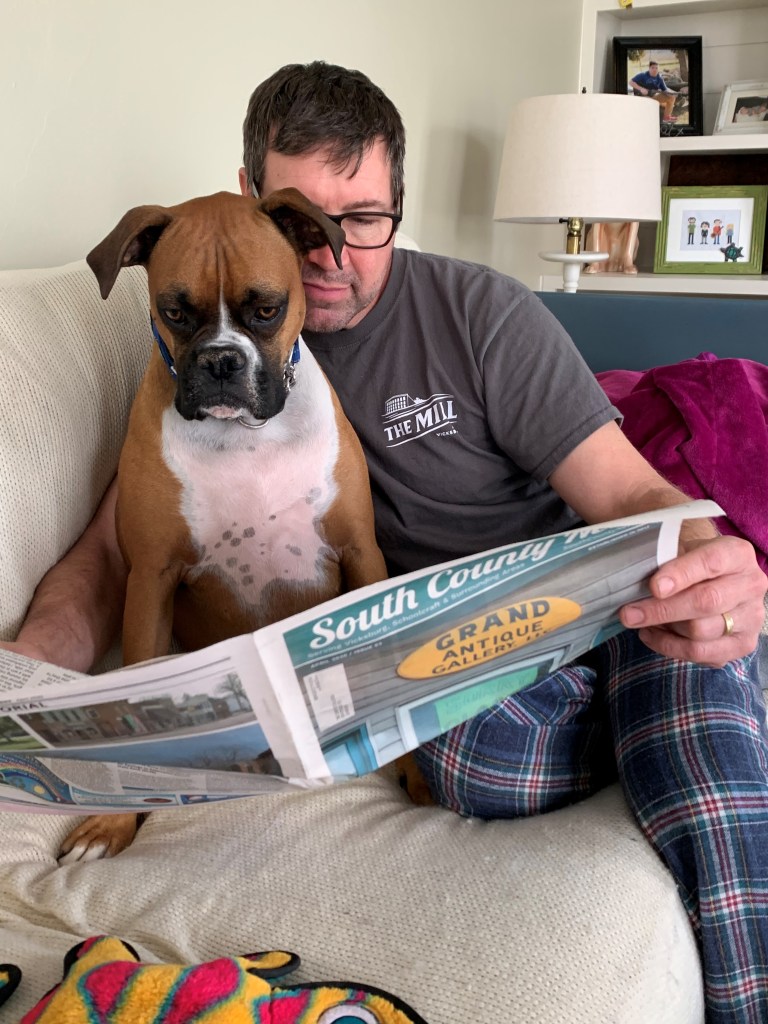
I’m a VHS ’70 grad who left for bigger things but never got Vicksburg out of my heart.  I didn’t get to know Sue Moore till this February, directed her way by my friend Eric Durham when I was looking for old Vicksburg Commercials.  Sue would know, Eric said, being the daughter of Commercial publisher Meredith Clark.  Sue delivered quickly: they were right on the shelves of the Vicksburg District Library, despite what their on-line catalogue said.  Sue was interested in the source of my curiosity.  I told her of my interest in an October 1968 accident that had killed 2 of my classmates and 3 other Vicksburg boys.  Sue helped me in my researches, directing me to persons I should consult.  The effort piqued her interest to the point she asked to interview me and my wife about it, and other things, culminating in a Sue Moore written and photographed article for the April South County News. https://southcountynews.org/2020/04/18/dr-ike-plans-to-write-about-1968-vicksburg-car-accident/ The SCN reminded me of the small town charm of the Commercial which had me getting it sent to my dorm at Michigan, much to the amusement of my more sophisticated classmates.  I get the SCN delivered now, something for which Sue asked only a donation.  I’ve distributed pictures and stories to colleagues and friends.  When I found the on-line May SCN did not include the cover photo of Tom Hardy and his boxer Freddie intently reading the SCN, I emailed Sue and she had the file to me in a day.

Sue and my dear high school English teacher Joyce Pharriss, now of Menlo Park California, were in the same “social circuit” in the 60s.  Knowing what a spitfire Mrs. Pharriss was (and is), I’ve got to believe those were sure some parties.   When I heard from Eric’s sister, Becky, on May 28th that Sue had died suddenly and unexpectedly the day before, I felt as if I’d lost a dear and close friend, someone I hadn’t even known three months ago.   I quickly got the news to Mrs. Pharriss, who was equally devastated, despite having not had contact with her for over 50 years.  

As I read the musings of others who have known her, I realize my appreciation of the chance to know her as someone truly special is hardly unique.  Our little burg and its environs were blessed to have had her all these years.  Now we grieve for and miss her, but we have the memories, themselves truly blessed.

Can I have some of that?

My life as a rheumatologist changed significantly just before the turn of the century. The FDA announced on November 2, 1998 that it had approved Enbrel (etanercept) for treatment of rheumatoid arthritis. Because it and similar compounds that followed were made in a living system rather than a test tube, they were dubbed “biologics”. This particular stuff was engineered to block the interaction of tumor necrosis factor (TNF) with its receptor. TNF has little to do with killing cancer, something it seemed to do in the test tube when first isolated in the 60s. But it has a major role in signalling it’s time to kick up the inflammatory response. So my poor rheumatoids finally had something that actually worked. Visits turned away from which joints to inject this time and how’s your Vicodin holding up towards more pleasant conversations about what are you doing with your newly won mobility, urging more, even exercise! Granted, it was hugely effective in only about 20% who got it, they did better if they kept on methotrexate, too and it was hard to get the steroids totally out of the mix. It did dampen response to infections, particularly weird old ones, so we had to stay vigilant for TB and histoplasmosis (mostly from pigeons). Enbrel was joined by other compounds with a similar mechanism of action: Humira (adalimumab) and Remicade (infliximab). Remicade is an i.v. infusion and the others you inject yourself every one or two weeks. The guys and gals in the lab kept at the exercise of blocking molecules that drove rheumatoid inflammation and today’s rheumatologist has a host of arrows in his quiver, with several different types of poison on their tip. Of those 1.3 million RA patients and the 1 million with psoriatic arthritis, most who take a biologic are on Enbrel, Humira or Remicade. TNF blockade helps in some other autoimmune diseases, like Crohn’s, ulcerative colitis, and plain old psoriasis, and a smattering of other oddball skin and eye conditions. But most of it goes to arthritis patients. U.S. sales for the trio in 2019 were $5.05 billion, $19.9 billion, and $3.2 billion, respectively. These numbers are expected to decline steadily now that it’s been over 20 years since their release. The FDA figured out several years ago how to certify that some other company’s off-patent version is just as good, calling such winners “biosimilars”. And they’re appearing.

So treating immune mediated arthritis is much more satisfying than it was in the bad old 20th century. Just keep that eye out for infection, dontcha know. Then, whether it was the Wuhan Lab or some bat at the wet market, a Mr. Corona emerged just slightly different from his ancestors, and here we are nearly 6 months later stuck at home, wearing masks and keeping 6 feet from each other, still piling up bodies, blessedly less all the time. As the thing started to rev up in February, my colleagues who are still practicing got spooked. Some of our patients were landing on the COVID ward. We were being asked how to use one of our potent biologics, the interleukin 6 inhibitor Actemra (tocilizumab), in COVID patients with the most horrible lung disease, as the Chinese had reported it to be helpful. Those who could recollect the 1918 flu pandemic, or had read about it, knew that what killed the lungs in these viral infections was the exuberant immune response of the patient, not the virus itself.

So that eye out for infection was getting nearly blinded by Mr. Corona’s light. Many of my colleagues worked to taper patients off their biologics. Realizing this was entirely new and very scary ground, rheumatologists around the world began carefully cataloguing the particulars of each of “our” patients who contracted COVID-19. The COVID-19 Global Rheumatology Alliance https://rheum-covid.org/ has collected over 1800 cases as of last week and at last week’s “State of the Art”(SOTA) meeting, they reported some of their findings. I’ve pasted in the Rheumatology News synopsis below.

The biggest shock was that patients on anti-TNF agents were 60% less likely to be hospitalized after contracting COVID, compared to others not receiving such agents. The drug that used to be the biggest gun against RA, prednisone, cut the other way. Patients on the equivalent of 10 mg/day of prednisone or more were at a 105% increased risk for hospitalization, compared with those not on corticosteroids after adjustment for age, comorbid conditions, and rheumatic disease severity.

I expect that there will be more than a few rheumatologists quickly contacting their patients currently kept away from biologics. It’ll be interesting to see what else emerges as this registry grows and continues to be mined for associations and correlations.

Oh, and all those patients of ours on Plaquenil? No difference one way or the other. But there’s no way with the data as collected to tell whether Plaquenil is effective as prophylaxis, as our President is taking it (https://wordpress.com/block-editor/post/theviewfromharbal.com/509). If you’re a patient who happens to be on Plaquenil, you get exposed to Mr. Corona and he doesn’t set up shop, you don’t even show up in the registry, as that’s only for infected patients. That’ll take a different sort of study. I’m still taking it, with a zinc chaser, if I’m ever thrown into the COVID wars,


Dr. Jinoos Yazdany

Heres the story:

CONFERENCE COVERAGE

TNF inhibitors may dampen COVID-19 severity

Publish date: May 19, 2020 By Bruce Jancin

 REPORTING FROM SOTA 2020

Patients on a tumor necrosis factor inhibitor for their rheumatic disease when they became infected with COVID-19 were markedly less likely to subsequently require hospitalization, according to intriguing early evidence from the COVID-19 Global Rheumatology Alliance Registry

<https://rheum-covid.org/> .

Dr. Jinoos Yazdany

On the other hand, those registry patients who were on 10 mg of prednisone or more daily when they got infected were more than twice as likely to be hospitalized than were those who were not on corticosteroids, even after controlling for the severity of their rheumatic disease and other potential confounders, Jinoos Yazdany, MD <https://profiles.ucsf.edu/jinoos.yazdany> , reported at the virtual edition of the American College of Rheumatology’s 2020 State-of-the-Art Clinical Symposium.

“We saw a signal with moderate to high-dose steroids. I think it’s something we’re going to have to keep an eye out on as more data come in,” said Dr. Yazdany, professor of medicine at the University of California, San Francisco, and chief of rheumatology at San Francisco General Hospital.

The global registry launched on March 24, 2020, and was quickly embraced by rheumatologists from around the world. By May 12, the registry included more than 1,300 patients with a range of rheumatic diseases, all with confirmed COVID-19 infection as a requisite for enrollment; the cases were submitted by more than 300 rheumatologists in 40 countries. The registry is supported by the ACR and European League Against Rheumatism.

Dr. Yazdany, a member of the registry steering committee, described the project’s two main goals: To learn the outcomes of COVID-19–infected patients with various rheumatic diseases and to make inferences regarding the impact of the immunosuppressive and antimalarial medications widely prescribed by rheumatologists.

She presented soon-to-be-published data on the characteristics and disposition of the first 600 patients, 46% of whom were hospitalized and 9% died. A caveat regarding the registry, she noted, is that these are observational data and thus potentially subject to unrecognized confounders. Also, the registry population is skewed toward the sicker end of the COVID-19 disease spectrum because while all participants have confirmed infection, testing for the infection has been notoriously uneven. Many people are infected asymptomatically and thus may not undergo testing even where readily available.

Early key findings from registry

The risk factors for more severe infection resulting in hospitalization in patients with rheumatic diseases are by and large the same drivers described in the general population: older age and comorbid conditions including diabetes, hypertension, cardiovascular disease, obesity, chronic kidney disease, and lung disease. Notably, however, patients on the equivalent of 10 mg/day of prednisone or more were at a 105% increased risk for hospitalization, compared with those not on corticosteroids after adjustment for age, comorbid conditions, and rheumatic disease severity.

Patients on a background tumor necrosis factor (TNF) inhibitor had an adjusted 60% reduction in risk of hospitalization. This apparent protective effect against more severe COVID-19 disease is mechanistically plausible: In animal studies, being on a TNF inhibitor has been associated with less severe infection following exposure to influenza virus, Dr. Yazdany observed.

COVID-infected patients on any biologic disease-modifying antirheumatic drug had a 54% decreased risk of hospitalization. However, in this early analysis, the study was sufficiently powered only to specifically assess the impact of TNF inhibitors, since those agents were by far the most commonly used biologics. As the registry grows, it will be possible to analyze the impact of other antirheumatic medications.

Being on hydroxychloroquine or other antimalarials at the time of COVID-19 infection had no impact on hospitalization.

The only rheumatic disease diagnosis with an odds of hospitalization significantly different from that of RA patients was systemic lupus erythematosus (SLE). Lupus patients were at 80% increased risk of hospitalization. Although this was a statistically significant difference, Dr. Yazdany cautioned against making too much of it because of the strong potential for unmeasured confounding. In particular, lupus patients as a group are known to rate on the lower end of measures of social determinants of health, a status that is an established major risk factor for COVID-19 disease.

“A strength of the global registry has been that it provides timely data that’s been very helpful for rheumatologists to rapidly dispel misinformation that has been spread about hydroxychloroquine, especially statements about lupus patients not getting COVID-19. We know from these data that’s not true,” she said.

Being on background NSAIDs at the time of SARS-CoV-2 infection was not associated with increased risk of hospitalization; in fact, NSAID users were 36% less likely to be hospitalized for their COVID-19 disease, although this difference didn’t reach statistical significance.

Dr. Yazdany urged her fellow rheumatologists to enter their cases on the registry website: rheum- covid.org <https://rheum-covid.org/> . There they can also join the registry mailing list and receive weekly updates.

remember

Carol Clausing of Albuquerque is the oldest of my 4 living cousins on my father’s side. Kathy and I yesterday went to visit a lot of the people we both know. I sent her this account.

Hello cousin,

Kathy and I visited some Ikes yesterday, and a few other family.  We make this trip every year around Memorial Day to decorate my mom and dad’s graves and linger by several others.  Yesterday morning was beautiful with bright sunshine that made chosing the top down Jeep for the trip west a no-brainer.  We kept to the back roads till we ended up at Grandville cemetery.  We helped along Dad’s and Mom’s, already sporting a crisp flag from the VFW, by placing our potted red chrysanthemum, Dad’s usual, into the green pail Diane had put between the stones.  She’d put her artificial flowers next to her mom’s, which will still be colorful in November when we have to pull things in.  I related to Kathy that Aunt Florence was resting in the plot dad had meant for me when he bought in ’62 and she was happy I hadn’t had call to use it.

We ventured west a few rows then toward Prairie where we found the four red stones of the Slaters: Uncle Jim (Stewart, her husband), Aunt Dorie, and Grandma and Grandpa Slater.

We mused how long Aunt Dorie and Grandma had lived as widows and recalled the quick deaths of the Slaters compared with the grisly prolonged exits of their spouses.

Then it was on to Rosedale in Standale, a place I had not visited for decades.  We had to route through downtown GR, stopping at Avron’s brewery on Division near Hall to pick up a case of their excellent beer I had ordered on line Friday.  The path to Standale does not go through the most attractive areas of GR, but things were nice once we hit Walker and we finally got there.  A couple nights before the trip I panicked as I had no idea where Grandpa’s grave was.  The “find a grave” program on Rosedale’s web site wasn’t finding him anywhere, Dirk or Dick.  Fortunately, there was an email address and on Friday night I got a message that an envelope with a map would be taped to the office door.  When we got there, sure enough.  We found the plots easily.  Grandpa must have bought these 6 all at once when your dad passed in ’62.  I don’t think they filled as he expected.  Aunt Ann was still alive when our Uncle passed.  Uncle Bob was already gone, so she probably decided she rather rest somewhere other than Standale when her time came.  She’s gone now, too, but I honestly don’t know where she was laid to rest.  Likely Dickie had a hand.  Two with whom I lost touch long ago (tho’ Diane still talks to Dickie).  Standale’s graves are more subdued than Grandville’s.  I saw few flowers and no flags, although there was a box that looked like a coffin full of them by the office.  Terry and Uncle Bob both merited a flag but I could see no place to put them.

Kathy got to know Grandpa a little, and was charmed and delighted by him.  Wasn’t everybody?  I know all the women at the Holland Home loved him.  She never met Uncle Bob, but went to his funeral.  She still remembers being shook by seeing the big sign at the door announcing this was the funeral of “Robert Ike”.   I told her a little of what I remembered about Terry.  I hadn’t remembered he’d been in the service.  My dad was keeping contact with him when he was living in Detroit.  We kept talking how we were going to both visit Terry and get a guided tour of his world.  It always sounded fun and interesting to me and I’m sorry we never made the connection.  It sounded like he was living an interesting, if troubled, life.  Gone too soon.  Speaking of gone too soon, there’s your dad, the first of a string of premature deaths to rip through my family.  Your mom lived a long time without him, and she was a great one to get to know.  The last of the Ike women of that generation, I still miss her.

So that was our tour. 13 graves.  I’m lucky I’m still above ground.   I know they’re not there, their bodies are dust and their souls are in Heaven, but standing by their graves puts a focus on the person you don’t get from idle thoughts, no matter how much you might try.  Where they really live on is in our memories, but that closet full of memories gets awfully crowded at our age, so having to go in, find them, and dust them off for a while is a rewarding exercise.  I’m very happy we did it, even if it made for a very long day.

What made it even longer was our trip up to Stanwood, where we dropped in on my living, breathing 87 year old birth mother, whom it’s been my pleasure and privilege to know for the past 11 years.  I want to make sure she’s got a few memories packed in there before her time comes, which may be sooner than I was anticipating.  See us 11 years ago when Kathy rented a plane and flew me to our first meeting, from Ann Arbor to Canadian Lakes Airport.  She drove up in her convertible.  So we both made an entrance.

Here’s to all who have touched our lives.  May we treasure their memories!

Hail to the Plaquenil, Chief!

So our much beloved and most able leader, President Donald J. Trump, has been taking Plaquenil (hydroxychloroquine) for prophylaxis against COVID-19 for the past week and a half, and even some on his own side of the fence have gone apoplectic (see Judy McLeod’s article from today’s Canadian Free Press, below). I applaud him. He’s a healthy obese 73 year old, but that’s two marks against him right there should he contract COVID-19. He runs into a lot of people and doesn’t practice social distancing. Mike Pence is a great guy and will make a fine president, but I’d rather he wait till 2024. The last thing we need is a sick PDJT.

Most antimalarial drugs, the class in which you find Plaquenil (although no one’s taken Plaquenil for malaria for decades), are given for prophylaxis, not treatment. You start taking the drug before you travel to the malaria infested region, not wait till you’re there and bitten by a falciparum carrying mosquito). And Plaquenil is incredibly safe long term, speaking as a retired rheumatologist who practiced medicine for 40 years and prescribed buckets and buckets of the stuff to hundreds of patients for decades. Their eyes have to be watched yearly, and once in a great while muscles of heart or skeleton might be compromised. And that’s it. The deaths that befell the patients “Doctor” Cavuto rails about were already sick with COVID-19 and likely were going to die anyway.

The little tidbit towards the end of the article I like is mention of the random survey of doctors that found by the first week of April, 22% were taking Plaquenil themselves for prophylaxis. https://www.foxnews.com/science/controversial-coronavirus-treatment-hydroxychloroquine-used-25-percent-doctors-say. Physician heal thyself, eh? If I were back facing patients who had a chance of carrying COVID-19, I’d sure be taking it, with a zinc chaser, just like PJDT.

Here’s the Canada Free Press column:

‘Physician-in-chief at Fox News’ Neil Cavuto has gone apoplectic

‘Dr. Neil Cavuto’: ‘Taking Hydroxychloroquine Can Kill You’

By Judi McLeod (/members/1/JudiMcLeod/2) —— Bio and Archives (/members/1/JudiMcLeod/2)May 19, 2020

Cover Story (https://canadafreepress.com/index.php/categories/C3) | 5 Comments | Reader Friendly (https://canadafreepress.com/print_friendly/dr.- neil-cavuto-taking-hydroxychloroquine-can-kill-you) | Subscribe (https://landing.mailerlite.com/webforms/landing/o1p1n0) | Email Us (mailto:letters@canadafreepress.com)

How dare the President of the U.S. take physician-prescribed Hydroxychloroquine as a potential preventative measure against the coronavirus without first runnining it by Fox News!

At least three Fox News talking heads have gone off the rails after finding out the president’s been taking Hydroxychloroquine supplemented by Zinc pills for the last week and a half: Juan Williams says Trump taking Hydroxychloroquine shows ‘he’s worried about getting sick’ in the White House. Never mind that the president’s been in the White House most every day since the pandemic struck, obviously not too worried about coming down with it.

Fox News medical contributor Dr. Manny Alvarez criticized President Trump’s announcement, describing it as “highly irresponsible”.

But ‘physician-in-chief at Fox News’ Neil Cavuto has gone apoplectic. A Fox News-described “stunned” Neil Cavuto Warns About Hydroxychloroquine After Trump Says He’s Taking the Drug: ‘What Have You Got to Lose? … Your Life’. (Mediaite (https://www.mediaite.com/tv/a-stunned-neil-cavuto-warns-about-hydroxychloroquine-after- trump-says-hes-taking-the-drug-what-have-you-got-to-lose-your-life/), May, 18, 2020)

Are all three trying to add weight to House Speaker Nancy Pelosi’s argument that, Donald Trump should not be taking Hydroxychloroquine—because he is “morbidly obese”?

“As far as the president is concerned, he’s our president and I would rather he not be taking something that has not been approved by the scientists, especially in his age group and in his, shall we say, weight group — morbidly obese they say.” (Breitbart, https://www.breitbart.com/clips/2020/05/18/pelosi-not-a-good-idea-for-morbidly-obese-trump-to-take-hydroxychloroquine/), May 18, 2020)

“Fox News’ Neil Cavuto was so shocked by President Donald Trump announcing he’s taking Hydroxychloroquine that he took a few minutes to explicitly warn viewers about the risks of taking it. (Mediaite) Dr. Cavuto insists that you know that taking. “At one point the president asked “what have you got to lose,” but as Cavuto said, “Hydroxychloroquine could take your life. A number of studies, those certainly vulnerable in the population have one thing to lose, their lives. A VA study showed that among a population of veterans in a hospital receiving this treatment, those with vulnerable conditions, respiratory conditions, heart elements, they died.” (Mediaite)

“Cavuto read from a number of other studies about the effects of Hydroxychloroquine and said, “Those who took it, in a vulnerable population, including those with respiratory or other conditions, they died. I want to stress again — they died. If you are in a risky population here and you are taking this as a preventative treatment to ward off the virus or, in a worst-case scenario, you are dealing with the virus, and you are in this vulnerable population, it will kill you. I cannot stress that enough. This will kill you.” “So again, whatever benefit the president says this has — and certainly has had for those suffering from malaria, dealing with lupus — this is a leap that should not be taken casually by those watching at home or assuming, ‘well, the President of the United States says it’s okay,’” Cavuto continued, bringing up the FDA’s own warning. “Cavuto emphasized he’s making a “life and death point,” not a political one.”

“President Trump revealed to reporters on Monday he’s taking the malaria drug Hydroxychloroquine in an effort to prevent getting coronavirus, saying he’s been taking a pill every day for about a week and a half. (Fox News (https://www.foxnews.com/politics/trump-reveals-taking-hydroxychloroquine-coronavirus), May 18, 2020

President Donald Trump’s physician on Monday noted that he concluded with the president that Hydroxychloroquine has a “potential benefit” against coronavirus.(Breitbart (https://www.breitbart.com/politics/2020/05/18/white-house-physician-donald-trump-taking-hydroxychloroquine-for-potential-benefit/), May 18, 2020)

A more recent display of now infamous words by former President Barack Obama:”If you like your doctor, you can keep him”.

But President Trump obviously didn’t first check in with the media who obviously think they know so much more than White House physicians.

“Hydroxychloroquine is being tested around the world to see if it can be used as a treatment for the coronavirus pandemic. As the debate intensifies on whether or not it works, 25 percent of physicians around the world believe health care workers should take the drug to prevent COVID-19 infections, according to a new survey. (Fox News

(https://www.foxnews.com/science/controversial-coronavirus-treatment-hydroxychloroquine-used-25-percent-doctors-say), April 21, 2020)


Hydroxychloroquine can kill is Bill Gates’ and Big Pharma’s highly coveted, one-size-fits-all coronavirus vaccine

“A study published in March by French researchers suggested that COVID-19 patients could be treated with antimalarial medication and antibiotics in the battle against the novel coronavirus.

“New York state recently started coronavirus drug trials in an attempt to control the pandemic’s impact on the state, according to Gov. Andrew Cuomo, who announced the state had acquired 70,000 doses of Hydroxychloroquine, 10,000 doses of zithromax and 750,000 doses of chloroquine.

“As of Tuesday morning, more than 2.49 million coronavirus cases have been diagnosed worldwide, more than 787,000 of which are in the U.S., the most impacted country on the planet.”

It’s not likely that President Trump would be taking Hydroxychloroquine if it was likely that it was going to kill him.

Media activists, perhaps some secretly hoping that the president they live to hate will soon be kicking the bucket, should remember the text of a long ago cable sent from London to the press in the United States by Mark Twain after his premature obituary had been published: “The reports of my death are greatly exaggerated.”

Meanwhile, time may prove that the only thing Hydroxychloroquine can kill is Bill Gates’ and Big Pharma’s highly coveted, one-size-fits-all coronavirus vaccine.

If so, we’ll never hear the end of it because if that happens, it will all be President Donald Trump’s fault.

Judi McLeod — Bio and Archives (/members/1/JudiMcLeod/2) Copyright © Canada Free Press

RSS Feed for Judi McLeod (https://canadafreepress.com/index.php/CFP-Judi-McLeod-RSS/)

Judi McLeod is an award-winning journalist with 30 years’ experience in the print media. A former Toronto Sun columnist, she also worked for the Kingston Whig Standard. Her work has appeared on Rush Limbaugh, Newsmax.com, Drudge Report, Foxnews.com.