The AMA ain’t what it used to be. Most docs, yours truly included, have had full and fulfilling careers without paying for an AMA card. Yet, what the organization says still carries some weight, so when they added their heft to the anti-Plaquenil for COVID movement when it first looked like there might be something there, it didn’t help those who remained proponents. So when they slipped the following language into the 10/30/20 addendum to the Delegates Handbook for the upcoming November annual meeting, you’d think we would have heard more about it.
“Resolved, that our American Medical Association rescind its statement calling for physicians to stop prescribing hydroxychloroquine and chloroquine until sufficient evidence becomes available to conclusively illustrate that the harm associated with use outweighs benefit early in the disease course”.
But if you do a Google search on “AMA” and “Plaquenil” all you get are all their earlier warnings, which in this resolution they state were based on potential side effects that did not pan out.
As if the raw data from the pandemic weren’t bad enough, the numbers can be crunched to produce even more depressing stats. One such measure comes from the concept of “excess deaths”. Presumably in any country the number of people who die off each year should be about the same year-to-year. Not so for our almost gone 2020. From March through August of this year, 1,671,400 slipped the mortal coil, leaving 328,052,960 or so behind. That’s all causes. For 173,300 (10.4%) COVID had something or other to do with it. Over those same months in 2015-2019 an average of 1,370,000 deaths were reported. I promised no politics, not no math. So that’s 300,600 – 3 full Michigan Stadiums (not that we’ve seen that for a while) – more bodies racked up this year than we managed to do in the 5 years previous. And only 58% of those could be tied to COVID. There’s another gruesome story there, but that comes later.
Not so fast, said Dr. Meredith Shields and her 5 friends at the National Cancer Institute, using the NCI’s internal research funds to support their deeper look at these numbers. Their paper came out yesterday in the prestigious Annals of Internal Medicine’s online edition*. They pointed out that our country in 2020 is a different place than it was in 2015-9, not just because of COVID. First, there’s more of us; per the Census Bureau, the total population of the US starting this year was 5.22 million persons larger than the average 2015-9. And we’re older. The increase is almost all boomers like me, with 5.04 million 65 or older, 10% more than last year. There were even some decreases in younger age groups, you know, those whippersnappers who do pretty well with COVID. Taking these factors into account, Dr. Shields and friends recrunched the numbers, ending up with 218,000 – only 2 Michigan Stadiums, packed – excess deaths, with now 80% having something to do with COVID. Most of those were in folks my age or older. But the non-COVID excess deaths were primarily in those 25-64. What gets these younger people? Cancer and heart attacks, of course, possibly made more deadly when the hospital or E.R. is avoided. Then accidents, overdoses and suicides, possibly borne of carelessness and despair from having to live under the fear and restrictions imposed by our betters trying to help us. Per Dr. Shields and company, the main causes of death in this younger group were diabetes, Alzheimer’s and heart disease. They did point out that for 28% cause of death was not stated and that the CDC had not yet released data on accidental deaths, drug overdoses, and suicides.
So, it’s been bad, but maybe not as bad as portrayed. Yes COVID can be a killer, but less than 1.9% of the 16,725,039 cases identified in our country this year have died with it, and many of those died “with COVID” rather than “of COVID”. Plus a lot of people have been infected but not bothered to be tested. Living in this pandemic is still hard, with conditions imposed to protect us having a not insignificant impact.
But, hey, they’ve got the vaccine. Two of them. And it’s Christmas! Remember how ol’ Ray sang it: “You only live but once, and when you’re dead you’re done.”
*Shiels MS, Almeida JS, García-Closas M, Albert PS, Freedman ND, Berrington de González A. Impact of Population Growth and Aging on Estimates of Excess U.S. Deaths During the COVID-19 Pandemic, March to August 2020. Ann Intern Med 2020; https://doi:10.7326/M20-7385
From the day I stepped into kindergarten to the day I was handed my M.D. degree was 22 years. I started to get a small paycheck for six years I spent in training, so nearly 3 decades passed before I was ripe enough to be trusted with real patients and to begin to teach others what I knew. That effectively ended 2 Decembers ago, although the U paid me to tie up loose ends and clean up my office for the six months they finished putting me through the meat grinder. Figure 34 years there, three more decades. As my birth mother is 88 and only starting to slow down while her mother made it past 100, I’m hoping I’ve got the genes for 3 more decades. My financial advisor says my money’s not likely to run out.
Except for socking money away, I never really “planned for retirement”. Medicine is a harsh mistress, although she offers ample rewards, not just monetary. My joy was always in joyfully doing what I had to do. After that there often wasn’t much time or energy for anything else. In med school, I learned to take pleasure in the mundane chores of everyday life: cooking, eating, drinking, laundry, cleaning, exercise, maintaining an old car, and chasing women (rarely mundane, but surely one of life’s necessities). 25 years ago, I began brewing my own beer, probably the closest I ever got to a “hobby”. Great use of all that chemistry and biology I had to study. I stopped once the craft beer revolution got far enough along you could go out and easily buy some pretty tasty stuff someone else had made for you. Sure, I enjoyed sports, particularly my Wolverines, followed politics, listened to all kinds of music, and liked to go places with my dear wife, who shared so many of my interests. We were avid bicyclists, owning 6 bicycles of various types between us, but that all stopped abruptly when I had a bad accident in Chile 6 years ago.
So what does a retired doctor do? I thought I would miss clinical medicine much more: the daily challenge of figuring things out, the gift of having to give of yourself to others, the variety of people with whom you come in contact, the gratitude from the occasional patient you’ve actually helped, the satisfaction of seeing a trainee finally “get” something you’ve been trying to teach them, your colleagues and co-workers (well, some of them), and the opportunity to publish on something new you yourself have figured out. All of that is gone, well except maybe for the very last item. But what’s also gone is having to listen to people tell you about their aches and pains all day while expecting you to do something about it. Can’t say I miss that at all. I still have an active license, and now and then someone will ask for some free advice and I give them their money’s worth. Every so often, I put on my white coat, yellow tag I.D., and scrubs and go into the Medical Procedures Unit to watch a young protégé begin to master a biopsy technique I’d been doing for all those 34 years which some of my ex-colleagues decided maybe they missed after all. I was worried during the first wave of COVID I’d be pressed into action, but other than a batch e-mail from my Chair seeking volunteers to staff the new medical services, nobody asked me, at least not nice enough for me to consider the offer seriously. Whew. That’s a lot of war stories I’ll never get to tell, but I appreciate being spared. With conferences and faculty meetings virtual, it’s easy to participate in them when they look interesting. I’ve been asked to deliver one myself next week. One of my former fellows asked me to participate in the combined Beaumont/Wayne State/Henry Ford journal club. I envisioned myself being the crusty old fart in the back of the room, grumbling that this stuff isn’t new; we’d figured that out a long time ago. A role I’d been preparing for all my life. Unfortunately, I came away from my first experience 2 nights ago with a sense of relief that I don’t have to know that stuff anymore. I’ll still give them another try. I haven’t yet uttered my first grumble.
But there’s another part of Medicine that remains active: publishing. Early in the lockdown one of those “predatory” journals asked if I’d write something for their special issue on arthroscopy. Flattered, I did. “Predatory” journals take advantage of the “open access” concept. Regular journals won’t allow access to their articles without a subscription. In academia, the medical library pays those fees, so the doc seeking an article never has a problem. Others outside the institution can pay for a single article rather than a full subscription, but the charges can be steep. In “open access”, the author pays the fee in return for having his work always available for free. Most legit journals now offer this as an option and some have gone to complete open access. Occasionally, the author’s institution or professional society will cover this fee, but authors with research grants just include these fees as part of their research costs. A cottage industry has sprung up of journals reaping open access fees from authors they’ve solicited with flattering e-mails. I get them every day. In my case, one of my co-authors, Ken, had a little slush fund he agreed to dip into and off we went (1). What we ended up with looked so good, I decided to buff it up and flesh it out and try to get it into the premier journal of my specialty: Rheumatology (Oxford). Yes, that Oxford. Lo and behold, that got in (2)! I next wrote a commentary on joint washout for knee osteoarthritis, which I had done and had written about for many years but had fallen out of favor. Incorrectly, I argued. And that got in (3)! I have 2 other completed manuscripts ready to go. The longer one has been kicked back by 2 European journals, but I’ve got some guy in Sydney interested. The shorter one was sparked by another request from a “predatory” journal, but came out so good we’re going to try the waters of the legit literature. A couple months back, I was contacted by one of my heroes, Roy, about joining him and 4 other guys trying to buff up their paper on hyaluronic acid in knee osteoarthritis, something I’m done research on, written about, and done enthusiastically for many years. I should be working on that right now instead of typing this. Once these 3 get in, there’s more! I keep putting more and more things into my paper that will be a guide on how to publish in the rheumatology literature. In various stages of development are papers on salivary gland biopsy, assessing competence in arthrocentesis, muscle biopsy, and making something out a book of cartoons my New Jersey friend Angel drew about arthroscopy while still in Cuba. Oh, and the editor of the journal Arthroscopy wants me to write him a letter describing my Rheumatology (Oxford) paper and how to access it. Kicker is I have to get Oxford Press to waive or substantially reduce the $4225 open access fee so Arthroscopy’s readers, almost all orthopedists, can get at it. I wrote that e-mail last week and have yet to hear back.
Writing for WordPress is much simpler. No editors, no reviewers, and no fees beyond the modest, and well worth it, annual. I’ve probably had more than 100 posts since I first started in mid January. COVID has inspired many posts, but I have other stuff to write about, like this one.
Back when I was practicing, some of my old guys would say something, commenting on retirement, like “I don’t know how I got anything done when I was working”. I used to wonder what that was all about. But I got it pretty quick once I retired myself. Work and its pressures keep a lid on so many things you’d like to do but can’t, or can’t do much, and on things maybe you never thought about doing in the first place. My late dad, who put in 31 years at Fisher Body (G.M.) before happily retiring at 51, one of the first salaried “30-and-outs”, and spending 2 more years retired than he’d spent working, used to say that “GM” stood for “Great Monopoly”, as in a “Great Monopoly” on a person’s time. I understand that now, too. Maybe UM is the “Ultimate Monopoly”. Anyway, I’m happy to be out from under. Now there’s time for shopping, cooking, hiking, decluttering and organization, music, reading, travel, connecting with my high school classmates (VHS ’70, 50 years out!), spending time with my dear wife, whose virtual teaching keeps her right by me in the living room, and of course writing. And I can be what William Shatner told me to be 4 Januarys ago: open to new possibilities. Now I’ve got the time.
Ike RW, Arnold WJ, Kalunian KC. Arthroscopy in rheumatology: a reminiscence. J Surg Surg Technol 2020;2(1):27-35.
2. Ike RW, Arnold WJ, Kalunian KC. Arthroscopy in rheumatology. Where have we been? Where might we go? Rheumatol (Oxford). Epub 2020 Dec 1. https://doi: 10.1093/rheumatology/keaa560.
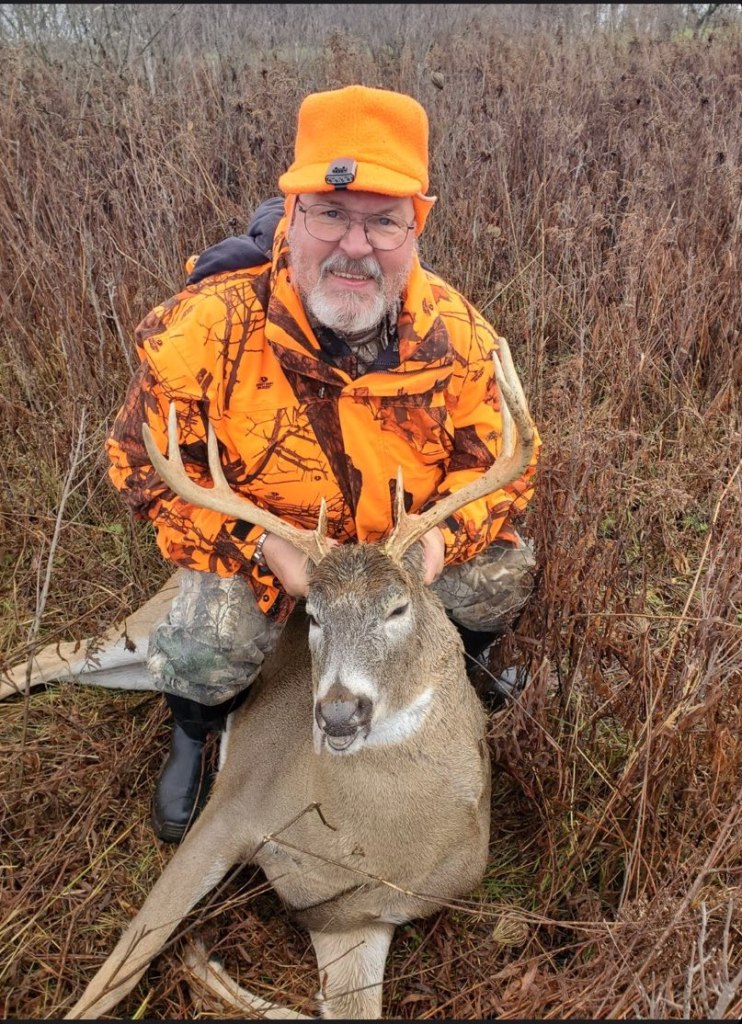
My brother Nick, 11 months my junior, loves to hunt, and is quite good at it
While I enjoy the product of his efforts, I myself was never able to take on the woods, armed, with any enthusiasm. I discharged a few firearms in the woods in my teens, but like John Prine sang “empty pop bottles was all we would kill” https://www.youtube.com/watch?v=DEy6EuZp9IY. Nick announced to the family a week from last Tuesday he’d been diagnosed with COVID. So we’re all praying for him, or at least those of us who still do such a thing. I gave him the doctor-brother advice to get out in the sunshine, realizing that a lot of UV still gets through the clouds (https://theviewfromharbal.com/2020/11/23/sunshine-on-my-shoulders-kills-my-covid/). So far as I know, he’s doing o.k.
I prefer to do my hunting (and pecking) at my laptop. For most of my free time the last week or so, I’ve been stalking parks and preserves in Washtenaw County where it might be fun to take a hike. I’d thought I’d compiled a pretty fair list from the city of Ann Arbor and my 2 hiking books (https://theviewfromharbal.com/2020/11/25/walkies/), but a peek at what the county had to offer let me know I still had work to do. My search through the parks and nature areas of Washtenaw County is now complete, I think. My run through their 28 nature areas (https://www.washtenaw.org/336/Nature-Preserves) found all but 2 with some pretty good looking trails. Of their 13 parks, I’d already tagged several, eventually coming up with 6 to add to the list. But there was more! The U itself owns 3 areas good for a hike, 2 operated as “ Field Properties“ by the School for the Environment and Sustainability (Natural Resources in my day, Forestry before that), and one by my old school, L.S.&A. Alltrails.com, where I went to get some maps, lists on the right sidebar local trails that might be of interest. Following trails I hadn’t yet captured, I learned about the Southeast Michigan Land Conservancy (http://smlcland.org/) with its several enticing properties and even little Superior Township runs 10 parks (https://superiortownship.org/departments/parks-and-recreation/), of which two look attractive for walkies. The State’s Department of Natural Resources lists 261 areas it deems good for hiking in the whole state (https://www2.dnr.state.mi.us/ParksandTrails/Default.aspx?filterID=57#list), but Jim DeFrense and Greg Tasker had already told me about the ones around me.
So my list is as complete as it’s going to get, lest I stumble on to another trail someplace. The list is in a ring binder along with all of the trail maps, 7 pages both sides, 65 properties. I actually have 2 ring binders now: one for Washtenaw County and one for farther flung areas in SE Michigan. The new binder isn’t done yet, as there are some maps to be sheathed and all I’ve collected still have to be alphabetized. Eventually, I’ll print out a list of properties, cut out each into a slip to put into a jar, into which Kathy and I will dip to see where we’ll go next. I don’t think we’ll get bored!
But here’s what you’ve got to choose from if you want to go walkies in my county. Those of you not from around these parts can do as I did. It’s fun digging. Places like nature preserves are seldom well marked or publicized, but looking on a township, city or county web site in the “parks and recreation” area should find ‘em, and sometimes a lot. Good to have a variety of places to go out and do that “forest bathing”. As a physician, even if retired, I care about your health. The outdoors is calling with some free Rx. Go for it.
Marischino’s Pub Corner Brewery 734 Brewing Co Ypsi Alehouse Sidetrack Bar and Grill Bobcat Bonnies The Wurst Bar The Tap Room Full House Powell’s Pub Bellflower
I hadn’t discovered blogging yet in June 2016 as Kathy and I were cruising down the Danube from Nurenburg to Budapest on the Viking Alta, but I still occasionally wrote things down for my own amusement. I found one sight at our third stop particularly inspiring. I came across the record in my leisure and travel folder while looking for something else and thought it was worth sharing. A good break from coronavirus. Here’s what I wrote:
Travel does broaden one, and its not just all the beer and nonstop eating. Sometimes you get a glimpse into another culture’s approach to some mundane aspect of daily life that takes your breath away. This afternoon, taking a break from the 95 degree heat at Lugeck cafe on Gutenberg Square in Vienna, just north of St. Stephan’s cathedral, that first half liter of beer got me climbing the stairs to the room for Herren, where I beheld one of the most amazing sights I can recall from my not-so-young life. There, in gleaming stainless steel stretching from 2/3ds up the wall to a trough below floor level, protected by a screen was a modern urinal that combined the traits of the sadly missed (but never missed) long metal troughs that used to be featured in Michigan Stadium’s men’s rooms and the old fashioned, rapidly disappearing all-way-to-the-floor porcelain numbers so much more satisfying to use than the little hung on the wall buckets that are replacing them. Perhaps this ultra-modern item with such heartening throwback features will catch on in the US. If I was building a new restaurant, I know I’d install ’em.
My oldest brother Nick, 11 months my junior, posted this item on his Facebook page 2 days ago. I just saw it this morning. I thought it was too good not to share.
My last post, which featured findings from a study by Professor Geneveive Briand of Johns Hopkins analyzing deaths from all causes in our year of COVID, finding that while deaths attributed to COVID were up, deaths from other causes, like cancer and heart disease, were down so in the end it was sort of a wash. My friend and former colleague Elena wrote Prof Briand an email congratulating her for her bravery and received in response 2 links I’ll share here. The first goes to the Johns Hopkins newsletter addressing their decision to pull Prof. Briand’s report https://www.jhunewsletter.com/article/2020/11/a-closer-look-at-u-s-deaths-due-to-covid-19. If you look carefully in the newsletter, you’ll a find a link to a PDF of Prof. Briand’s original report. While it’s got “retracted” plastered all over it, you can easily read through that to get at what she actually said.
Elena grew up under Romanian Communism, and tells me she gets sad when events happening around us now remind her of the old days. She says this squelching of Prof. Briand reminds her of those times. Elena enjoys living in the land of the free, and is not afraid to exercise her first amendment rights. She wrote a letter to the editor of the Detroit Free Press, which was published last Sunday, and I show you below.
C
Clearly, our leaders have applied their “help” for us with a very heavy hand. The time for some questioning and civil disobedience is here. COVID’s not going to wipe us out. Measures our leaders continue to apply just could.
We’re into the 10th month of this COVID thing. Early on, I discovered the Johns Hopkins Coronavirus Research Center site https://coronavirus.jhu.edu/. For a long time, I’d check it daily with the fervor of a sports nut looking up ESPN for the scores. Not so much the last couple months, so I missed last Sunday’s, which featured the report of a study analyzing deaths of all causes across age groups. Bottom line, while deaths attributed to COVID have risen, deaths from all other causes, particularly cancer and heart disease have fallen by just about the same amount. No more are dying in this age of COVID than they were last year when the only coronavirus was a little bugger that caused about a third of all colds. Hopkins pulled the article, explaining “it was being used to support false and dangerous inaccuracies about the impact of the pandemic”.
Thanksgiving has always been my favorite holiday, even if I never get any presents. So simple: fantastic food, the company of family and friends, and the enforced focus on all those things for which you can be thankful, always a much longer list than you could have imagined when you first started. We should do it more often, but Thanksgiving is a good start. Thank God and George Washington, and thank God for our blessings.
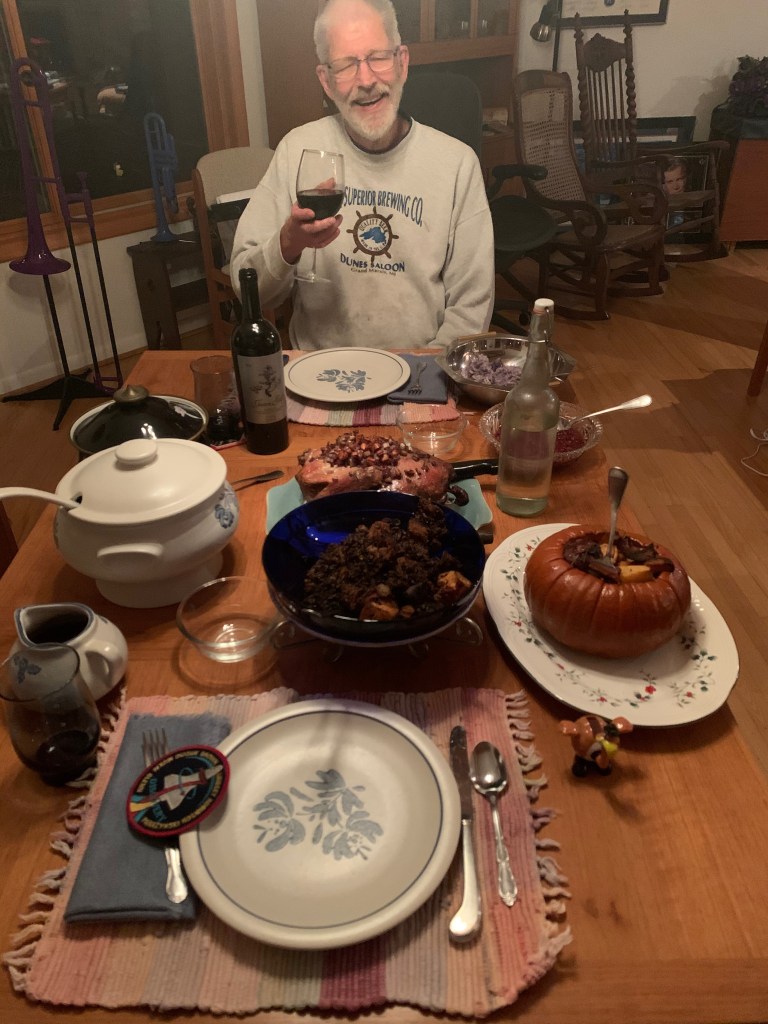
I hope you all had a blessed and bountiful Thanksgiving. I’d have invited you all over, but if a number anywhere near the readers WordPress says I have had showed up, I’d actually be over Governor Gretchen’s limit. We invited my Vicksburg High ’70 classmate, retired Alaskan bush pilot Tim, who’s come into the ‘burg from his home in Healy, near Denali National Park, to escape the early winter for a while and also to look after his dad’s property. But Tim chose to stay home, so it was just the two of us. We ate well, as you can see by the menu below, tho’ it wasn’t Turkey Day for us. After an afternoon of chopping, jockeying for oven space, and drinking (of course) (plenty of time to watch our Lions lose, another TG tradition), our target of a 4 P.M. dinner slid to about 7:30. Fortunately, Kathy didn’t complain. After all, she was helping in the preparation.
Tomatin, Highland Single Malt (12, 15, 18 years old)
Traverse City Whiskey Co. – Straight Bourbon
Here’s what it looked like before we messed it all up by devouring everything:
As I write this, we’ve put away everything, either into our guts or into the refrigerators. What’s left of the bird went into the big pot for tomorrow’s project: making duck soup! I don’t know if it’ll make enough after feeding us for Groucho, Harpo, and Zeppo, but if they were still alive, I’d find a way.
Footnotes
* Golden Harvest Squash soup has been know as “explodey soup” in my family ever since the Thanksgiving many years ago when I first made it. It was to be the first course for our feast and the last item to come out of the kitchen. I had made it to the last step, where everything gets pureed in a blender. The action was going too slow for my likes, and I decided to help things along with a rubber spatula. The blades of the blender caught that spatula and exploded the contents all over my face, chest, and the kitchen ceiling. There was about a thimbleful for each left, which they devoured eagerly between sniggers and pronounced delicious. It was. I’ve made it many times since, with a food processor.



 Bob Ike's blog