to Linda

Linda might be my favorite cousin, oldest daughter of my mother’s brother Jim, who raised many, many children in Arlington. One of them, Linda’s big brother Terry, is in his last stages of a battle with gastric cancer, so I’m going to visit him in Bridgewater, an hour out of Charlottesville, next week. Linda teaches in Arlington and needs to work out plans to visit. We initially swapped e-mails fine, but my latest just won’t go through. She’s seen my blog (and still loves me), so I’m depositing the e-mail right here for her to see. Depending on how much I want to pad my posts, I may or may not remove it later, Here’s what I tried to send her:

Good afternoon, cousin

I spoke and swapped texts with Rick a little bit ago and I think I’m all set to come down and visit you folks.  To hear Rick’s description, Terry doesn’t have much “visit” left in him.  Sad.  But Rick says he seems to be aware of other’s presence, so I do want to see him if he holds on a few more days.  I’d already bought a plane ticket yesterday morning, knowing I could cancel if things weren’t going to work out.  I’m set to land in Charlottesville next Tuesday at noon.  Your injured and currently underemployed younger brother will drive his truck over from Rockingham to pick me up, then put me up in one of his spare rooms, finally taking me back to the airport next morning to head back to Detroit (via Laguardia).

Since making those arrangements, I’ve used my twin tools of Facebook and Instant Checkmate to check out some of your sibs.  Besides you, Terry, and Rick, I’ve managed to check out Tammy, Kelly, and Joe.  Their pics are always populated by children, sometimes a lot.  Where could they have picked that up?

The circumstances drawing us together are very sad, but I’m glad for the chance to get reacquainted regardless.

See you soon

Love 

Bobby

PS. When I talked to Terry a few weeks ago, he said one of his daughters sort of followed in the Slater family business and became a firefighter/EMT.  I’ve come across a wonderful old picture of our very young (but still tall and handsome) grandpa at work, and I’d like to give her a copy.  But I’ve forgotten her name.  I’ll carry it to Terry and he, or his wife, can give it to her.  I have a scan of it I can send you once I’ve downloaded it off the disc.

DTE II

Just like my first post titled “DTE” (1), this one’s about electric cars.  But there is some news about my own energy provider in here.  Stories about EVs just keep piling up like a freeway full of Teslas with dead batteries.  Since you’ll not be hearing these on the Nightly News, I have a duty.

Several general discussions about the problems with EVs have appeared.  Danish economist Bjørn Lomborg, who’s had the audacity to apply cost-benefit analysis to proposed climate change mitigation policies (2), got some space in the Wall Street Journal to expound on EVs (3).  He starts by asking if EVs are so great why do they have to pay us to buy them?  He blasts those who drive them to save the planet by using actual numbers.  He calculates that if all states and countries reached their ambitious goals by 2035, the planet will have been spared 251 million tons of CO2.  Plugged into the United Nations Climate Panel model, that leads to a temperature reduction of 0.0002 degrees Fahrenheit by the end of the century.  For this there will be costs.  EVs generate more particulate air pollution than gas guzzlers.   Material costs for EVs, mainly for batteries, are skyrocketing, and the social costs of relying on resources from Communist China and poor third world countries are considerable.  Always one to look at the true costs of subsidies, Bjørn offers an example from Norway, where most new cars are electric.  To promote these sales, the government has waived sales and registration taxes on these vehicles, amounting to $25,160 a car.  Norway can afford this lost revenue as it is rich with North Sea oil.  To cut one ton of CO2 emissions through the subsidization of electric cars, Norway has to sell 100 barrels of oil, which emit 40 tons of CO2.

Steve Hayward, commenting in a lesser forum (4), included this tidbit about Volvo’s new electric car, the C40 Recharge, whose manufacture generates 70% more CO2 than its gas twin, the C40.  Volvo says the deficit will be redressed by carbon savings while driving.   Volvo calculated that at the world’s average electricity sourcing today, a C40 Recharge driver would need to drive his car 68,000 miles to reach a break-even carbon footprint with a gasoline-powered model. The average American drives about 14,000 miles a year, and thus would need to drive his Volvo EV almost five years before reaching a lower carbon footprint.  What if we had a grid that was 100 percent wind- or solar-powered? Volvo calculates that an EV driver would still need to drive 30,000 miles before reaching a carbon-footprint breakeven point with a gasoline car.  But the Volvo has always been a prime car for virtue signalers (“it’s so safe!”) – I myself had a black 142 in med school – so I’m sure sales of the Recharge will be brisk.

Even us gas guzzler aficionados might admit that a little EV go cart might be good for getting around in town, not that we’d even buy one.   But EV mania has extended to some much bigger vehicles, with not unexpected consequences.  Ford’s made an electric version of their iconic F-150 pickup truck.  It’s quiet, looks snazzy, and has mighty torque, but can’t haul worth a pinch (5).   And who asked for the electric Hummer?  The $110,295 (base) 9,000# (2,923# is battery) guzzles energy just like its replica HV2 with the 60-gallon gas tank.  A 212-kWh charge is said to give 329 miles of range (6).  At regular DTE rates, that’s 11.5¢/mile, nearly 3 times that for a Tesla S (4.6¢), which is cheaper.   Charging the Hummer on a regular 120 V home outlet will take 4 days.  An upgraded 240 V charger will do it in half the time, maybe even 24 hours.  Regardless, it ain’t no overnight plug-in.  And if we’re talking big trucks, how about Elon’s super semi?  But I’ve already covered that (1).

But don’t EVs “save resources”?  This burning Tesla required over 25,000 gallons of water to douse, something ever-drought stricken water-poor California can ill afford to waste, although the reported fire took place in Connecticut (7).   And it was an “easy” EV fire to quench, as the burning battery fell out of the car out in the open where it could be attacked directly.  And those burning lithium batteries generate plumes of toxic smoke (8).

Yet governments, particularly California’s, are beginning to eye EVs as “resources” in themselves.  The charge in those EVs’ batteries can be tapped and returned to the grid, a process recognized since the last century (9).  Power nerds and politicos are salivating over this new “source” (10), no more so than in – of course – California.  The California Public Utilities Commission is looking seriously at this process as a way to pump some juice into its sorry-assed grid (11).  There’s not only a name for this – “bidirectional” or “vehicle-to-grid” charging – the latter has already generated an acronym “V2G”.  Will fit easily onto the stickers the state will slap on your EV to explain why its battery is dead.  But the future’s so bright, they gotta wear shades.  If California really does get 14 million EVs by 2035, local utilities could use V2G to power every home in the state for 3 days!  Heck, you could blow up another hydroelectric dam and save more endangered minnows!  Sounds like a disaster waiting to happen.

Those natural disasters God visits upon us, as opposed to those we bring on ourselves, can put a sharp focus on problems that might not have been so evident when things were normal.  Electric cars aren’t too popular in Florida, fortunately.   Just trying to get out of Dodge to flee Ian in one of them would have been a disaster, with dead EVs whose charge range can’t possibly traverse the peninsula dying in flight clogging the highways for ICEs that can.  The state had investigated this situation 2 years previously and knew what might happen (12).  Of course, EVs and water don’t mix, especially salt water.  You can imagine what a class IV hurricane did to Florida’s fleet.  Not only do the waterlogged go-carts not run, they go flambé big time, and those lithium battery fires are damned hard to put out (13).   But don’t worry, Uncle Joe – with the help of Congress – has authorized the printing of $1.5 billion to build charging stations across the fruited plain.   Coming to a storm near you.  And fighting those EV fires is proving to be a burden on Florida fire departments, as dousing a pile of burning lithium takes much more time and more than twice as much water as it does to put out a gas car fire (14).  Sometimes, even in a state surrounded by water, there isn’t enough for the task and fire departments must just clear the area and hope the virtue-signaler doesn’t catch anything else on fire. The process obviously takes resources away from other rescue efforts, for which there is plenty of demand after Ian.

Just driving a car these days is draining plenty of resources from the average citizen.   Mayor Pete, Bimbo Jenn, and Uncle Joe in particular push EVs as the way to escape high gas prices.  Pain at the pump has been a fact of life since the last election, mitigated only somewhat by Uncle Joe’s draining 10s of millions of gallons of crude from our strategic reserve.  EV drivers sit smugly by as their cost per mile continues to drop relative to us poor gas guzzlers.  But that ain’t gonna last.  Remember when Obama was talking about how under his plan to combat global warming “electricity prices would naturally skyrocket” (15)?  Well, here come the fireworks.

Electric utilities do not operate in a free market.  If they did, we’d probably be screwed already as the companies passed on to us the costs for the fuels they used to generate our juice.  Yeah, God hasn’t jerked up His prices on wind, water, and sunshine, but His other gifts come to us through intermediaries who most assuredly have.  We’re all aware of oil and gas, but even coal, which accounts for most of DTEs energy, has tripled in price over the last year (16).

Whatever utilities wish to charge, they must first have the numbers approved by a public service panel.  In Michigan, we have the Public Service Commission (MPSC), composed of three members appointed by the Governor to serve staggered six-year terms (17).  They’re supported by staffers specialized in engineering, law, economics, finance, accounting, and technical and administrative support.  They meet about every three weeks.  Companies must submit a detailed application which then grinds though a dozen step review process that takes at least 10 months.  DTE made its last formal new application in June 2020 but has submitted numerous addenda, last on 10/5/22.  Even though each of the 3 commissioners is a highly accomplished person, I’m sure they’re aware of the political ramifications of their decisions and thus are slow walking these requests for rate increases.  But they can’t hold them down forever.   In DTE’s next to last brief (8/16/22), it projected an operating loss for the coming year of $367.9 million.

So, look for a reckoning, probably not till after the midterm elections.  These are Public Utilities, not Public Charities.  EV drivers will be laughing out of the other side of their mouths, their butts bitten at least as hard by DTE for KwH as we unenlightened knuckle-draggers have been forking over to Sunoco.  Meanwhile, what’s a good response to our betters pressuring us to go electric?  Dear Nancy Reagan said it best – on another topic – over 3 decades ago: “Just say no”.

References

1. Ike B.  DTE.  WordPress 9/10/22.  https://theviewfromharbal.com/2022/09/10/dte/

2. Lomborg B.  Cool IT (Movie Tie-in Edition): The Skeptical Environmentalist’s Guide to Global Warming.  New York: Vintage Books, 2010.  https://www.amazon.com/Cool-Movie-Tie-Skeptical-Environmentalists/dp/0307741109/ref=sr_1_5?crid=3OL97J5C62RQV&keywords=bjorn+lomborg&qid=1665328913&qu=eyJxc2MiOiIzLjQwIiwicXNhIjoiMi44OCIsInFzcCI6IjIuODYifQ%3D%3D&sprefix=bjorn+lomborg%2Caps%2C142&sr=8-5

3. Lomborg B.  Policies Pushing Electric Vehicles Show Why Few People Want One. Wall Street Journal 9/9/22.  https://www.wsj.com/articles/policies-pushing-electric-vehicles-show-why-few-people-want-one-cars-clean-energy-gasoline-emissions-co2-carbon-electricity-11662746452?st=v1dcpgxbxxptev1&reflink=desktopwebshare_permalink

4. Hayward SF.   Piercing the Electric Car Fantasy. The Pipeline 7/24/22.  https://the-pipeline.org/piercing-the-electric-car-fantasy/

5. Sanibel H.  “Complete And Total Disaster”: YouTuber Drives Electric Ford Truck, Recounts Disastrous Results [VIDEO].  The Blue State Conservative 9/27/22.  https://thebluestateconservative.com/2022/09/27/complete-and-total-disaster-youtuber-drives-electric-ford-truck-recounts-disastrous-results-video/

6. Posky M. How Long Does the GMC Hummer EV Really Take to Charge?  TheTruthAboutCars.com 10/7/22.  https://www.thetruthaboutcars.com/cars/news-blog/how-long-does-the-gmc-hummer-ev-really-take-to-charge-44497092

7. Landry M.  Tesla Catches on Fire, Takes Over 25,000 Gallons of Water and 42 Minutes for Firefighters to Extinguish.  The Western Journal 9/20/22.  https://www.westernjournal.com/tesla-catches-fire-takes-25000-gallons-water-42-minutes-firefighters-extinguish/

8. Nolan L.   Green Inferno: Tesla Battery Catches Fire in California Causing Shelter-In-Place Advisory Due to Toxic Smoke.  Breitbart.com 9/21/22.  https://www.breitbart.com/tech/2022/09/21/green-inferno-tesla-battery-catches-fire-in-california-causing-shelter-in-place-advisory-due-to-toxic-smoke/

9. Kempton W, Letendre SE.  Electric vehicles as a new power source for electric utilities.  Transportation Research Part D: Transport and Environment 1997:2(3):157-75.  doi.org/10.1016/S1361-9209(97)00001-1. https://www.sciencedirect.com/science/article/pii/S1361920997000011

10. Marshall A, Simon M.  Electric Vehicles Could Rescue the US Power Grid.  Wired 9/19/22.  https://www.wired.com/story/electric-vehicles-could-rescue-the-us-power-grid/

11. Zavala A.  Experts: Electric vehicles could help, not hurt, California’s energy grid.  KCRA3 9/8/22.   https://www.kcra.com/article/experts-electric-vehicles-can-help-california-grid/41126929

12. Downing S.  Challenge of electric cars in mass evacuation was warned of in 2020 Florida report.  Must Read Alaska 10/1/22.  https://mustreadalaska.com/challenge-of-electric-cars-in-mass-evacuation-was-warned-of-in-2020-florida-report/

13. Roberts K.  Florida’s Top Fire Marshal Warns ‘Tons’ of Waterlogged Electric Vehicles Catching Fire After Hurricane Ian.  Epoch Times 10/7/22.  https://www.theepochtimes.com/floridas-top-fire-marshal-warns-tons-of-waterlogged-electric-vehicles-catching-on-fire-after-hurricane-ian_4781135.html?utm_source=News&src_src=News&utm_campaign=breaking-2022-10-07-1&src_cmp=breaking-2022-10-07-1&utm_medium=email&est=6slM8W6EoX6h0A2xKT%2BKCQ2bX3QSmNhAaVfR3Hp8p7wGhPg5buujVoYEf2%2FoI38%3D

14. Altus K.  Battling fires from water-damaged EVs ‘ties up resources’ in Hurricane Ian recovery, Florida fire dept says.  Fox Business 10/7/22.  https://www.foxbusiness.com/technology/battling-fires-water-damaged-evs-ties-resources-hurricane-ian-recovery-florida-fire-dept-says

15. Martinson E.  Uttered in 2008, still haunting Obama. Politico 4/5/12.  https://www.politico.com/story/2012/04/uttered-in-2008-still-haunting-obama-in-2012-074892

16. Trading Economics. Coal.  https://tradingeconomics.com/commodity/coal

17. Michigan.gov.   Michigan Public Service Commission.  Ratemaking.  https://www.michigan.gov/mpsc/regulatory/ratemaking


show-off

Should you send me an e-mail and receive a response, chances are I left in the signature box I created for my Yahoo email.  The bottom line will be these 14 logos, each representing an important stop from my snotnose 60s to today’s much-enjoyed retirement.  If I talk you through them, you’ll know more about my arc than you probably ever wanted to hear.  But I do these posts mainly for me, so just sit back.

  1. The bulldog.   These guys were the mascots for all the sports teams at Vicksburg (MI) Community High School, where I was a student ’65-’70.  The logo came long after I left, but I love it.  My time in the ‘burg let me start becoming a real person, rather than the fat stilted individual that was developing in Birmingham, which my dad happily left to come here.  Part of my heart is forever in that little village, as some of my lifelong friends are still there and I go back to visit frequently.  A few years back, some kids at the high school made a video over top of an ‘85 chestnut, if you want to take a look (1).  Still the same place.

2. The U.  It was the only place I would really go to college, coaxed on by my True-Blue dad, who never went there but followed Wolverines sports since the Depression.  I almost didn’t survive the post-hippie era but managed pre-med and grad school only to come back for post-doc and ultimate faculty position.  My paychecks outnumbered tuition checks and I retired True-Blue, even if the U didn’t love me back.

3. Commander Cody and His Lost Planet Airmen.  My wife tried to coax me out of this one, as I never had a real official connection to the band.  But I’ve been a fan since end of my freshman year and have written a book about the experience.  No band has brought me more joy.

Fisher Body Logo, 1930s era

4. Fisher Body.  My job for 4 summers as a security guard at the Comstock Fisher Body plant, where my dad was head of Labor Standards, basically paid for my college.  I had to tuck my long locks under a short-haired wig one summer to fake it.  The 30s era coach insignia, which used to grace every GM car, is long gone except for some very good bottles of red from Fisher Vineyards (2), started in the 70s in Napa by some descendent of Frederick, Charles, William, Lawrence, Edward, Alfred, or Howard.  I had a bottle of their cabernet to celebrate my father’s 100th birthday.

5. University of Chicago.  The coat of arms for this staid college on the south side of Chicago – where I was privileged to go to medical school – had a pretty fierce beginning (3).  Approved by the board in 1910, just 18 years after the founding of the University, the hot red phoenix rising out of yellow flames hearkened to the rebirth of the entire city of Chicago after the 1871 fire.  Since 2012, the University has used a monochromatic maroon version of the same image.  Not so scary. By the way, “Crescat scientia; vita excolatur” translates to “Let knowledge grow from more to more; and so be human life enriched.”

6. St. George’s Hospital.  One of 2 London Hospitals where I did a month’s rotation as a senior medical student in the winter of ’79 (4).  The figure is St. George slaying the dragon.  The group of medical students seeing St. George’s that year were to be the last.   This site on Hyde Park Corner, the most expensive piece of real estate in London, had seen a hospital since 1733 and this grand white building since the early 1830s (5).  It’s now a luxury hotel, the Lanesborough (6).  Rooms start at £1000/night, give or take a few quid.

7. The Brompton.  Pardon me, Royal Brompton Hospital, the national chest hospital (heart and lung), more prestigious than St. George’s, started in 1842 as a place for patients with “consumption” (tuberculosis) and moved to its present site in 1846. Hyde Park and the Royal Albert Hall are nearby.

8. Barnes.  Where the computer matched me for my internal medicine internship and residency, probably one of the top five programs in the country.  Opening in 1914, it was one of the first teaching hospitals in the country.  Much of the money to make the hospital possible came from Robert Barnes, who made most of his bankrolling a little brewing operation by August Busch.  The “symbol” is something I scanned off my i.d. tag.   In 1996, Barnes merged with the even older (1902) Jewish Hospital next door, yielding one of those awful, hyphenated terms.  Two years earlier, Barnes merged with Christian Health Care which operates the two hospitals north of St. Louis we used to call “the Christian Brothers” (Christian and Christian Northwest), known to us for their excellent moonlighting opportunities.  The corporate name is “BJC Healthcare”, but somehow, no one says “Christian” when talking about Barnes.

9. The Karolinska.  The Nobel prizes are chosen by an assembly of 50 professors selected from the faculty of the Karolinska Institutet in Stockholm.  Karolinska Hospital is their medical branch.  Shortly after I hired on as faculty with the directive to develop arthroscopy as a tool for the rheumatologist, Staffan Lindblad, a rheumatologist at Karolinska Hospital, published a paper describing features of the synovium (joint lining) in arthritis he discovered by using an arthroscope (7).   Staffan was immediately my hero and we became friends.  When he organized the 1st EULAR/ESCIT Arthroscopy Course to take place in March ’95, he invited me to be on the faculty, a duty I’d repeat for the 2nd course the next September.  We faculty were treated well: at each setting around our lunch table was placed a cold bottle of beer.

10. Hôpital Cochin.  French rheumatologists were the first to do arthroscopy in their county and did the most of it till the last decade or two.  At an American Rheumatism Association meeting in ’85 or ’86, my arthroscopy mentor Bill Arnold met up with Maxime Dougados, a hugely productive clinical researcher based at Cochin who was finding research applications for arthroscopy as performed by his young charge Xavier Ayral.  Bill and Maxime saw to it that Xavier and I met, and we became fast friends.  His activities were an inspiration.  We collaborated and co-authored a paper (8).  He and Maxime were instrumental in getting me invited to address the ’95 EULAR meeting in Amsterdam.  I visited Cochin once when I was in Paris for another meeting.  Xavier said he’d invite me there to give grand rounds, but that I’d have to deliver my remarks in French. 

11. Leeds.  Yes, I was once “Live at…”.   Paul Emery asked me to be part of the faculty for the 4th EULAR Arthroscopy Course to be held at University of Leeds Hospital in June ’99.  His young charges who were actually doing the work, Dougie Veale and Richard Reece, became good buddies of mine.  Both moved on from Leeds, Dougie being hugely successful at St. Vincent’s in Dublin.  Yes, I spent some time there for a project, but it was only a few days, so I didn’t include the logo. Oh, and “Et augebitur scientia” translates to “And knowledge will be increased”.

12. UCSD.  Ah, those 3 winter months in La Jolla ’17 .  Tenured UofM faculty are eligible for a paid sabbatical leave, so I aimed to take mine.  I’d hang out with scopy buddy friend Ken Kalunian and see what we could come up with.  Our grand arthroscopy plans were dashed but I managed to submit 5 papers and a grant.  My formal UCSD title was “Voluntary Clinical Professor, Department of Medicine, University of California at San Diego” and ran to July ’19.  Of course, “voluntary” means “no paycheck”.  Lovely part of the world.  Wish I could afford to live there.

13. Harbal.  When I started my blog “The View from Harbal” in January ’20, I thought it could use a logo.  For not too much money, some on-line outfit constructed this one for me.  It’s graced over 300 posts since. It actually looks a bit like my house on Harbal.  The only other street in the world with that name is in India.  The guy who developed this cul-de-sac neighborhood from an apple orchard in 1958 was named Harry Baldwin, and he just contracted his names (9).

14. Docere.  The word comes from the Latin “to teach”.  My wife formed this LLC in ’02 as she emerged from her Chief Scientist’s position at NASA to take on the speaker’s circuit, needing a place to park her fees (10).  The current income stream is mainly from her on-line textbook on scientific writing (11).  She let me join the outfit after about 6 months of retirement, in part so I could gin up some new business cards since all the rest were obsolete.  I designed our business cards and stationery, choosing our big blue earth as company symbol.  I don’t believe it’s trademarked.  We deal in all forms of knowledge generation and dissemination.  And as we know from Faber College (Animal House), “Knowledge is Good.”

References

  1. Small Town – Vicksburg, Michigan.  YouTube.  https://www.youtube.com/watch?v=JpwDXiOXgjA

2. Fisher Vineyards. https://www.fishervineyards.com/

3. University Emblems.  https://secretary.uchicago.edu/university-emblems/

4. Ike B.  London ’79.  WordPress 11/11/21.  https://theviewfromharbal.com/2021/11/11/london-79/

5. London Remembers.  Memorial.  Plaque: St. George’s Hospital.  https://www.londonremembers.com/memorials/st-george-s-hospital-1

6. Oetker Collection. The Lanesborough. https://www.oetkercollection.com/hotels/the-lanesborough/?utm_source=google&utm_medium=local&utm_campaign=lanesborough_local_listing

7. Lindblad S, Hedfors E. Arthroscopic and immunohistologic characterization of knee joint synovitis in osteoarthritis. Arthritis Rheum. 1987 Oct;30(10):1081-8. doi: 10.1002/art.1780301001. https://onlinelibrary.wiley.com/doi/abs/10.1002/art.1780301001

8. Ayral X, Gueguen A, Ike RW, Bonvarlet J-P, Frizziero L, Kalunian K, Moreland LW, Myers S, O’Rourke KS, Roos H, Altman R, Dougados M.  Inter-observer reliability of the arthroscopic quantification of chondropathy of the knee.  Osteoarthritis Cartilage 1998;6:160-166.  doi: 10.1053/joca.1998.0108.  https://pubmed.ncbi.nlm.nih.gov/9682782/

9. Ike B.  on Harbal.  WordPress 9/21/20.  https://theviewfromharbal.com/2020/09/21/on-harbal/

10. Ike B.  Docere. WordPress 2/24/20.  https://theviewfromharbal.com/2020/02/24/docere/

11. Clark K.  Scientific Writing. An Online Book.   Dubuque IA: Kendall Hunt Publishing Co, 2019.  https://he.kendallhunt.com/product/scientific-writing

Hooked

Talk about a find.  It all began as a search for a suitable Chicago restaurant for our 36th anniversary dinner.  I searched for spots near our Lakewood AirBnB, specifically seafood restaurants.  Pescadaro was plenty close (1), but we’d been there and the long tables upon which the admittedly great food is served detract from the elegance of the place.  Not that we need elegance, but Kathy would be wearing a dress, forgodsakes!  A little further out, where Dominick Street & Clybourn Avenue cross in the West DePaul neighborhood near the river, was Diamond Hook (2).   Great looking simple menu, 2022 OpenTable Diners Choice Award, pretty new (established 2021).  Booked!

We didn’t talk much of it as the trip approached, and I had trouble even recalling the name of the place.  We came off a grueling morning characterized by a lunch of Harold’s Fried chicken (3) and beer in Grant Park followed by a 4 mile walk home. Come anniversary afternoon, we weren’t too keen on the 20-minute ride to Diamond Hook on the #9 bus, which would include about 12 minutes of walking.  It would be a straight shot down Southport to walk it cxompletely, about 1 and a quarter miles, but we weren’t in the mood for that either.  Our Uber driver arrived so fast we thought he was hyper-enthused to take us to the place.  We got there to see a clean white storefront and nicely appointed interior, completely empty, save for the waitress who greeted us.  Granted, it was 6:15 on a weeknight, and the waitress assured us all was o.k.  Indeed, it was, as we sat to an outdoor table on quiet Webster and proceeded to chow oysters and octopus downed by French champagne followed by the best crab cakes we’d had this side of Maryland then crab stuffed shrimp, washed down with a nice sauvignon blanc.  Thinking ourselves done, and very satisfied, the chef brought us out a piece of his key lime pie that even my sweets-averse sweetie liked.  All in all, it was a memorable anniversary dinner.  We’ll surely be back.  West DePaul neighborhood isn’t on the tourist track, nice as it is (4), but worth the venture if the Hook is your destination.

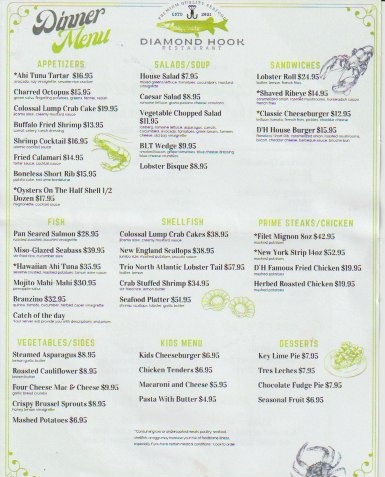
Here for your reference is their menu.

References

  1. Pescadaro Seafood and Oyster Bar. https://www.pescaderofish.com/
  2. Diamond Hook Restaurant.  https://www.diamondhookrestaurant.com/
  3. Ike B.  eat Harold’s.  WordPress 5/23/21.  https://theviewfromharbal.com/2021/05/23/eat-harolds/
  4. Trulia.  Chicago IL.  West DePaul. https://www.trulia.com/n/il/chicago/west-de-paul/83019/

Cindy’s

Cindy’s on Michigan was our destination as we set out on our 5 1/2 mile walk from Lakeview.  It was a beautiful sunny October morning, perfect for a stroll along the lake.  Choosing to go inland along the Miracle Mile for our last leg, we stuttered after crossing Madison before finally identifying the entry to the 13 story Chicago Athletic Association’s 1893 Venetian Gothic hotel (1), upon whose roof Cindy’s (2) sat.  There was no marking other than the 12 S. street address.

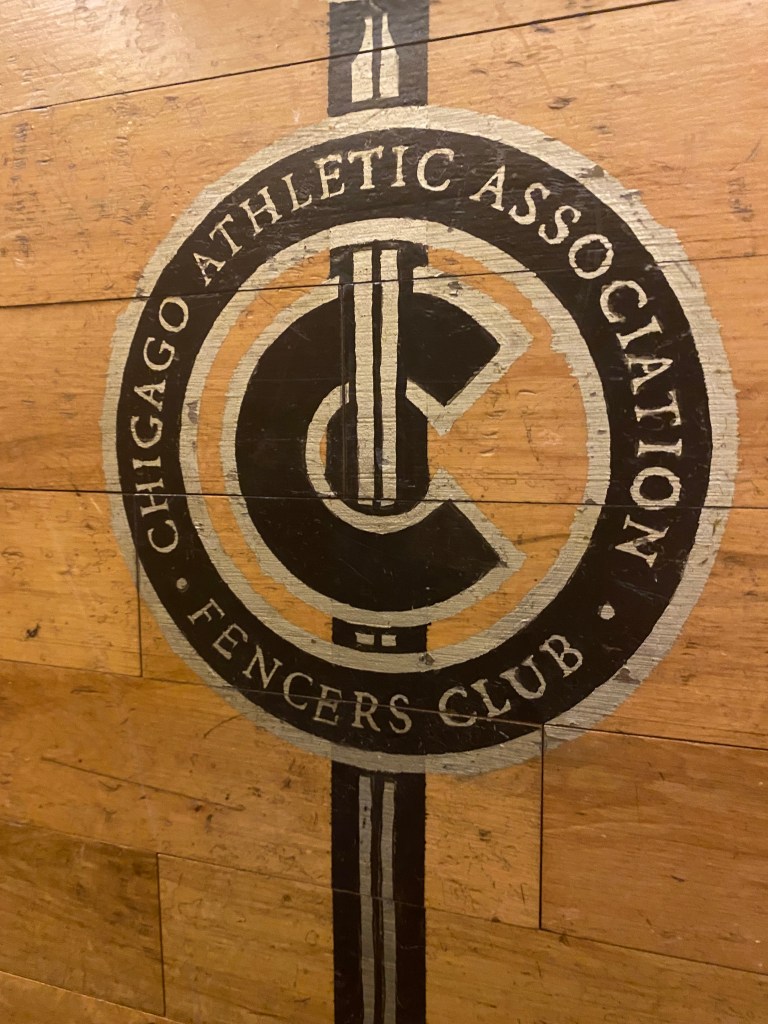
You had to go through the lobby to the elevator before seeing a small sign to Cindy’s.  If you looked down off Michigan, out could see the worn logo of the CAA on the rug in front of the door. 

For the first 123 years of its existence this home of the Chicago Athletic Club was a private club, a hotbed of social activities and athletics.  A few mementoes of that past are on quiet display

On the way up the elevator to Cindy’s you’re reminded that this place is still home to some sweating with a purpose.

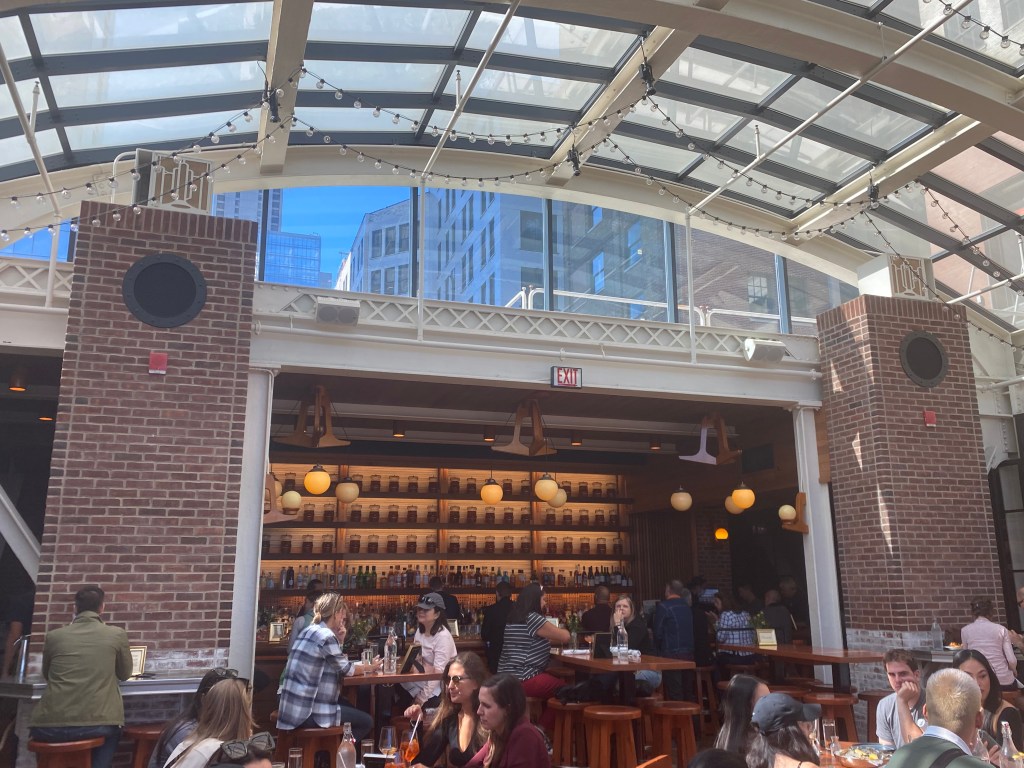
Once up and in, it was clear from the Monday brunch crowd that the place was no longer a very well-kept secret, even if you had to work to find it.  It’s hard to get a seat there, but there’ll be no sitting whatsoever on their deck.  Patrons may bring their libation out there to admire the view – and in summer be served by a bar right on the deck – but sitting and eating must take place inside.  The deck commands the best outdoor views in all of Chicago (the observation decks of those skyscrapers are all enclosed), with the lake and the park straight ahead, flanked by architecture to the left and museum row to the south.

Looking east from Cindy’s deck you see out to Monroe Harbor and Lake Michigan.  Millennium Park is in the Foreground, with the skating rink to the side and the seating area of the Jay Pritzker Pavilion crisscrossed by metal bands.  Beyond to the lake is Maggie J. Daley Park (she was Da’Mere’s beloved wife).  The skyscrapers you can see on East Randolph include the deep blue Blue Cross Blue Shield building and the rounded black shiny building at the end, the Park Shore Condominiums, where my brother-in-law Bob lived for a year.  Cut out of the picture to the left of BCBS is “Big Stan” (once the Standard Oil building, now the AON building), the 3rd tallest skyscraper in Chicago.

Looking southward you see mainly the buildings of the Art Institute.

The little round bump on the end of that spit, the Adler Planetarium, makes the east end of the Museum Campus. Just in from there at the foot of the spit is Shedd Aquarium and in from there the much larger Natural History Museum.  Way, way beyond that on the water are the buildings of the South Shore neighborhood.

Even when you’re done taking the view, the bar/restaurant is pretty good, with fancy cocktails and fine food served under soaring ceilings.

As you come back down the elevator and step onto Michigan Avenue, the fun is hardly over.  You can turn right and ascend the stairs between the lions of the Art Institute to go in and see your Monet, van Gogh, Seurat, Picasso, and such, or you can turn left into Millennium Park, climb the steps to Cloud Gate (“The Bean”) and see yourself in all sorts of distorted ways.  Once done, you can walk back to Michigan and look up to see where you’ve been.

You can make reservations at Cindy’s through RESY, with a booking window of one month.

References

  1. Chicago Athletic Association. https://www.chicagoathletichotel.com/

2. Cindy’s.  http://www.cindysrooftop.com/

Le Piano

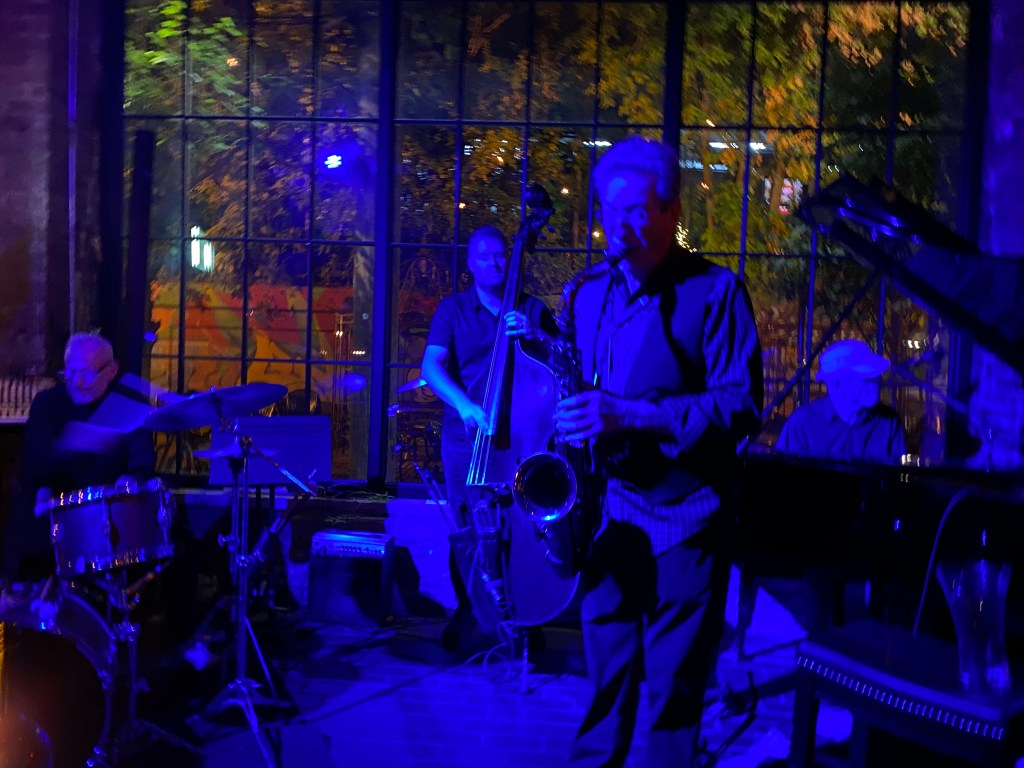
There are lots of places to hear live jazz in the Windy City (1).  Some experiences are not to be missed.  You can sit in Al Capone’s booth and listen to whomever is sharing the stage with Ceres, goddess of the harvest and fertility, at the oldest jazz club in the world, Green Mill in Uptown (2).  You could venture into the South Loop, slip into the elegant Jazz Showcase (3) and slide into one of their plush leather chairs to stare at the big picture over the stage of Charlie Parker cradling his sax then wish you had a tiny fraction of his cool.  Someday, the Fat Babies will emerge from their COVID hibernation so you can check out their swing that’ll make you think the 20s are roaring again (4).  But if it’s just plain fun you seek, take the Red Line north to Rogers Park, get off at the Morse stop and walk around the corner to 6970 Glenwood to knock on the door of Le Piano (5).  They’ve closed off that block of Glenwood to traffic, so if the weather’s nice and you want to hear your jazz outside, you can sit in their tables there.  Occupying an old brick industrial building with high ceilings and a front face of windows that go nearly floor to ceiling, the owners have installed a magnificent grand piano and scattered touches than invoke Paris’ Latin Quarter.  The bartender knows how to whip up a sazarac, and their wine list is 4 times as long as their spare menu, on which every item is sumptuous.   It doesn’t take many to fill up the place, with little tables right up front by the musicians and booths back a bit for those who prefer comfort to contact.  Sitting close has its advantages.  You can talk to the musicians as they’re setting up and you might even get pulled into the show, as Kathy and I were when here last November, invited to lay under the piano as it was played, the better to feel the vibrations from that grand instrument.  Although I don’t recall doing so, it’s an experience you can order off the menu: “The Happy Ending” (6).   Le Piano is far more than a piano bar, with a schedule that features a cabaret night, Brazilian Latin jazz, retro blues and jazz, and our favorites, the Chad Willetts band.  Chad owns the place.  See his band here as we watched them Friday night.

No, they weren’t playing the blues.  For 30 years in music, Chad is pretty shy vis-à-vis YouTube.  He drives his band from behind a drum kit, but plays a pretty nice piano, too (7).   This 3 ½’ clip purports to be about the “under the piano” experience but is also a nice intro to everything about Le Piano (8).  So next time you’re in Chi-town, head north and check this place out.  Your evening will have a happy ending even if you chose not to crawl under the piano.

References


1. Ike B. Chi Jazz. WordPress 5/23/21. https://theviewfromharbal.com/2021/05/23/chi-jazz/

2. Green Mill cocktail lounge. https://greenmilljazz.com/

3. Jazz Showcase. https://www.jazzshowcase.com/

4. The Fat Babies. http://thefatbabies.com/the-fat-babies-band-uptown/


5. Le Piano. https://www.lepianochicago.com/

6. Lie under a piano at this jazz club. abc7 Chicago 2/6/20. https://abc7chicago.com/chicago-piano-happy-ending/5906571/

7, Chad Willets at the Chicago Knickerbocker Hotel. YouTube 1/4/13. https://www.youtube.com/watch?v=QxdGvm8lJeg

8. Lay Under a Piano at this Jazz Club | Localish. YouTube 10/20/20. https://www.youtube.com/watch?v=gOU-2R-P-nI&t=57s

lab prattle

In recent interactions with a woman, founder of a 508(c)(1)(a) to whom I might eventually consult, she took me up on my offer to prattle on about my virology lab experience.  As her organization deals with consequences of a particular virus, she might be interested in knowing where I’m coming from.   Here’s what I told her:

My CV (1) has a listing of my lab experience (a post-retirement embellishment), but I offered a prattle and you said bring it on, so here goes.  I stumbled through U of M undergrad, finally collecting enough science credits to get pre-med pre-reqs and a Zoology degree in ‘74, doing well enough on MCATs to make it look like I’d have a chance at med school.  Since I didn’t do that in time to enter med school right after graduation, I went to grad school in microbiology.  In the mid 70s, molecular techniques like restriction enzymes were just emerging which would turn virology into such a hot area.  My classroom success didn’t translate to the lab, but I spent time in the lab of up-and-comer Tony Faras working on retroviruses, RNA viruses implicated in cancer.  Maybe my experiments fell flat, but I learned the lingo.  When Tony went back home to Minnesota, I hooked up with Bill Murphy, who was working with slow viruses, like visna and kuru, which cause no symptoms for a long time after they infect, then disaster happens.  At the time they were thought to be implicated in Alzheimer’s.  HIV was a decade away from being discovered, but is now characterized as a slow virus.  Bill recognized my skills so I wrote proposals and did no bench work.   I would have done more with him had I made it into Michigan med school.  Instead, I had to settle for the University of Chicago.  There, I spent 2 semesters and a summer in Elliott Kieff’s lab.  His thing was Epstein-Barr virus, which has never not been interesting, given its role in lymphoma, autoimmune diseases, and even chronic fatigue.  I actually got a few things to work in his lab, tho’ nothing publishable.  For me, lab research was always a means to an end, with scholarships and posts open to those who had put time in the lab.   My tales of research experience impressed those interviewing me when I was seeking an Internal Medicine residency and I matched to an elite place, Barnes Hospital in St. Louis, a Wash U affiliate.  I got my first taste of rheumatology in med school but my experiences at Barnes convinced me that was where I belonged.  I may have overrated my assets as I sought a fellowship, as of Hopkins, UCSF, Barnes, and Michigan, only my home institution offered me a position.  That was fine with me as I enjoyed coming home, had a great fellowship experience, and a long satisfying career on faculty.  Research was expected of fellows, and Michigan had a unique young hotshot who was a virologist, Tom Schnitzer.  He was working with a reovirus that caused muscle inflammation, similar to what happens in the rare but important autoimmune disease polymyositis.  Again, I stumbled in the lab, but enjoyed other benefits, not the least of which was meeting my wife-to-be, then a PhD student with whom I was going to collaborate.  Plus, I’m sure I would not have been offered a job had I not done bench research.

I never returned to bench research, but realized that those who succeed there are a different breed.  Good for them.  But I’ve kept my interest in viruses and really enjoyed dusting off those chops starting in December ’19 when Mr. Corona first raised his spikey head.  I started blogging the next month and many of those posts were about coronavirus.  By June of ’21, I’d written enough to fill a book https://www.amazon.com/Musing-through-Pandemic-Year-Corona/dp/B098GV14KY/ref=sr_1_4?crid=28SWTSTDEQ2ZN&keywords=%22Robert+Ike%22&qid=1664631812&sprefix=robert+ike+%2Caps%2C107&sr=8-4

Worth the 10 bucks (or $3 Kindle) if only to read “Fauci’s feeble-minded fear-filled followers”, inspired by an encounter with one of those in the woods.

You can check out my Amazon author page to see what else I’ve published https://www.amazon.com/Robert-Ike/e/B095CPDZGP?ref=sr_ntt_srch_lnk_2&qid=1664631980&sr=8-2

Well, that’s more than enough for now.  I look forward to talking with you next month.

References

  1.  Ike B.  My C.V. (updated). WordPress 10/1/22.  https://theviewfromharbal.com/2022/10/01/my-c-v-updated/

brother Nick’s truck driver’s chicken

After another delicious dinner of this easy, simple, cheap dish, I decided I had to share it.  I owe it to my brother Nick, who drives the truck he owns for a living.  As I was remarking on the impressive weight loss he’s managed to achieve while the rest of us still struggle with COVID pounds, he mentioned this staple for on-road eating.  After throwing some chicken drums and thighs into a crock pot with onions and such, he spreads the result on flat bread which he rolls up into hand-held sandwiches stored into a plastic box under his seat, ready to reach in and eat whenever he got hungry.  Sounded good to me.  I gave it a go and it turned out pretty good.

I sent it to Nick and he said it was pretty close to what he did.  When you can get 5# of chicken quarters for 5 bucks or less, it’s a pretty good deal.  Nick doesn’t add stock and the mix I get using it has about ¾ C juice you could strain off and save for other purposes (it’s delicious).

Part 2 of the feast is the bread you wrap this in.  Any of the various flatbreads you might buy will do.  Heck, you can probably plop it on a regular bun and call it a chicken sloppy joe.  But if you’ve got a bread machine, you can make your own naan, that delicious slightly crusty warm flat bread you thought you could only get in an Indian restaurant.  But it’s easy peasy.  The machine makes the dough and you and your iron skillet make the bread.  It’s what we do and I recommend it highly.

Heck, this could probably sustain you for six days on the road (1)

References

  1. Dave Dudley. Six days on the road. YouTube. https://www.youtube.com/watch?v=6ncw-CwRwRo

device

My dentist no longer uses laughing gas, but none was needed on my visit to his office this morning.   I was there to get a new crown to replace one I’d lost.  The tedium of the injections and grinding with pauses to let the former take effect to make the latter tolerable began to get interrupted when Doc commented on his observations of the bed for the new crown.  Realize that conversations at the dentist’s are stilted, with something always done when the patient opens up his briefly freed mouth.

Doc: You probably lost this crown quite a while ago, as the remaining tooth protrudes more than it did when we did the last crown.  It’s had time to grow a little.

(pause)

Me:  I really don’t know when it happened.  I’m not in the habit of panning my stool for gold.  Whenever it did happen, my net worth dropped that day.

Doc: You needed a metal detector

(pause)

Me: A new essential bathroom appliance!

(pause)

Me:  Maybe it can be paired with a bidet to give a combination device

By then, all were thinking we were on to something, till Doc spoke up

Doc:  Bob, I don’t think you’d have a very big market for your device

Me: We just need the right celebrity spokesman

The group discussed who that might be as my mouth was full again

Me:  It’s clear to me.  Hire one of the two best known posteriors in show biz: Kim Kardashian or Jennifer Lopez

(pause)

Me: My good friend Ken at UCSD is Kim’s cousin.

So, Kim became the obvious choice.  She couldn’t find the gig beneath her dignity and with her jewelry collection and eating habits, she’d obviously had at least one experience where such a device would have helped her out.

Assistant: you could call it the “Gold Digger”

We all agreed that was apt for Kim also.

Doc:  So, who will be the go between on this?

Me:   Ken, like all my friends, likes my wife Kathy better than me.  Plus, he has lots of Hollywood connections and managed her in her attempt to break into the movies in the 90s.  (I threw in some details of how that went down)

So woman to woman and all that.

With the tedium of prep work completed, Doc proceeded with the more intense task of seeding the crown, and the conversations petered out.

But after Doc made his final remarks to me and was waving bye, I told him “You know, my best friend from childhood is a patent attorney.  I’ll be sure to include you on the discussions.”

As I paid for the visit, I hoped that our new product would make a killing.