Sgt. Ike

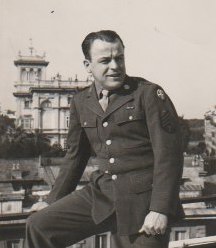
Memorial Day is a time to remember and respect those who made the ultimate sacrifice for our country.  Fortunately, my dear dad emerged from World War II unscathed, living a long and happy life until leaving 20 years ago in March.  But he considered his time in the service as the best thing he ever did in his life.  See him here in Rome, May 10, 1945, 2 days after V-E day. 

He’d come to Rome in 1943, an eager draftee who had his hernia fixed so he could serve.  His Fisher Body plant had geared up for defense production, and he was the sole remaining of 3 sons at home, the 2 others already off to war.  That’s 3 excuses he ignored to join the effort.  The Army thought this athletic sparkplug would make a good paratrooper, till someone noticed his glasses.  So they leaned on his other talents, Haney’s Business School honed already in a couple years at GM.  He flew a desk, running the Military Mission to the Italian Army, seeing that that outfit was well supplied.  He says no one ever shot at him, and he came home with a new taste for Italian food if not for opera. 

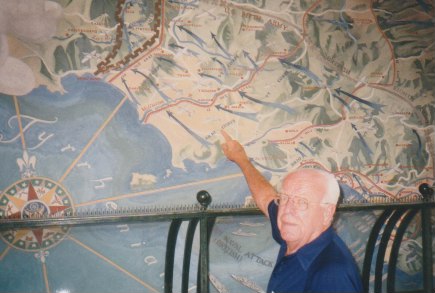
Here he is 53 years later, standing in front of a mural at the American cemetery in Naples, pointing out the movements of the Allies’ campaign to retake Italy, which preceded his arrival there by several months.

Per his request, he had a military funeral – complete with a flag draped casket, 3 rifle volleys over his grave as he was lowered down, and taps from a real bugle – and his highest rank – T-Sgt (Technical Sergeant: 3 up, 2 down) – is inscribed on his tombstone, by which a flag placed by the local VFW is flying now.  Thanks, Sergeant Ike.  Thanks Dad.

Jean d’Arc

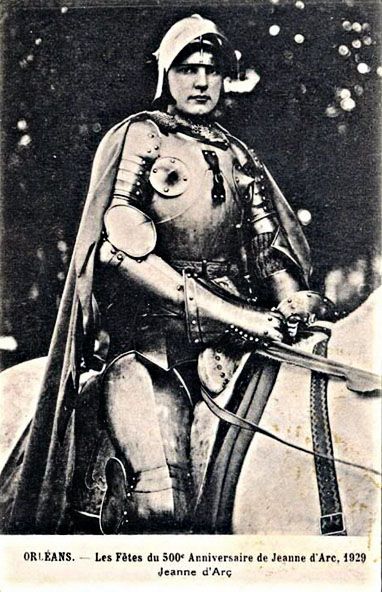
I’ve missed the anniversary  of the canonization of Joan of Arc, who entered sainthood thanks to Pope Benedict XV on May 16, 1920.  That’s a long time to serve as a martyr, leading the French to victory over the English at Orleans in 1429 and in effect securing the coronation of King Charles VII , to have saved a nation only to be burned at the stake.  A model for virtuous women everywhere. Her feast day is comingup: May 30th, anniversary of her execution,

She’s inspired many, including Leonard Cohen and Jennifer Warnes (1).

References

  1. Joan of Arc – Jennifer Warnes & Leonard Cohen.  YouTube https://www.youtube.com/watch?v=gtwUyDPXROQ

bye, Mom

A friend offered such nice condolences for my mom’s recent passing (1), I felt compelled to offer her some information about this person she never knew.  Here’s what I wrote:

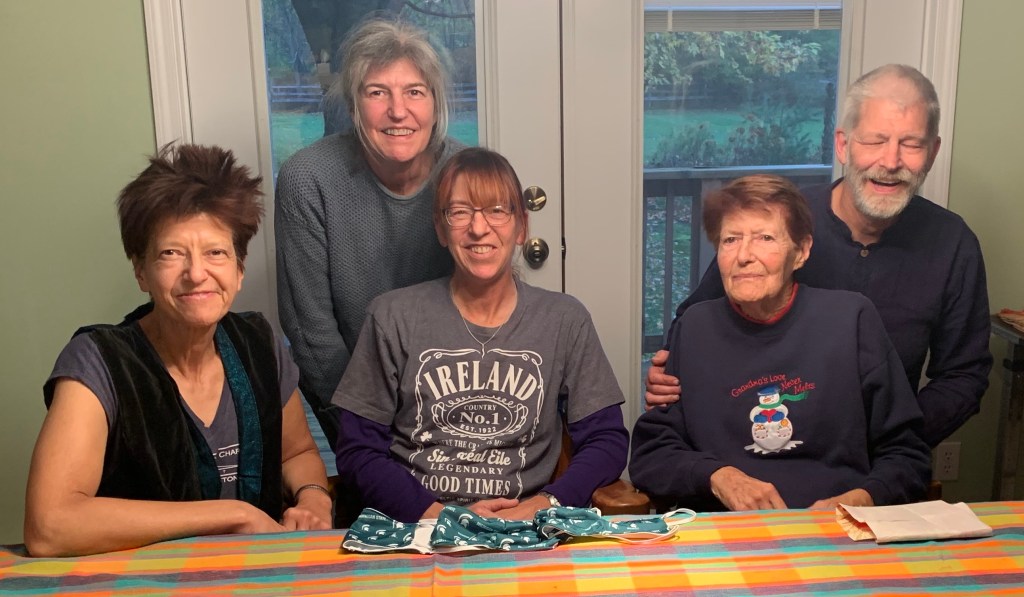
Mom was a spitfire.  Chose to carry me when she got knocked up at 19 even though cad-Dad offered to pay to “take care of it”.  Went on to raise 4 more of her own when she and her Italian electrician husband bolted Dee-troit to live among the Amish in Stanwood by Big Rapids.  It wasn’t a farm, but it had a barn and they had horses and other animals for the kids.  All got college degrees (3 with 4 from MSU!) and thrived except for baby sister Amy, who chose to become a Colorado ski bum – still happy in her own way – and died of a vaxx heart thing at 56 last May.  Mom’s mom made it past 104 (see them on the beach at Anna Maria Island in FL a couple years before I came along), just like my own Grandpa Ike, so I expected to have her around.  Heart issues got her, and she became very frail her last few years, though her mind remained sharp, sharp enough to get zingers to her oldest son regularly.  Her maternal grandparents worked the copper mines in the Keweenaw after coming over from Cornwall before buying cut-over farmland in the thumb, so I can say I have Yooper blood, something of which I’m very proud.   My favorite picture of her is one we took very early in our relationship, back in May ‘09.  We arranged a meet up by her house after the PI had found her.  Kathy rented a plane and flew me and her to the nearby Canadian Lakes airstrip.  Mom drove up in her red convertible, so we both made an entrance.  After that came a visit where Kathy’s jaw dropped to see the similarities in our mannerisms. It was never distant or awkward with Mom. Words between us just flowed. We could talk for hours, but didn’t do so often enough. Mom spent winters in Mazatlán, and we always threw her a party when she pushed off.  See us in October 2020, when Amy was still alive.  There’s a missing son, living down in the “other peninsula”, but we love him too. The last is me, Mom, Kathy, my tall sisters, and some cousins at a restaurant in little Beaufort, County Kerry, last July.  Mom had hinted to her daughters for several years she’d like to celebrate her 90th birthday in Ireland, so we did.  At one point she said she’d had such a good time she wanted to have her hundredth there.  I wouldn’t doubt that her spawn will end up there in July 2032 to summon her spirit.  And to honor her wishes, we’ll have a great time doing it. 

Marlene and Violet Gilbert on the beach at Anna Maria Island, sometime in 1949

Mom meets her first born for the first time (as an adult) on the grass field of Canadian Lakes airstrip, May 2009.

Mom’s girls (and one boy) wish her well as she pushes off to Mazatlán for the winter, October 2020. Front row: Di (a.k.a. Jack, CPA for the State and also MSU volunteer women’s rowing coach), Amy (Amelia, a.k.a.Madge, driving FedEx truck), Mom. Back: Jolene (a.k.a. Ish, became pharmacist after her dream of veterinary was dashed), me.

Mom’s testosterone laden offspring, tempered by their dear wives. On our porch at Madeira Beach January 2023. Spartoon John (B.A., LL.B), Karen, Kathy, me. Yes, John and I smoked cigars beforehand (2). As you can see, John did get some of our mother’s good looks. I trust he’s used them to good purposes.

Gathered at Dunloe Hotel & Gardens in Beaufort, Killarney, County Kerry, near Kilkenny, after Mom’s second or third 90th birthday party. First row: cousin Krissy, Mom, Kathy, Di, Krissy’s mom Laura. Back: Jolene, me. The hats were Jolene’s idea.

References

  1. Ike B. Mother’s day. WordPress 5/14/23 https://theviewfromharbal.com/2023/05/14/mothers-day/
  2. Ike B. Tobacco Road. WordPress 1/21/23. https://theviewfromharbal.com/2023/01/21/tobacco-road/

fellowship

They called ‘em “fellowship groups”.  We were encouraged to join one shortly after we became members of the Ann Arbor Christian Reformed Church (AACRC) in 2006.  Small groups of parishioners met regularly in one another’s homes to share each other’s company while discussing a biblical topic in some depth.  Bill, Marilyn, Tom, Claudia, Larry, Ruth, Jim, and Alice had an opening, so we joined them.  All were a little bit older than us, each with a much longer history with the AACRC, but we got along.  Over the years we’ve become very good friends and cherish our meetings together.  Apart from some dust ups over politics and COVID (do I repeat myself?), we’ve shared a love of Jesus and Michigan sports, although Jim and Alice were Spartoons, since moved to Muskegon so less of a problem.  With passage of COVID, we’ve started to get together again, now much bigger social occasions with post-discussion snacks replaced by full dinners.  This Wednesday was our turn to host.  It had been a while since the group had been over to our house.  With our new countertops and a gallery of space/music/memento posters plastering our walls, we were eager to show off.  Plus, the food.  Give me an excuse to cook and several days to prepare, just look out.  Here’s what awaited our guests as they came to 1611 Harbal.

Openers

Guac & chips

We got this simple guac recipe from our dear friend June Rogers of little Nathrop Colorado.  So much simpler than the guac recipes we’d been attempting, and so good.

June is widow of my dear friend Sam.  You can see more of her here (1)

marinated asparagus

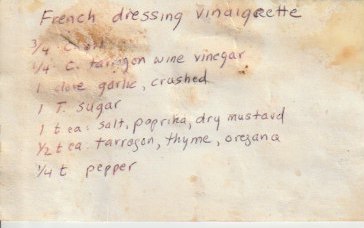
This time of year, when this magical grass is abundant, you want to eat as much of it as possible.  Steamed, chilled, then marinated in French dressing, it’s pretty delectable.

The first line is “3/4 C oil.”

(guests brought cheese & crackers)

Main courses

Piri-piri chicken

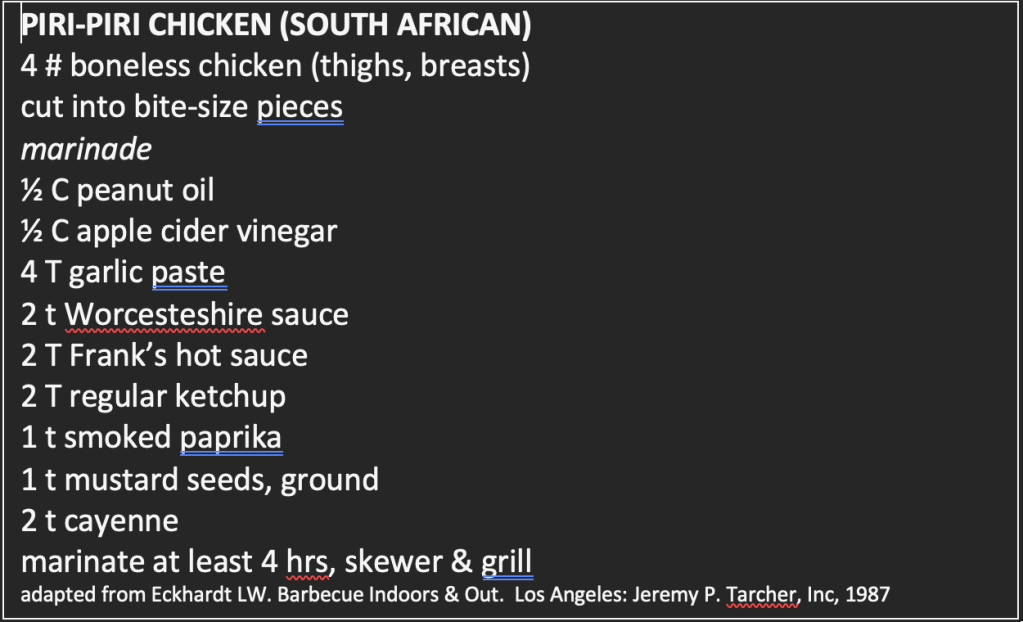
Adapted out of an old barbecue cookbook, where it was meant for whole chicken pieces, this bath for boneless chicken produces bite-size wonders.  The dish originates in South Africa, whence we got Elon Musk.  Think he’d like it?

Steak chunks with Montreal steak seasoning

Why wait till that nice steak is on your plate to cut it up?  Cutting up a strip sirloin or ribeye into bit size chunks then exposing them to Montreal steak seasoning before skewering leads to some tempting treats

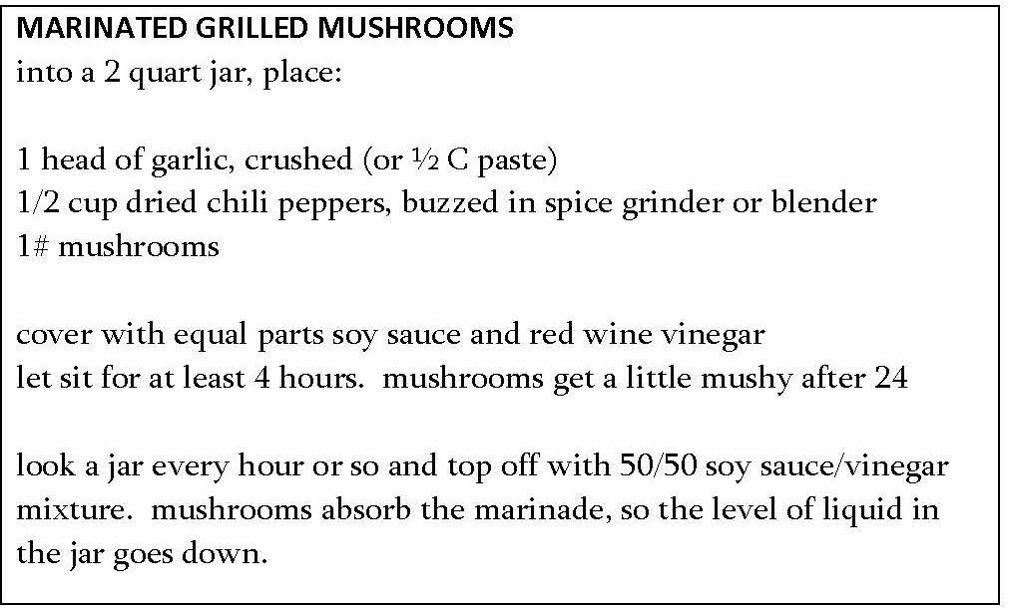
Marinated mushrooms

This simple winner of a recipe has seen these pages already. (2)  At last serving to this same group, we realized that substituting the same volume of ground chilis to whole chiles led to a much hotter ‘shroom.  We cut back by half on no one was burned.

This recipe has evolved since its inception.  Lately, the ½ C chilis has become ½ C ground chilis, clearly increasing the potency.  For this gathering, I reduced that volume to ¼ C.

Grilled peppers and onions

Too simple for a recipe card.  Just chunk up one big, sweet onion and 3 bell peppers, skewer and grill.

See here the grill output

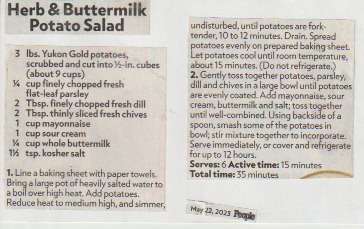
Herb and buttermilk potato salad

From People Magazine, no less!  Everybody likes potato salad, as our guests did this one.  The extra jar of pimentos (not included in the original recipe) didn’t hurt.

Dessert

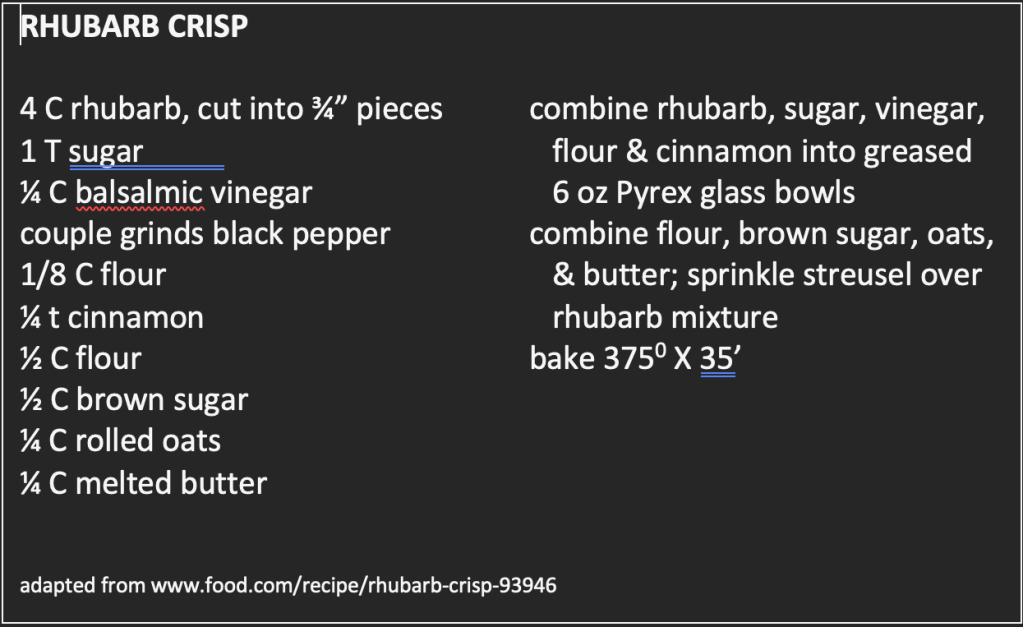
Rhubarb crisp w/ice cream

The first “fruit” of the season is this abundant stalk.  Definitely for adult tastes.  My wife’s experiment with balsamic vinegar as a substitute for sugar bore out here (3).  We even left out the oatmeal crumble top and added non-dairy ice cream to satisfy the 2 vegans in our midst.

Of course, the wines, white and red, flowed freely.   What would a night with Jesus be without wine?   We closed out our evening as we always do, sharing the troubles we face as well as those of those close to us, prayers to follow.  In the end we emerge with a Harbaughian notion of who’s got it better than us?  Nobody! We shall meet up again.

References

  1. Ike B.  See Sam.  WordPress 1/14/20 https://theviewfromharbal.com/2020/01/14/see-sam/
  2. Ike B.  ‘shrooms!. WordPress 3/15/21 https://theviewfromharbal.com/2021/03/15/shrooms/
  3. Ike B. Sauce. WordPress 7/6/21. https://theviewfromharbal.com/2021/07/06/sauce/

Mother’s Day

On this Mother’s Day, I’m back to being an orphan. I’ve been blessed with two wonderful mothers. Marion Lela Slater Ike (left) took me in and gave me joy until she left me when I was 10. Marlene Joan Gilbert (right) chose to have me when she became pregnant at age 19. I became reacquainted with her this month 14 years ago. Last week she left us after 90 years and 10 months. How I love and miss them both.

Pappy said son…

A dear friend who’s a surprisingly talented artist is turning one of my favorite Commander Cody photos into a painting. She’s needing clarification of some details in the photo. One of them is “what’s that on your t-shirt?” Well, it’s a poster for the celebration of the 50th anniversary of “Hot Rod Lincoln”, held at Kent State (yes, that Kent State) April 25th, 2008.

Here’s the photo she’s working from, taken at Bull Run Restaurant in Shirley Massachusetts, about an hour’s drive northwest of Boston’s Logan airport, after a June 13, 2015 concert by Bill Kirchen (far right) at which the ol’ Commander (between Bill and me) was the guest.

Kathy’s wearing a Michigan hockey jersey as the Commander has two degrees from UofM and says he played freshman football and ran track while Bill was born and raised in Ann Arbor and is a proud UofM dropout. George Frayne (CC) was also an accomplished artist and sculptor who also did paintings on commission. He did that poster, by the way. I asked him several years ago if he would take on this picture. He declined, saying it had “too much detail.” Should you be interested in what his own art looks like, check out his web page, where some of it is even for sale (1).

Should you wish to know what all the fuss over “Hot Rod Lincoln” is about, and somehow missed its appearance on the radio in 1972, here are five renditions.

First the original, the song Charlie Ryan wrote and recorded it in 1955 (2). Charlie lived the life he wrote and sang about (3), dying at age 92 in 2008, the same year his song would be memorialized at Kent State.

Johnny Bond’s version made #26 on the Billboard charts in October 1960 (4).

I’m not certain which version the boys found in the old record bins, but they sure did a bang up job with it. Checkout their performance at the Free John Sinclair rally at Crisler Arena in Ann Arbor December 10, 1971 (5). Their version would make #69 on Billboard’s top 100 Singles of 1972.

Big Ray Benson credits CC&hLPA with inspiring him to start up Asleep at the Wheel, as they showed you could sell old country music to hippies. They often shared a bill during the 70s. Ray wasn’t above poaching some of their songs, and HRL is a staple of their sets now (6).

Bill’s look at my tee shirt in Shirley was the first he’d heard of the Hot Rod Lincoln celebration. He said “I should have been there”, and indeed he should have. Bill has taken Hot Rod Lincoln and made it his signature song, always closing out his first set with it. He’s taken the events after the character sings “I’ve got a license to fly” and used them as a platform to showcase his encyclopedic knowledge of classic guitar licks and his ability to play them. Neophytes at a Kirchen concert always get a sleeve tug from a knowing friend when this tune comes up “Ya gotta hear this!” Here he is playing it in Washington, D.C., less than 2 months after the Kent State celebration (7).

Only Kirchen (8) and the Wheel (9) are still out there performing. Each is a guaranteed good time, and you’re sure to hear a rousing version of Hot Rod Lincoln!

References

1. https://commandercody.com/the-artwork

2. Hot Rod Lincoln – Charley Ryan (1st version). YouTube https://www.youtube.com/watch?v=e58NJU5B3v8

3. Hughes DL. Hot Rod Jukebox. Charlie Ryan – “Hot Rod Lincoln”. CarShowCrazy.com. https://carshowcrazy.com/hot-rod-lincoln-various-artists/

4. Johnny Bond – Hot Rod Lincoln (1960). YouTube https://www.youtube.com/watch?v=eZu5TwRbYiA

5. Hot Rod Lincoln by Commander Cody and His Lost Planet Airmen 12/10/71. YouTube https://www.youtube.com/watch?v=c8TeHA4UL_8

6. Asleep At The Wheel Hot Rod Lincoln Official Video. YouTube https://www.youtube.com/watch?v=HSF3DQkN9aM

7. Bill Kirchen – “Hot Rod Lincoln” in Washington D.C. *UPGRADED*. YouTube https://www.youtube.com/watch?v=gsLdufJePz0

8. BILL KIRCHEN https://www.billkirchen.com/official

9. ASLEEP AT THE WHEEL https://www.asleepatthewheel.com/

more on Paul’s pots

Finally getting those old pots and pans out of storage and restoring them for sale proved to be a more emotional experience than I had counted on (1).  But they’re ready to roll, as good-looking as they’re gonna get, and about to get packed into a box to await being claimed by someone who sees them on eBay and makes the right offer.  I think true lovers of Revere Ware may comprise a cult, their hearts going pitter patter at the site of those copper clan bottoms.  True, it’s incredibly cool they were made by a company started by a major Revolutionary War hero, but that company lost its way in the sixties when they started to make the stuff cheap, the design later falling through a series of companies of which one finally threw in the towel and stopped making it in 2018.  But there’s still enough out there it’s not hard to find on eBay and an on-line company makes a go of it selling replacement parts solely for Revere Ware (2).

So the new owners of this set may know everything they need to know about Vintage Revere Ware.  I still felt moved to include a little letter of introduction to their new purchase.  It went as follows:

May 10, 2023

To the new owners of this beautiful vintage Revere copper-clad cookwear:

Congratulations on your purchase.  They don’t make ’em like this anymore.  This is the real deal, a blast from the 50s, made just as the first pots the Revere company – two generations removed from being run by Paul Revere’s grandson, a company his grandfather started at the end of the Revolutionary War – made and showed at the 1939 Chicago Housewares Show and not changed until the mid-60s when Revere Ware reduced thickness of the copper cladding by 50% as a cost saving measure.  The stuff still looked nice but didn’t conduct heat near as well.  Rights to the design and sale of Revere Ware passed through several hands with World Kitchen, Inc. (makers of OXO – “Good Grips” – utensils) filing for bankruptcy in 2002 and the last holder of the rights, Corelle Brands, discontinuing production completely in 2018.

Both my mother and grandmother owned a set, so these are the pots and pans that cooked the food I was raised on.  As I grew to 6’8” and ended up a professor of medicine, it must have been some good stuff.  I’m not sure which set this was.  Grandma took better care of hers, keeping that copper gleaming like new by dusting each pot’s bottom with a little Copper-Glo after each use, spreading it around with the moistened palm of her arthritic hand to get full effect.

I apologize this set does not have a Dutch oven or lid to it.  They might have fallen victim to some kitchen experimentation as I struggled in my youth to become the cook my mom and grandma had been.  I found several on eBay just now, so it shouldn’t be too hard to complete your set, if you want to have such a pot.  There is a stainless steel insert here that makes a double boiler when nestled into the 3 quart pot, somewhat unusual for sets like this.

In my opinion, it’s the copper that makes this stuff special.  Keeping it gorgeous requires the same regular attention my grandma gave it.  They stopped making Copper-Glo some time ago.  An on-line commentator mentioned Kleen King, which I bought on Amazon and used to good effect.  I’m enclosing my unused portion, as I’ll no longer have any copper cookware when this goes out the door. Bar Keeper’s Friend also does a good job on copper, but none of the conventional abrasive cleansers, like Comet, will do it.

A Revere Ware aficionado named Peter some years ago set up an on-line business – Revere Ware Parts (2) – to supply replacement parts to other fans out there.  The site is also a wonderful repository of Revere Ware history.   There’s an item there “Identifying Vintage Revere Ware”.  You can check out your new pots and pans against Peter’s guide and see that they’re the genuine article.  One aspect is the name of the plant that made the 8” (medium) skillet.  Mine was made in Clinton, Illinois, the last plant they brought on line, in 1950, to cope with demand for the product.

I’m sad to part with this piece of my past, but heartened they will be going to a home where they will be used and cherished.  Bringing them out of storage and preparing them for sale has been an emotional but very satisfying exercise, even inspiring me to write something for my blog, which you’re welcome to check out (1).

The listing is up on eBay and looks like this:

Should you wish to check out the listing for yourself, go to (3).

References

1.         B. Ike. The tarnish R coming!  WordPress 5/10/23.  https://theviewfromharbal.com/2023/05/10/the-tarnish-r-coming/

2.         Revere Ware parts. https://www.reverewareparts.com/

3.         vintage pre-1968 revere ware copper clad cookware.  https://www.ebay.com/itm/155550717756

the tarnish R coming!

Paul Revere’s day job was silversmith.  He was very successful.  His products were more functional than ornamental, vessels for preparing and serving food and drink.  We know his role as a patriot, and he applied his metal working talents to the war effort, during and after the war using the profits from his expanding business to finance his work in iron casting, bronze bell and cannon casting, and the forging of copper bolts and spikes. In 1800, he became the first American to successfully roll copper into sheets for use as sheathing on naval vessels.

Mid-20th century American cooks knew Paul Revere and his copper very well.

How we got there goes way back to the end of the Revolutionary war (1).  Revere focused on copper, starting his own company.  He brought in his son Joseph in 1804, the company becoming Revere and Son. Paul died in 1818 at age 84.  10 years later Revere & Son merged with James Davis & Son of Boston Brass Foundry to form the Revere Copper Company.  Joseph died in 1867 succeeded by his nephew, Frederick Walker Lincoln. Several Revere family members (John Revere followed by his two sons William Bacon Revere and Edward H.R. Revere) remained active in the company.  In 1881 John Revere, Paul Revere’s grandson, became company president. Subsequently, Revere Copper Company merged with the New Bedford Copper Company and the Taunton Copper Company, to form the Taunton-New Bedford Copper Company. Revere retained its name as a separate division.  In 1928, six companies – Rome Brass & Copper Company, Michigan Copper & Brass Company, Baltimore Copper Rolling Mill, Dallas Brass & Copper Co., Taunton-New Bedford Copper Company (Revere’s company), and Higgins Brass & Manufacturing Company were merged and incorporated as the General Brass Corporation on December 1, 1928. The merger produced the second largest fabricator of copper & brass products in the U.S. with 25% of the country’s rolling mill capacity. Four days later, the name was changed to Republic Brass Corporation.  The next year, on November 12, out of respect to the founder of the American copper industry, the name of the company was changed again, this time to Revere Copper and Brass Incorporated. 

About that time began a 10-year effort that would find the Revere brand in America’s kitchens as well as its shipyards.  At the time home cooking was done in cast iron pots, with finer cooking, as in restaurants, in vessels of pure copper or copper lined with tin, delicate and expensive alternatives to cast iron.  In 1931 Revere introduced a line of cookware with chrome plating the copper instead of tin.  The product failed, as potatoes cooked with salt caused the chrome to flake off.  By 1934 the team investigating this product’s failure found that only stainless steel could effectively replace chrome, but this material conducted heat unevenly.  The leader of the team judged that a heavy layer of copper bonded to the stainless steel would solve the problem, copper being an excellent and even heat conductor.  Such bonding was thought to be impossible.  In 1938, after 2 years’ time and considerable expense, the objectives were reached: A 2-step electroplating technique was developed which could deposit a thick layer of copper plate (1 1/2 times the thickness of the underlying metal) on 18-8 stainless steel at production speeds. This thickness was more than sufficient to overcome the burning problems of regular stainless-steel cookware.

The newfangled cookware was introduced at the 1939 Chicago Housewares Show and was an immediate hit.

World War II halted Revere Ware’s march into America’s kitchens, as all copper went into the war effort rather than consumer products.  In 1942, Revere was issued Patent No.US2272609, covering their new copper cladding process as used in the Revere Ware product line, which they would later stamp onto every pot and pan produced.

Postwar sales boomed, the sales of Revere Ware limited only by the production capacity of the Rome, NY plant.  The decision was made in 1948 to establish a second plant on the west coast. Subsequently, an abandoned manufacturing plant in Riverside, CA, was acquired and equipped for production.  In 1950, a third plant, in Clinton IL, came online.

Even in the heyday of Revere ware’s popularity, signs of the company’s eventual demise could be seen, such as new product lines and a foray into aluminum (even foil pans!).  As the copper cladding patent expired in 1959, the company attempted a relaunch, with modernized styling and accompanying utensils. Enthusiasm for the new/old copper clad products was blunted by near simultaneous introduction of Teflon clad cookware, a bandwagon Revere would later jump on.

The 60s found Revere trying to make a go of it with aluminum cookware, still producing the copper clad classics.  With the aluminum products failing, management sought to squeeze some profit out of the copper clad line by making it more cheaply.  The electroplating process was gradually shortened – reducing the thickness of the cladding while simultaneously increasing the production line speed. Ultimately, the thickness of the cladding was reduced by 50% (which unfortunately caused the cladding to lose much of its ability to dissipate heat). This change passed unnoticed by consumers (at first) – as there was little change in the appearance of the product. The changes allowed Revere to lower retail prices, leading to a rebound in sales through the mid 1970’s. 

After that, it’s a sad story of cutbacks, consolidations, selloffs, mergers & acquisitions, and bankruptcies.  The last company to own rights to Revere Ware, World Kitchen Inc., filed for Chapter 11 bankruptcy protection in May 2002.  The next year found them emerging from financial restructuring, and all Revere Ware production was transferred to far-eastern plants, and the product imported to the US.  You can still find Revere Ware on Amazon, but it’s all used.  A Google search finds a mishmash of historical sites and purveyors of used cookware.  World Kitchen was a successful outfit, featuring the popular OXO (“Good Grips”) line.  They sold out in 2004 to Helen of Troy Limited for over $273 million in cash. In 2018, Corelle Brands discontinued all production of Revere Ware and Bakers Secret.  So that was, as they say, that.

While I love my mother’s Revere Ware and have fond memories of her using it, I’ve never used it myself, at least regularly.   I’ve accumulated my own collection of more modern cookware (mainly Chantel), a couple woks, and some ancient cast iron pieces and am very happy with their performances.  Part of the problem with Revere Ware is that copper bottom.  Essential for heat transfer to the pan, and a major part of the eye appeal, it starts tarnishing the moment you take it off the stove, maybe sooner.  While the tarnished copper will still do the heat transfer thing, it just doesn’t look as pretty as it could.  From ages 0-10, I never paid much attention to what Mom did in the kitchen, just what she brought out of it.  I got to observe my dear Grandma Slater much longer, and I enjoyed sitting at her kitchen table watching her work her magic.  That extended to cleanup.  Her Revere Ware always gleamed, never put away without a good sprinkling of Copper-Glo carefully applied by her full arthritic hand, palm included.  It’s a motion I know well but am too lazy to apply, at least regularly   Had to be Copper-Glo, as nothing else came close (2).  They’ve stopped making it so it’s good I was able to read about Kleen King in an online comment and get some in Amazon. The guy at the hardware store swears by Barkeeper’s Friend for copper, and that works too.  And it’s well worth it to get ‘em all polished and shining, as the before and after pictures below show.

So, this last restoration to gleaming copper of my Revere Ware’s bottoms will be their last roundup, at least by me.  I’m gathering them up hoping they can find a home where they are appreciated and used.  Vintage Revere Ware sets are going on eBay for $100 and up.  The memories are of course worth much more, but I’ll still have them even when these pots and pans I never use are gone.  Sorry Mom and Grandma, but I did get to be a pretty good cook with your start.

References

1. Revere Ware Parts.  Revere Ware History.  https://www.reverewareparts.com/revere-ware-history/

2. Alice.  Stain Removal 101.  Copper Glo Review: Gets Rid Of Dullness & Spots On My Copper Pots & Pans.  https://www.stain-removal-101.com/copper-glo.html


shaksuka!

This morning, we had our second homemade batch of this breakfast treat.  It was then I knew I had to spread the news to the mountaintops.  Yeah, I know I only have my WordPres blog but, hey, Jesus only had 12!  Shaksuka is a spicy underside to your eggs that had its origins in Tunisia but has become very popular in Israel.  Pilgrims from the Holy Land bringing home a desire for this dish probably account for its popping up on menus here and there.  Babo Detroit was one of those places (1).  An eclectic little café a half block down Woodward from the DIA, it was where we stopped for breakfast before taking on the van Gogh exhibit at the DIA one Friday morning (2).  Seeing this shaksuka on the menu – “spicy moroccan tomato sauce, sautéed peppers & onion, poached eggs, fresh jalapeño, cilantro, french baguette” – how could you pass that up?  It was every bit as good as advertised.  Knowing my next several hours would be occupied contemplating the works of a very troubled Dutchman, I parked my food curiosity for the next day.  But then Dr. Google was very accommodating.  While the Israelis owned shaksuka, it came from Tunisia or Yemen, or maybe even the Ottoman empire (3).  Recipes were abundant, but I like the one I crafted together from several sources (see below).  Hard to imagine a healthier sauce, then plop your poached eggs into it.  Mmmm.

Here’s a peek at what the stuff looks like, some leftovers from breakfast in a bowl. But not for breakfast anymore is this.  You could make a nice pasta dish (which we have) or spoon it over most everything.

As for breakfast, it helps if you can poach an egg old style.  Set those passive “egg poachers” you might have aside and pick up a whisk.  You can salvage those egg whites going through a strainer by collecting them in a dish sprayed with some non-stick (I have a garlic spray I prefer) then nuking the collection for a minute.  More protein!  But here are those simple instructions about how to poach an egg.

You’d think such a feast would call for sides.  Babo served some sliced baguette which was nice.  But if your grocery store is up on this stuff, snatch ‘em up!  Stonefire mini NAAN ORIGINAL!  Pop one in the toaster, and out it comes, nice and puffed up as any naan you might get from your Indian restaurant, minus the slathered butter.  Perfect for pushing around the bits of goodness in your bowl.

I didn’t mean to tease you but here’s that recipe for shaksuka.

Don’t know if it’s a thing over there, but Google translate says “bon apétit” in Hebrew is בתיאבו.

References

1. Babo Detroit.  https://www.babodetroit.com/

2.      Detroit Institute of Arts.  Van Gogh in America.  https://dia.org/events/exhibitions/van-gogh-america

3. Kantor L.  A Brief History of Israel’s Famous Dish, Shakshuka.  Culture Trip 12/16/17.  https://theculturetrip.com/middle-east/israel/articles/a-brief-history-of-israels-famous-dish-shakshuka/

Hyde ‘n’ seek

I first set foot in Hyde Park when I was 14.  Mrs. Kitchel had taken Vicksburg High’s Biology Club on a field trip to the Museum of Science and Industry.  After horsing around the many exhibits, boarding the U-505 submarine, and descending into the coal mine, it was time to clown for the cameras.  Some of my friends crawled into that old car for a tintype.

In front: Tim, Rupe, Sam.  Back: Al, Shorty, Rod.  Eric (Rupe) was and is my best friend.  Sam came close in his later years up to his unfortunate premature death (1).

The Museum is a massive piece of neo-classical limestone standing on the north edge of Jackson Park, not far from Lake Michigan.. 

It is the sole remaining on-site structure from the World’s Fair convened to celebrate the 400th anniversary of Columbus’s 1492 discovery of America, the Columbia Exposition of 1893, which introduced the Ferris wheel and widespread electrical lighting.   The building served as the Palace of Fine Art then and stood empty until 1933 when, after having its plaster facade rebuilt in limestone 1928-32 it opened as the Museum of Science and Industry, during the City’s Century of Progress Exhibition (2).  The next largest surviving building from that fair was one of the few built downtown in Grant Park, not in Jackson/Hyde Park, and now houses the Art Institute of Chicago.  The Dutch Cocoa House – modeled after the Franeker, Netherlands, City Hall – serves as a multi-residential building in Brookline, Massachusetts.  The Pabst pavilion was built in Milwaukee and returned to Captain Pabst’s estate after the fair.  That estate is now a museum, and the old Pavilion serves as a its gift shop.  A little ticket booth from the Fair survived and now resides next to the de Caro House, a Frank Lloyd Wright house in Oak Park.  The Norway Pavilion, which had been built in Tronheim and travelled to Chicago by boat, ended up in Wisconsin, first on the Lake Geneva estate of C.K. Billings, owned briefly by William K. Wrigley, and ending up in Blue Mounds, west of Madison’s Little Norway Museum.

The Museum was the brainchild of Julius Rosenweld, philanthropist and CEO of Sears, Roebuck, and company (3).  He was inspired by the Deutches Museum in Munich to build a similar interactive in the United States.   The museum still features that coal mine and U-boat, as well as a 3,000 square foot model railroad.  The museum has major exhibits on mining, automobiles, telecommunications, aviation and aeronautics, space travel, agriculture, time, and medicine, many of which are interactive.   Little did I know then that in 8 years I’d be back, executing an assignment for my Anatomy class by returning to one if those interactive exhibits, walking through the giant, and accurate, model of the human heart.  Cardiology became one of my loves through med school.  Did that start here?

I made it back to the Museum once more in those 4 years in Hyde Park, taking my girlfriend Laurie there when she came from Ann Arbor to visit for the bicentennial.  Of course, we had to take one of those tintypes.

A school bus took me into Hyde Park first time.  In med school, either Dad’s Cadillac or my old Volvo hauled me and my belongings back to school from Kalamazoo.  Nowadays, Kathy and I enter from the north, taking the Metra electric from Millennium Station or the little platform on Van Buren.  Back in med school, this was the slick, fast, and clean way to get into town. 

It was the Illinois Central then, or “IC”.  I got a warm feeling riding the IC, as it recalled the Doobies (“Illinois Central, Southern Central Freight.  Ya gotta keep on pushin’ momma, ya know they’re running late” (4)).  But that feeling came with a price.  It was far cheaper to take one of CTA’s options for that 7 ½ mile trip, either the #6 bus or the Cottage Grove-Harlem El.  A buck would get you a ticket plus change and a transfer, good for a free ride back if you use it within an hour of issue.  The IT was over twice that.  But the CTA did take you through some pretty dicey South Side neighborhoods.

Hyde Park – named after Hyde Park in London – began as a real estate development when young lawyer Paul Cornell, cousin of the founder of Cornell University, purchased from the federal government 300 acres of land between 51st and 55th from which the feds had recently removed the Potawatomi (5).  Cornell envisioned a lakeside resort, erected a hotel, and deeded some of his land to Illinois Central Railroad for a station to take residents into the city.  Growth was swift and it accelerated after the 1871 Chicago Fire when many Chicago “captains of industry” built mansions in the untouched Kenwood area around 51st.  The Hyde Park neighborhood was annexed by the city in 1889, saw the new University of Chicago dedicated the next year and shortly after was chosen as the site of the 1893 Columbia Exposition.

Our goal in visiting Hyde Park these days is mainly to go to church. More about that church later.  It’s a ways from the train stop, with Hyde Park and campus in between.  Metra’s southbound electrics leave about every half hour, so getting to Hyde Park with enough cushion to eat breakfast and walk to church leaves plenty of time for both if you time it right.  Right on the way, an easy half mile 8-minute stroll from the 55th-56th-57th street station, is Medici’s on 57th (6).  Medici’s was the name of the small coffee house and gallery original owner Hans Morbach bought to turn into this restaurant in 1962.  He said he couldn’t afford to change the sign.  The place acquired its own gargoyles early on, crafted by a customer who had worked on the National Cathedral. 

The warm, wooden interior, upon which every square inch bears carvings and graffiti, is overseen from a platform above the second level by a 6’ tall mostly naked wooden Indian temple guard Hans had purchased in Vienna.

She happens to rotate once an hour to get a good look at all the customers (and they at her).  When you think of all the eccentric and eventually important sometimes famous people who have passed through UofC, you can begin to get a feel for the flavor of this place.  And the food and drink are excellent.  The bloody Marys come in a pint beer glass with lots of vegetables.  Good prep for church.

Church is still a ways from Medici’s, about as far as Medici’s was from the train station.  After about 4 blocks through commercial and residential Hyde Park on 57th you cross Woodlawn and campus become evident.

There’s an imposing gothic beauty to the UofC campus, complete with many gargoyles.  I think it was wasted on me back in med school.  I longed then for the warm red brick of Ann Arbor and saw all that gray granite as stark and cold.  You had to study so much you rarely got to go or and see any of it anyway.  The social center was Regenstein library, with plenty of imposing cold gray granite it its modern design.

The climate didn’t help, as cold and gray seemed to be the order of the day.  Cold, gray, hard, you can see maybe why I didn’t mind leaving Hyde Park when my time was up in June ’79.  Yes, there were some spots of fun and I keep in touch with several classmates.

Only when Kathy and I got going with our Chicago jaunts did I consider revisiting Hyde Park.  The initial attraction was to attend Sunday services at Rockefeller Memorial Chapel.  This glorious neo-gothic cathedral stuck in my Hyde Park memory much more than any other of those old gray buildings.  It was the last UofC building I occupied officially, as it housed my graduation ceremonies June 15, 1979.  I’d gone to church there a few times and found some solace.  It’s also site of one of the best UofC stories I’d heard.  When the chapel was originally erected, there were no locks on the door, as it was not customary in those times for churches to have them.  However, it was not long till President Robert Maynard Hutchins ordered locks.  His explanation “When I looked in there, there were more souls being conceived than saved.”

The cathedral was dedicated 10/28/28, nearly 30 years after the University was founded.  John D. Rockefeller, oil baron considered the richest man in the world at the time, was a devout tea-totaling Northern Baptist and teamed with the American Baptist.  Discussions beginning in 1886 came to fruition in 1890.  This would not be the first University of Chicago, as one was established about 3 miles north by Stephan A. Douglass (remember the Lincoln-Douglass debates?) in 1857 (8).  It also had a strong Baptist connection, as the Baptist Union Theological Seminary had its first classes there before departing for suburban Morgan Park in 1877.  UofC the first collapsed under debt in 1886.  Rockefeller began donations to Baptist causes in Chicago in 1873, working with the Midwest Goodspeed and their associate William T. Gates (9).  He entered into discussions about a new U of C in 1886 and in 1889, pledged $600,000 to help launch the new university, provided that its Chicago supporters raise an additional $400,000 within a year’s time. The University was dedicated in 1890 and saw its first students 2 years later.  I heard several times while a student there that UofC’s initial charter was as a Baptist college.  I’ve been unable to corroborate that but given the many Baptist associations in these early days, I can see how it might have happened.

The cathedral (modestly called “The University Chapel” in its early days), came from Rockefeller’s “final gift” to the University.  He’d already given $24.7 million, but on December 13, 1910, added $10.0 million (total $1 billion with $29,890.00 in change in today’s dollars) (10).  With the gift was the express directive it go to the chapel.  It was nearly 8 years before architect Bertram Grosvener Goodhue of New York was commissioned to design the chapel (11).  Mr. Goodhue was a well-regarded architect of his time, a proponent of Spanish Colonial Revival and Gothic Revival.  The latter was a perfect fit for the gargoyle granite UofC campus.  Ground was not broken till a year after he died in 1924.  But the product was magnificent, dedicated 10/28/28, a little after the 8/28/25 groundbreaking.  Total cost of the project was about $1.9 million ($32 million and $596,202 in 2023 dollars).  The massive stone structure was not copied from any European church but is a true American original.  Unlike other tall buildings going up in Chicago at the time, there was no structural steel support.  The building is 120 feet 1 ½ inches wide and 265 feet 2 inches long.  

Foundations were sunk to bedrock 80 feet below and the spire is 207 feet above the sidewalk.  Pews seat 1,500.  The organ and bells are world class, of course.   And the carillon.  After Rockefeller died in 1937 at age 98, the Board of Trustees voted to rename University Chapel as Rockefeller Memorial Chapel.

Church services are protestant but ecumenical.  Clergy and choir wear vestments.  I doubt most of the messages delivered these days would have passed muster with old Baptist JD.  The organ and voices resonate magnificently in those high ceilings.  It’s sad that so few worshipers take part.  Caretakers of this place see to it that the space is kept busy, with many offerings beside Sunday worship service (12).

As you exit the chapel with bells peeling, it’s time to face the rest of campus. 

The 59th street Metra station is a half mile beeline back East along the Midway Plaisance.  Nice enough scenery along the way.  The Plaisance is a green sunken space between 59th and 60th, running from Jackson Park on the East to Washington Park on the West, a mile long and 220 feet wide.  It used to be all open space.  We played a lot of Chicago-style softball (16” ball) there.  It was from the Midway Plaisance that the Bears’ nickname – “Monsters of the Midway” – came.  They’ve plunked a skating ring in the middle.

If you know a little French, you’ll recognize “plaisance” as “a place for boating”.  So, where’s the water?  When the city fathers conceived of a park here in the late 1860s, they hired Olmsted and Vaux, designers of NYC’s Central Park (13).  They saw the proximity to Lake Michigan to be connected with lagoons up and down.  A canal would need to be constructed but the Great Fire of 1871 intervened, halting all progress.  The land lay dormant until planning started for the 1893 Columbia Exposition and planners agreed this would be a great spot to put everything.  So, as you walk along the Midway these days, imagine it teeming with fairgoers, amusements, restaurants, foreign villages, ethnological exhibits, and the world’s first Ferris wheel.

As you look across the Midway to those decidedly non-gothic buildings on 60th, those are things like the Social Work School, Law Quad, several arts and assembly buildings, and Burton-Judson Court, the dorm where I ate my freshman year.  But this strip of buildings is a thin veneer of civilization abutting the Woodlawn neighborhood, a rough ghetto.  If you want to take the EL (Cottage Grove-Harlem, now “green”, line) into the loop, you need to walk 3 blocks south to the 63rd street Cottage Grove station.  It was on such a walk I got mugged by a pack of young adolescents in broad daylight.  Most of my classmates can tell similar stories.  During our orientation week, they sat us down to talk frankly about safety and crime.  Many of us were new to an urban neighborhood.  We were told how all the harsh halogen lighting seemingly everywhere helped deter crime.  That must be a core UofC belief because as recently as 2019 they were producing reports how street lighting cut crime (14).  We were advised to stay cautious, never go south of 60th or north of 47th, and rest assured that the U of C Police Force was the second largest unit in the State of Illinois, right after the Chicago Police Department.  We all felt so much better.

If you turn north out of church and go back up Woodlawn, some prize campus sites present themselves.  First, I still have to hit 59th, not just for a glimpse of the Midway but to take a block or 2 east to see how ol’ Albert Merritt Billings Hospital is doing. 

This is where I first bumped into patients and began to get some guidance about what to do with them.  AMB held the beds, but also the clinics.  “UChicago Medicine” is a huge enterprise these days (15), with Hyde Park patients housed mainly in the glass and steel towers of Mitchell Hospital and the “Center for Care and Discovery”, but with other affiliates around the Chicagoland area.  Billings Hospital goes back to before World War I, when the Albert Merritt Billings family began to amass the $1 million they’d put up. There was even a doctor in the family, cousin Frank – Dean of rival Rush Medical College – who contributed.  The war and higher post-war construction costs delayed opening of the hospital till 1927.  Further donors led to further named hospitals, yet all were housed under the roof of Billings.  We strive to teach doctors to learn lessons from the past.  How effective can that be when they’re surrounded by glass and steel?  Nothing like a little granite to make those lessons sink in.

So, after that, it’s up Ellis.  The days of popping inside side doors to the hospital are long gone, so there’s no sneaking in to see my class composite picture, wherever it may hang.  Leaving the medical complex behind, there’s the campus bookstore. 

Great selection of books and UofC gear, and you might want to take home a stuffed gryphon of your own (I know someone who did!).

Had you turned up Woodlawn outside church, you would have come across Robie House on your right. 

Built in 1909 after a design by Frank Lloyd Wright, his last before splitting for Europe for a while.  Frederic Robie was a supply manager in his dad’s company with a wife, Laura Hieronymous, a 1900 UofC grad who liked the townie life.  Financial and marital problems forced Robie out after 14 months and the next owner, David Taylor, died a year after moving in.  The next occupants, the Marshall Wilbers, were the last family to use the place as a home, selling to the Chicago Theological Seminary in 1926, who twice made plans to demolish the building, which finally was purchased by a benefactor in 1958 and donated to the University.   The structure is still in use for university functions and tours can be arranged through the Frank Lloyd Wright Society (16).  58th will take you across a quad back to Ellis.

Past 57th, you enter hallowed ground.  This now has been consumed by libraries, both Regenstein and the modernistic Mansuetto, looking like something they might construct on the surface of Mars for long term survival of the astronaut crew. 

But on this land once stood Stagg Field, where at the turn of last century, Amos Alonzo Stagg led his Chicago Maroons – the original “Monsters of the Midway” – against whatever opposition might face them, usually crushing them decisively.  Only that team from the East, Fielding H. Yost’s Meechegan Wolverines, posed a challenge.  So titanic were their clashes, they moved them to Soldier Field.  Stagg was also athletic director, who knew you had to make the most of your facilities, so he had squash courts installed under the stands of his namesake field.  And you remember what happened at those squash courts, don’t you?  Italian expatriate physicist Enrico Fermi had conducted experiments with several other colleagues at Columbia suggesting fission in nuclear “piles” was feasible (17).  Seeking space to attempt a self-sustaining nuclear reaction, he approached UofC, assuring that chances of an accident were minimal.  Construction was finished on December 1, 1942. 771,000 pounds of graphite were used to build 57 layers. The pile also used 80,590 pounds of uranium oxide and 12,400 pounds of uranium metal, approximately $1 million worth of materials ($18.52 million in 2023 dollars).  It worked the next day, with 49 in attendance.  The reactor was dissembled and rebuilt at the Argonne national labs, where it also generated plutonium.  The Stagg stands were torn down in ’57.  For the 25th anniversary in 1967, British sculptor Henry Moore erected a bronze sculpture on the site of Stagg Field titled “Nuclear Energy.”

Whew!  What can be left to do after that?  Maybe time for a drink?  For a neighborhood heavy with college students, Hyde Park has surprisingly few places to go get a drink.  Yelp finds only 5 “bars” in Hyde Park that aren’t also restaurants, and one is a private club run by the University in the basement of a dorm (Ida Noyes Hall).  A lively place to be sure (18).  It was there in ’76 I saw one of my best concerts ever:  Asleep at the Wheel, Bonnie Raitt, and George Benson.  Very up close. My girlfriend at the time bore a striking resemblance to Bonnie, so it was fun to check back and forth.  Later that year, we saw R. Crumb and his Cheap Suit Serenaders (19).  The iconic cartoonist Robert Crumb, slumming in his little old time jazz combo, tossed popcorn at my date as he relaxed at table between sets.  But in my day, we really only went to two places: Jimmy’s and the Cove.  Jimmy’s Woodlawn Tap was a place of legend. Up on 53rd, it is said to have escaped the wave of urban renewal that swept that area in the late 50s through the graces of late Father Jack Farry of St. Thomas the Apostle Church, whose photo still graces the wall.   Jimmy is the name of original barkeep and owner Jimmy Wilson.  UofC students Mike Nichols and Elaine May were said to have met there, started up their improv routine (20) as well as the Compass Players, forerunner of Second City. Jimmy’s was the place for UofC’s eggheads to tipple, and I’m proud to have been one of them.  A more recent wave of development leveled the original Jimmy’s, which lives now in a soulless strip mall down and over on 55th.  Some of the artifacts from the old Jimmy’s made the move, but the soul is gone.  Surely a new generation of students will make the place their own, with their own memories, but it’s not worth any more visits from me.

So it’s a long walk from new Jimmy’s to the bar that was even more my own, the Cove, almost a mile straight east on 55th.  The Cove Lounge was right behind my freshman “dorm”, the Shoreland Hotel.  More about that in a bit.  The Cove had a funky nautical feel.  Woulda fit right in in New England.  Beer was cheap and they’d sell ya a six pack to go.  But on my latest visit looking for that familiar nautical front, I was sad to see all fronts along the street had been turned to uniform glass.  At least they kept the sign.

Which brings us to the Shoreland, where UofC started for me and where we’ll finish.

In ’75, the incoming class of ’79 was bigger than UofC had dorm beds to accommodate.  As a solution, they had the Shoreland Hotel, a once grand lakeside place built in the 20s that had fallen into slight disrepair.  It housed UofC retirees and some other old folks but was far from full.  Room for freshmen, dontcha think?  It was a fur piece from campus and had no facilities to feed students.  Nothing that some shuttle busses couldn’t handle.  So, we moved in, tried not to step on the old folks, and built our own community.  It was fun in its own way, but I never could get that line from the Dylan tune out of my head about “the old folks’ home in the college” (21).  These days, Shoreland’s been restored to its old splendor, the students are long gone, with luxury apartments renting for $2000 and up (22).  Nice place, huh?  Lakefront living and good bar right around the corner.  Train stop 12 minute walk away.  Maybe this is what Paul Cornell had in mind all along.

References

1. Ike B.  Goodbye Sam.  WordPress 1/12/20.  https://theviewfromharbal.com/2020/01/12/goodbye-sam/

2. Living History of Illinois and Chicago Community.  The 7 Surviving Structure of the 1893 Columbian Exposition.   http://livinghistoryofillinois.com/pdf_files/The_7_Surviving_Structures_of_the_1893_Worlds_Columbian_Exposition.pd

3. museum of science + industry chicago.  Press.  Our History.  https://www.msichicago.org/press/about-the-museum/history/

4. The Doobie Brothers – Long Train Running (official video). YouTube.  https://www.youtube.com/watch?v=m4tJSn0QtME

5. Hyde Park Historical Society. Hyde Park History: 1833-1889.  https://www.hydeparkhistory.org/history-from-1833-1889

6. Medici 57thhttps://www.medici57.com/

7. Goodspeed EJ.  The University Chapel.  Chicago: The University of Chicago Press, 1933

8. Old University of Chicago.  Encyclopedia of Chicago.  https://www.johnsonfs.com/obituaries/Dr-James-A-Slater?obId=7213566

9. Guide to the University of Chicago Founders’ Correspondence 1886-1892.  University of Chicago Library.  https://www.lib.uchicago.edu/e/scrc/findingaids/view.php?eadid=ICU.SPCL.ROCKEFELLER#:~:text=Within%20the%20first%20ten%20years,were%20not%20financially%20self%20sustaining.

10. Building for a Long Future.  The University of Chicago and its Donors 1889-1930.  John D. Rockefeller.  https://www.lib.uchicago.edu/collex/exhibits/building-long-future/john-d-rockefeller/

11. Bertram Goodhue. Wikepedia 3/8/23.  https://en.wikipedia.org/wiki/Bertram_Goodhue

12. Rockefeller Memorial Chapel.  https://rockefeller.uchicago.edu/events

13. The Official Site of the Chicago Park District. Parks and Facilities. Midway Plaisance Park.  https://www.chicagoparkdistrict.com/parks-facilities/Midway-Plaisance-Park/

14. UChicago URBAN LABS.  Projects.Ca Street Lighting Reduce Crime?  https://urbanlabs.uchicago.edu/projects/crime-lights-study

15. AT THE FOREFRONT.  UChicagoMedicine. https://www.uchicagomedicine.org/

16. Frank Lloyd Wright Trust.  Frederick C. Robie House. https://www.flwright.org/visit/robiehouse

17. Atomic Heritage Foundation.  Chicago Pile-1.  https://ahf.nuclearmuseum.org/ahf/history/chicago-pile-1/

18. The Pub.   http://uofcpub.com/

19. R. Crumb and his Cheap Suit Serenaders.  https://www.timshome.com/css/

20. Nichols _ May classic _Mother and Son_ skit.  YouTube https://www.youtube.com/watch?v=lKL1tNv__kU

21. Bob Dylan – Tombstone Blues (Official Audio).  YouTube. https://www.youtube.com/watch?v=ag-Esuy44ks

22. Mac properties.  https://www.macapartments.com/property/Shoreland?utm_source=Google.com&utm_medium=Other&utm_campaign=GoogleMyBusiness&utm_content=Website&utm_term=Button&rdnaLabel=GoogleMyBusiness