My high school classmate Walt, a lifelong Vicksburger, sent me this video about Ann Arbor (1), asking me if this was False or Russian disinformation. I reviewed the 11-minute video, which I mostly liked. Always interesting to get an outsider’s perspective on your hometown.
My response: Thanks Walt. I really enjoyed watching that. Guess the $125K I plunked down for my little brick ranch high atop the Defiance moraine in 1985 was a pretty good investment.
Mr. Wolfert does puff things up a bit. We do have a lot of restaurants, but they are mostly mediocre. A few ethnic spots are pretty good. Availability of good food to take home and cook – from the twice weekly farmers’ market in season, independent small grocers like the co-op and Argus, direct purchases from local farmers, really good big but small grocers like Plum Market and Busch’s (across the street from each other in my neighborhood), and many, many little ethnic groceries – is ample. And if you can’t rustle up an appetite, there’s a pot shop on every corner. Two within 4 blocks of my house. He said nothing about the excellent bus service, provided both by the University and by Ann Arbor Transportation Association. He seemed to say biking was fun and available. Hardly. Drivers are out to kill cyclists and succeed a couple times a year. The insane city designers of bike lanes seemed determined to maximize those chances.
He gave short shrift to the cost side. He mentioned the booming housing market, but neglected what that means in cost of housing and ridiculous rents. Most of the students these days come from rich families, who either buy their kids a condo or just fork over the high rents, driving up the costs still further. And the property taxes, oh my! There’s a reason many U employees live just across the border in Saline or Dexter, or go slumming in Ypsilanti.
He didn’t touch on politics. City gov’t is composed of hard lefties, reflecting the electorate. Mask wearers abound. There are way more BLM and rainbow flags flying than Old Glory, which flies at my house.
There are still some real Ann Arborites – who call themselves Townies – who don’t much like all these monied out of towners coming in and driving up the cost of everything. The litmus test for identifying a Townie is the elementary school they went to. So, alas, even though I identify as a Townie, having lived here for all but 8 of the last 53 years come September, my first AA school was the U, making me forever an outsider. So, while I have my issues with Tree Town, Kathy and I pretty much love it here and will be here for the duration. Fortunately, we both love winter and are satisfied with our week or two in Florida each year.
It’s high season for peaches here in the mitten. Joy! And better yet, the freestones are here, with Bellaires leading the way. The beauties in the peck I bought at the farmers’ market yesterday morning are already stripped, sliced, and put up. A ritual I thoroughly enjoy. But every time I gaze on a bowl of peaches I’ve just peeled – pretty in their own right – I wonder if I’ve deprived the fruit of some of its beauty just to save eaters of my bounty from having to fight through fuzz. After all, isn’t it that skin that makes them “pretty as a peach”? So I ask the readers of this blog to help me decide: do you prefer your peaches clothed or naked?
Yes, we’ve moved on. Masks are off (except for a few Hiroo Onadas (1)) and we’re dancing cheek-to-cheek. I’d sworn off writing about Mr. Corona, but I just saw this 13 minute video which encapsulates so well my frustrations with how things went (2). There’s talk we should have an “amnesty” about those times, and we should all just forgive and forget. I totally disagree. What happened to us all as Americans, to me as a doctor, and to my wife as academic, was so heinous and horrible as to seem satanic. It may not have been the Holocaust, but “Never Forget” is for sure the appropriate response.
Kathy and I survived, even thrived. We never got vaxxed, getting exemptions from it shortly after then-President Schlissel decreed in August ’21 that all the faculty shall be vaxxed. Despite doing penance with our weekly spit tests, Kathy was still ostracized by her peers. Shunned by neighbors, some others we thought friends, and even family, we still had an active life, traveling all over the country while getting out daily in the sunshine and fresh air when home. I bought a bottle of veterinary ivermectin from Amazon, and we took it pretty regularly. Hard to stay on track as dosing is weekly. We were especially faithful when embarking on a trip. We never got sick except for November ’21 when the whole campus was swept with the flu. Watching the ever-mounting toll of vaccine injuries, we are very thankful to Ana, our New Mexico lawyer friend who defends victims of vaxx tyranny, who convinced us not to go ahead with it when I was ready to “just get it over with”. Robert Malone, Peter McCullough, and Pierre Kory have become my heroes. They figure prominently in this video (2)
Nathan Wei, MD (b8/10/49 NYC d3/27/18 Washington D.C.) was a ground-breaking rheumatologist practicing in Frederick, Maryland, about an hour southwest of D.C. We became fast friends on our first meeting in the early 80s, as we shared an interest in what Bill Kelley called “certain technical procedures appropriate to our specialty” (1). No one pushed forward with those procedures harder than Nathan. He was always looking for new ways to complement and improve his practice, and in the early teens he took on social media. He’d have a regular podcast on Facebook, usually addressing medical issues. Sometimes, he’d just kick back and let a guest help him fill the time. Once, that was me as I was visiting him to check out a procedure he was doing that I wanted to adopt. Facebook reminded me this morning that was a little over 7 years ago. Click here to see the video (2).
I still miss Nathan at least as much as when I wrote about him over 3 years ago (3). He was one of a kind, and irreplaceable.
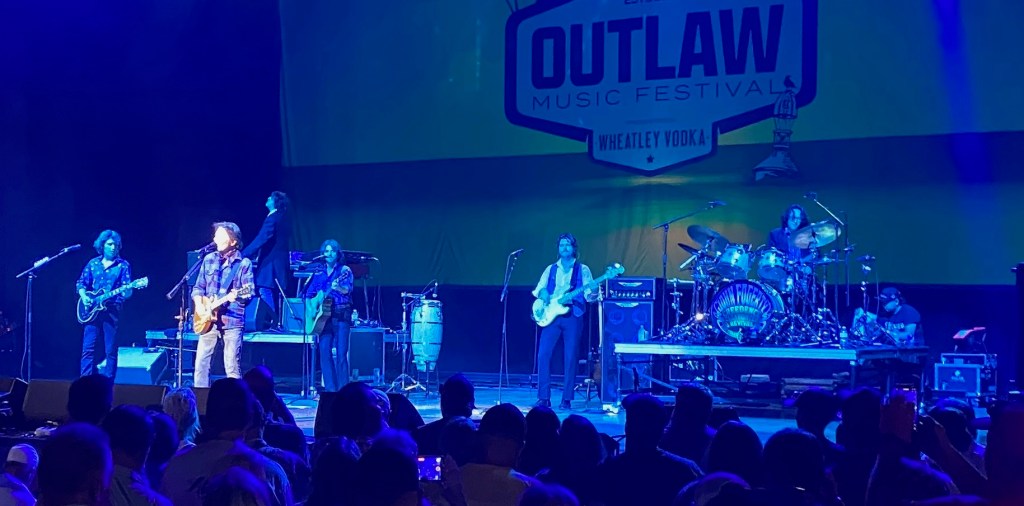
I’ll turn 78 in less than 7 years and a month. I feel good, but by then I’ll be happy to rise from my blue recliner without mechanical assistance. Unless I can get my hands on whatever that 78 year-old guy I saw on stage last night at the Blossom Music Center is taking. That guy would be John Fogerty, who in ’59 with the help of his brother formed a little band out of El Cerrito California, a few blocks north of Berkeley. They toiled under different names from 1959 onward before settling on Creedence Clearwater Revival (CCR) in ’67. You may have heard of them. Their sound made folks think they came from somewhere in the bayou, but they were California boys all the way. In those hippie times, their roots sound was kind of a contrast, and wildly popular. Between 1969 and 1971 they produced 14 consecutive top 10 singles (many of which were double A-sides) and five consecutive top 10 albums in the United States – two of which, Green River (1969) and Cosmo’s Factory (1970), reached number one. The band performed at the 1969 Woodstock festival, and was the first major act signed to appear there.John wrote his iconic “Who will stop the rain?” (1), inspired by his soggy experience there. They broke up in ’72, at the peak of their success. John continues to perform as a solo act and the remaining boys tried to pass themselves off as CCR.
The songs that John plays in concert these days are almost all CCR songs. The audience knows them by heart and sings along loudly and enthusiastically, always standing. Should John wish to take a break from singing, he can just turn his microphone to the audience and they will fill in. John still sings these songs with all the exuberance and joy of back in the day. The years have been kind to his voice and it’s easy to close your eyes and think it’s 1969 again. John, dressed in his everyman’s flannel shirt and jeans, still jumps all over the stage while delivering. But delivering these songs was once a complicated matter. In the high days of CCR, John signed over rights to his songs to Fantasy Records, who had produced all the band’s records. It wasn’t a conscious decision, just part of the standard recording contract, endorsed by his bass player (Stu Cook’s) dad, an entertainment lawyer. But over the years John saw his beloved compositions used to sell all manner of product, and didn’t like it. Thus ensued a battle that has only recently been resolved after years of legal struggle (2). Fantasy let the other members of Creedence out of their contracts when the band broke up, but held on to John. He learned he owed them 186 tracks, something he figured would take close to 20 years to fulfill. He gave up his artist royalties in 1980 to get out of his Fantasy obligations. But he remained soured on Fantasy and for many years he refused to play CCR songs out of protest. An epiphany at Robert Johnson’s grave in 1990 got him playing “his” songs again. My wife and I have seen him 4 times since we started our “Fogey Rock” tour in June 2014, and he’s always played Creedence songs. But until recently, they weren’t “his” and he realized no financial gain for playing them. He learned about 7 years ago that U.S. law would restore at least partial ownership. The way U.S. copyright law works is, [songwriters get full rights] after a period of two terms of 28 years. Somebody could actually have their songs become free after 28 years, but if the owning party exercises an option, then it goes for another 28 years, so you’re dealing with 56 years. John and his lawyers did all that (preparatory) stuff 10, 11, 12 years ago, so the songs were going to revert back to him by U.S. copyright law. But he wasn’t getting rights to his songs all over the world. John, his wife, and his lawyers eventually worked out a deal to purchase back his rights, and he now has a majority share of his publishing catalog, internationally as well as domestically; and since he is able to control how it gets used, he figures that is good enough.
Maybe this is too inside baseball for most of you. But it clearly means a great deal to John. Several times during the concert he talked about how ”I’ve got my songs back!”, spoken with both joy and tears.
Well, we in the audience are elated to have those songs back. And what songs! Still fresh as the day they were released, just like the guy singing them.
John’s the one in the light. That’s his son to his immediate right.
Rather than pepper this blog with references to YouTubes of his many great tunes, here’s a link to a recent setlist.fm, where every song on the list has a link to a file that will play it for you, which just so happens to be his setlist from last night (3). If you’re looking for something a little more permanent, there are a couple great greatest hits collection (4,5). If you seek more immediate gratification, there’s a great full concert on YouTube from several years ago (6).
So, if somehow the glory of CCR and John Fogerty has slipped your mind, it’s well worth your effort to check him out again. He may claim he’s not the Fortunate One (7)*, but we in the audience sure are.
*PS. If you’re wondering about John and the military, he served in the Army reserve in the Bay Area ’66-68, entering after his original 4-F classification was “corrected” to 1-A. Possible deployment to Vietnam was held over his head by supervisors, but never acted upon (8).
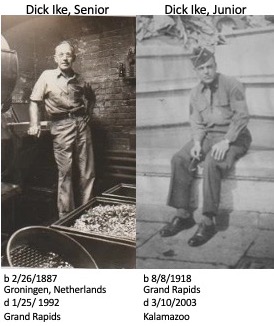
On this day, 105 years ago, Dirk and Dena Ike of Johnson Street in Grand Rapids – less than nine years off the boat from Groningen – welcomed their third boy into the world, little Dickie. He wouldn’t shed that name till he left for school, over shadowed by his big brothers Bowenus (Bob)(1), the star athlete, and Gerritt (Gary) the ladies man. He was tough enough to start at guard for the Ottawa Hills Indians football team and had a lifelong love of sports. The guns were still blazing in the Great War, the Armistice more than 3 months off. The 20s were yet to roar. This little boy would enjoy that ride, ride out the Great Depression, undergo surgery so he could enlist in the Army , see the the Ike years of the 50s coincide with the fat years of his employer Fisher Body (GM), see the 60s as a solid member of the “establishment” while his boy toyed with the other side, and relish his retirement in the 70s as one of GMs first salaried “30-and-outs”. He’d spend one more year drawing a pension check from GM than he’d drawn a paycheck. He lived with cancer for over nine years before finally succumbing to it. This man chose to be my father and did a magnificent job of it, even the 20 years after my mom died suddenly when I was 10, leaving Dad to be “a single parent before it was fashionable”, as he always like to say.
A few weeks back, tidying up our downstairs office/sewing room, I came across a big envelope from Sheldon Durham, the ‘burg’s undertaker, and father of my best friend Eric and also father of the son who handled my dad’s funeral, Jon. In it was a tabloid newspaper from Kalamazoo – not the Gazette – which on the back page had a half page tribute to my dad. This was less than a month after he’d died. I thought I’d scan that and post it around his upcoming birthday. Wouldn’t you know, I haven’t been able to find that paper for the life of me. Maybe it’ll turn up, and I’ll surely post it then. Till then, you’re stuck with my words. There have been ample paeans to my dear old dad, should you care to check (2,3,4,5).
The evening finds a lot of Count Basie and Ray Charles – Dad’s music – a good t-bone steak and a cab. Plum Market couldn’t find a Fisher Coach Insignia – the bottle I enjoyed for his 100th. From Fisher Body, dontcha know, as some of the offspring bought a vineyard and emblazon their bottles with the little coach you used to see inside the door of every GM car, gone now alas. My dad was part of the team that built and ran the biggest stamping plant GM had ever built.
Since there’s no Dick Ike, Junior without Dick Ike, Senior, let’s see them both here.
Two better men you couldn’t meet. I treasure the many years I knew them. Happy Birthday, Dad. Had you lived, you would finally have eclipsed your old man’s longevity, as he only made it a month and a day short of his 105th. Talk about old Hollanders!
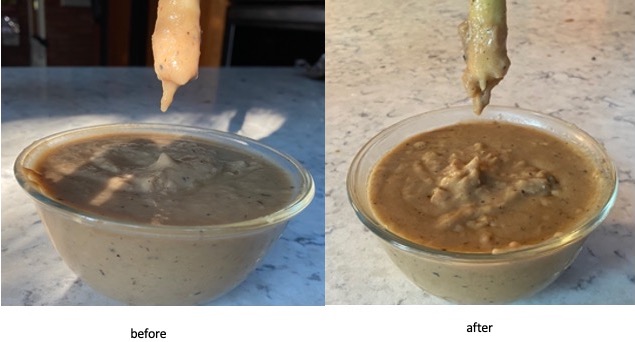
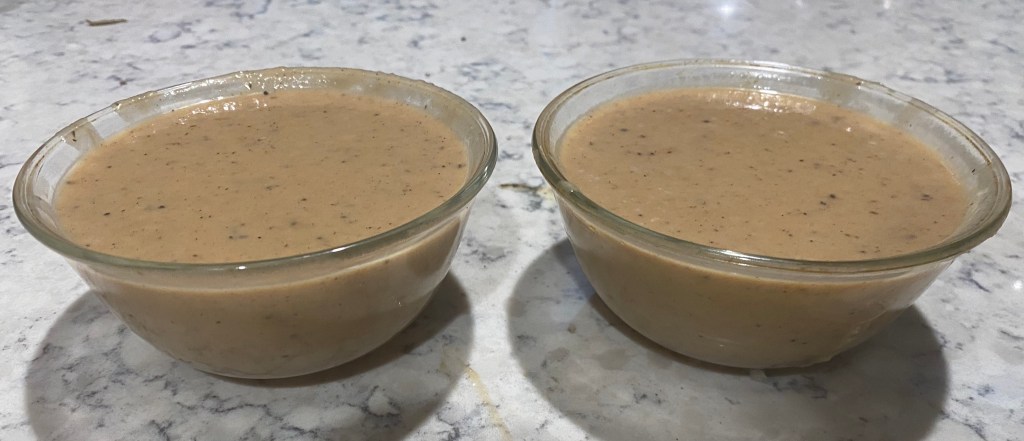
Dipping a big spoon into a warm bowl of that soup from the five lilies (1,2) is plenty satisfying. But I got to wondering how it would go to dip other edibles into the stuff, like bread, vegetables and such. Made for kind of a drippy experience when I tried it, even though the soup is kinda thick (see below). Facing tonight’s planned dinner of lamb and feta cheese burgers, I thought bits of those would be yummy dipped into a five lily concoction. Could you thicken a soup into a sauce for this purpose? Dr. Google sent me straight to Taylor Munsell who said not only yes, but spelled out 7 ways to do so (3). I picked the first one on the list, making a flour-and-water roux, plopping a specific portion into a volume of the soup, heating and stirring. But before Ms Munsell’s encyclopedic guide, Dr. Google had an article from BBC’s Lulu Grimes about using a beurre manié for the task (4). If it’s French, it’s got to be bon, n’est-çe pas? The term translates as “mania butter”. Sacre bleu! Is that what happens to the diners who taste stuff made with it? Don’t you love how French lends elegance to simple things? A beurre manié is 2 teaspoons each butter and flour mixed together – another kind of roux – then blended into the simmering soup. Ms Grimes wasn’t specific on proportions, but Ms Mansell was. For her, it was 2 ounces of the mix into each cup of soup. 4 teaspoons is 20 cc, with 30 cc equaling 2 ounces. So it was 1 tablespoon each butter and flour. Butter and flour aren’t natural mixers, so it takes some effort to get them together. My pastry cutter was worthless, and a plain old fork not much better. Then I remembered Julia Child said beurre manié is best mixed with the fingers (5). Of course, she was right. Read what she said right here.
So, the beurre went into a simmering cup of soup, stirred for 10’. The thickening was encouraging. So how did it turn out?
C’est meilleur, n’est-çe pas? Hardly a spread, but a much better dip! And it thickens more as it stands. So now you know what you can do with some at that 5-lily soup you’ve stocked up. It can live on as a very tasty dip. Just remember to lavez votremains, s’ils vous plait, après making the beurre manié!
Might I have a future as a songwriter? All songwriters need inspiration and mine came from good ol’ Barnes buddy Dave, a.k.a. Stick, a.k.a. Chappelletti. We were the two tallest in our class, and competed for biggest renegade. He practices in Marin County and I decided a few years back I should look him up on one of our frequent excursions out there. I wrote him a snail-mail letter and he said he had to read it over twice to make sure it wasn’t some sort of scam. We met up and found we had more in common now than back in the day. I visit him regularly and am recipient of his voluminous e-mail and mp4 output. The world is not shaping up to Dave’s satisfaction, and he’d become particularly disappointed with how his Austin College roommate and one-time best man “Eggy”, who after a career as a CIA analyst now in high finance in London has gone totally woke. After yet another screed, I realized a path Dave might follow for the benefit of his mental health. A Peter, Paul, and Mary tune from the 60s folk revival came to mind, and the new lyrics just poured forth, with apologies to Peter Yarrow (performer) and Leonard Lipton (author of the poem that inspired the song). Insider alert: the mascot at little Austin College – the Antioch of Texas – is the Kangaroo. Hence Austin faithful are ” ‘roos”.
Flush, the tragic drag-on
Out to the sea
Let him pollute that vast expanse
And not the mind of me.
He’ll be o.k. swimmin’
With all the other turds
Like his hero Biden and Kam’s salad of words
Oh, flush, the tragic drag-on
Out to the sea
Let him pollute that vast expanse
And not the mind of me.
Oh, E.G. used to be one
Solid upright dude
But someone got inside his head
And fucked his attitude
Now he’s with the lefties
And praises all they say
While good friends from his old ‘roo times
Shake their heads in dismay
Flush, the tragic drag-on
Out to the sea
Let him pollute that vast expanse
And not the mind of me.
‘roo friends are forever, but for politics
What can you do when another ‘roo
Says stuff that makes you sick?
Tis for a pity such a great mind
Once had style and taste
Who knows how it happened
But it’s all gone to waste.
Flush, the tragic drag-on
Out to the sea
Let him pollute that vast expanse
And not the mind of me.
Here you can hear Stick himself singing the tune
Should you be nostalgic for the P,P & M original, here ya go (1).
In my enthusiasm yesterday to tell you about the wonder of alliums at the Ann Arbor farmers’ market and the great soup I’d just made with them (1), I omitted an important ingredient from the recipe! Without the juice of those three lemons right at the end, you don’t cut the pungency of the alliums or the heaviness of the cream, and the soup turns out totally different, not nearly as good. I’ve gone and corrected it in the post. If you don’t want to live in the past, here’s that recipe right here:
The good Lord is really beginning to show his bounty in these parts. Trips to our farmers’ markets no longer target just one or two acts, punctuated by some hydroponic greens. Those treasured early seasons – rhubarb, asparagus, strawberries – have come and gone but now we get a real show. There are those precious, and pricey, little raspberries, and blueberries, and sweet corn (yay!). The greens are local now, and luscious. But one of the biggest explosions has been on the allium front. I just wrote about the monster shallots I encountered (1). But the whole family’s like that. Heads of garlic you could chuck like a weapon, green onions that look like leeks, leeks like oh well, and onions of every stripe. Though those grapefruit size numbers are nice, the little purple bulbs that still have their shoots are awfully appealing. I realized that whenever I’d made my 5-lily soup in the past, I’ve relied on grocery store ingredients, as those items tend to be available year ‘round. But fresh, local, dontcha know! Can’t beat that! As I surveyed the bounty I hauled home, I realized it wasn’t going to fit into my old recipe. Adjustments were in order, and they were made!
First, see here what I had to work with:
Starting at the bottom and going clockwise, there’s the garlics. That’s a real baseball, just for comparison. It did not go into the soup. Green onions next, shallots in the middle, then onions of several sorts. Smaller purple bulbs at top, then large red and large white. Leeks to the side. They’re often bigger in the grocery store off-season but these were fine and still slightly bigger than the green onions.
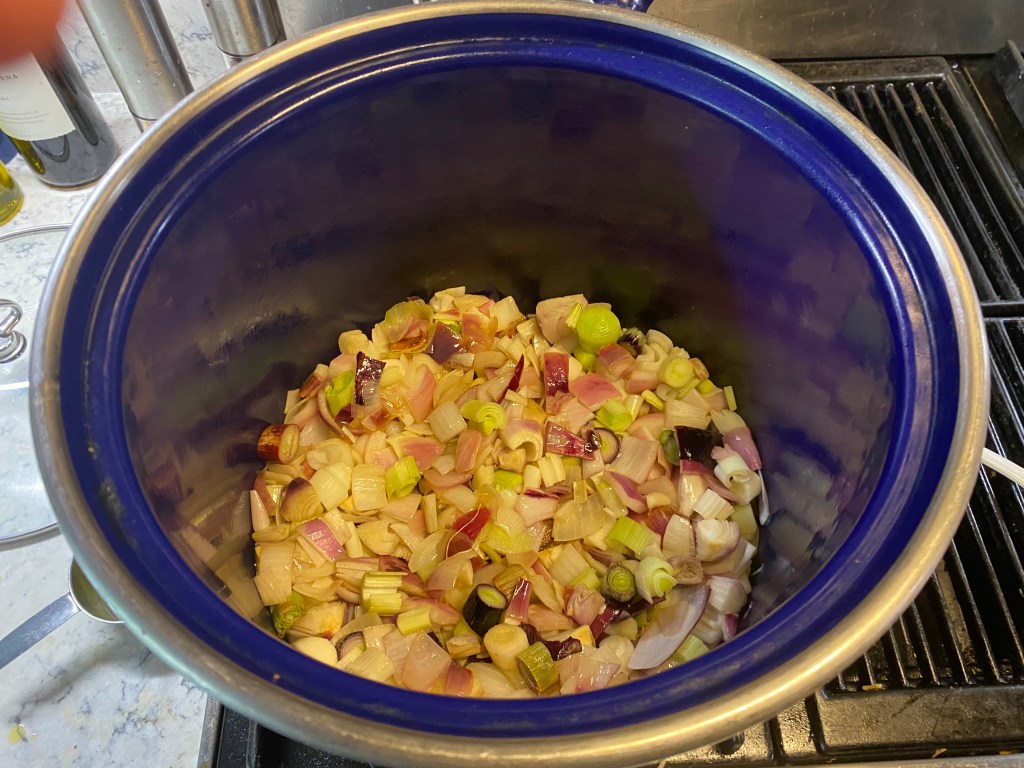
You roast the garlic, then choppy, choppy everything else. Looks mighty nice in the pot.
After simmering in stock, it has to cool to room temperature so you can buzz it smooth in the Cuisinart, blend in the cream, heat and eat!
So, here’s the recipe. Realize how much garlic is in this, so respect social considerations.







 Bob Ike's blog