
Now all of you who just completed that phrase, raise your naughty little hands! No, this isn’t a treatise on childhood snigger porn – good one for later – but results of my cost analysis of making that classic summer refresher.
My motivation was my rediscovery of the Arnold Palmer drink as part of my continuing quest to find substitutes for beer. I think ol’ Arn often put a couple shots (he preferred Ketel One) in his tea and lemonade on the 19th hole, but it’s very enjoyable without (1). The stuff is available in cans everywhere, but it’s so simple to make, why put up with the empties (cans and your wallet)?
Even though Palmer was among the first pro athletes to commercialize his name on a long line of sports and apparel products, I don’t believe he trademarked his name for his signature drink. His trademark signature/umbrella logo boldly emblazons every container of AriZona Tea’s version (2), so I think Arn’s descendants are doing o.k. People have enjoyed Arnold Palmers for decades without paying an extra penny for his name. AriZona beverages started putting the drink in cans in 2001 and now sells 400,000,000 cans annually (world).

Per Wikipedia, Arnie preferred his drink 3 parts tea to one part lemonade (1), but the universal recipe is half-and-half. Indeed, that’s the name given to the drink by those who eschew eponyms. You can get the deep story straight from the source on Arnie’s webpage (2). The spiked version is often called a John Daly (3). Miller Cohrs sells a drink called “Arnold Palmer Spiked” (4), but the alcohol comes from a fermentation of malt (Ketel One is a Dutch product made from 100% European winter wheat, and some other vodkas come from potatoes. But no malt for vodka, that’s for beer). But alcohol is alcohol, and who cares if the spiking juice came from distilling a brewing batch otherwise slated to be Cohrs Light? The brand’s been very popular, outstripping “Twisted Tea” as the #1 canned alcoholic tea (4).
I just made my last (non-alcoholic) batch with a half gallon of tea from 10 bags at room temperature plus a half gallon of prepared lemonade that was on sale at Busch’s.
I decided to make a fresh batch before writing this and tally up cost and calories for various methods of preparation. I live in a food jungle, not a food desert, with the 2 mile stretch of Plymouth from my house East to US-23 populated by 3 major grocery stores (Kroger’s, Busch’s, Plum), 2 very good ethnic groceries (Chinese, Indian), and 3 party or convenience stores. If I want to reach out, Yelp tells me that within 2 miles of my address are 5 grocery stores, 4 ethnic markets, 4 delis (including Zingerman’s!), 2 butcher shops, 1 fishmonger, 10 party/convenience stores, and of course the Farmer’s Market, convened just 1.2 miles away every Wednesday and Saturday morning in season. We eat well in Tree Town.
I decided to go to Busch’s, the middle brow of my nearby groceries. If you want to stock up your lemonade factory, here’s what you’ll need, along with prices I paid:
Lemons: $2.99/2# bag of 6
Sugar: $4.99/5# Pioneer beet sugar
Stevia*(liquid): $9.79/2 fluid ounces -> 12 tsp -> equivalent to 12 C sugar
and if all you want to do is open a container:
ReaLemon: $3.79/32 oz, enough for 42 8oz regular lemonade, or ~9¢/serving
frozen lemonade concentrates: $2.79-$3.49/12 oz: 47¢-58¢/8 oz serving.
commercial ready-made lemonade: ranges $2.99/64 oz to $4.29/32 oz, or 37¢ – 98¢/8 oz serving
There’s a lotta sugar in traditional lemonade, ready to fatten us up not to mention the many other ways it slowly poisons us. Of all the low-cal sugar substances, only stevia is a plant-based product. All the rest – like aspartame, sucralose, saccharine, and the US-banned cyclamate, are generally not considered as healthy due to potential side effects and lack of nutritional value. The Mayo Clinic has summed up those choices nicely (5). Stevia is derived from the shrub Stevia rebaudian, native to Paraguay (6). The plant extract contains glycosides. These glycosides, extracted from the plant’s leaves, including stevioside and rebaudioside A, are diterpenes with a common backbone structure called steviol. These two are the main sweet components and are significantly sweeter than sucrose (table sugar), typically by a factor of 250-300. Those diterpenes tickle “sweet” receptors without raising glucose or insulin levels, a boon to the pre-diabetic with a sweet tooth (7). As with all non-sugar sweeteners, stevia consumption alters gut flora a bit. That plus some other adverse effects have led some to question whether the compound deserves its place on the FDA’s GRAS (generally regarded as safe) list (8). Maybe it’s true what they say (9). It’s easy to find and seems pricey until you consider how potent the stuff is. Amazon features 7 pages of options (10).
Lemonade’s a pretty simple recipe, but I hadn’t made my own from scratch for a very long time, so I had to look one up. I went to the bible that has guided my cooking from the very start, Rombauer and Becker’s Joy of Cooking, first published in 1931, and still in print (11), Doctor’s daughter and lawyer’s widow Irma Rombauer’s first go with a trade publisher came in 1936, and you can get a used copy for a mere $549.95 (12). Getting the best-selling cookbook of all time (over 20 million copies sold to date) off the ground was no piece of cake, as it were (13). The 90-year-old cookbook has a bright future, as the trad wives of gen Z have taken to it big time (14). With the current edition, at 1200 pages and 4.6 pounds, you certainly get your money’s worth, especially at Amazon’s current price, nearly half that of list (11).

Reinforcing what a bargain this is, my aunt’s 1964 edition set her back $6.50, or $68.20 in today’s dollars. This latest edition was revised and expanded by Irma’s great-grandson John Becker and his wife, Megan Scott. You could say the boomer generation was fed from it, at least the lucky ones. You can still get a replica of Irma’s original self-published edition, only $16.95 on Amazon (15). My mom and Aunt Dorie both found it indispensable, and I inherited both of my aunt’s hardbound copies, one I had given her for as a Christmas present. When I went off to school, I bought my own copy as a pair of paperbacks, which still sit on my kitchen bookshelf, ever shedding their covers to be taped back on
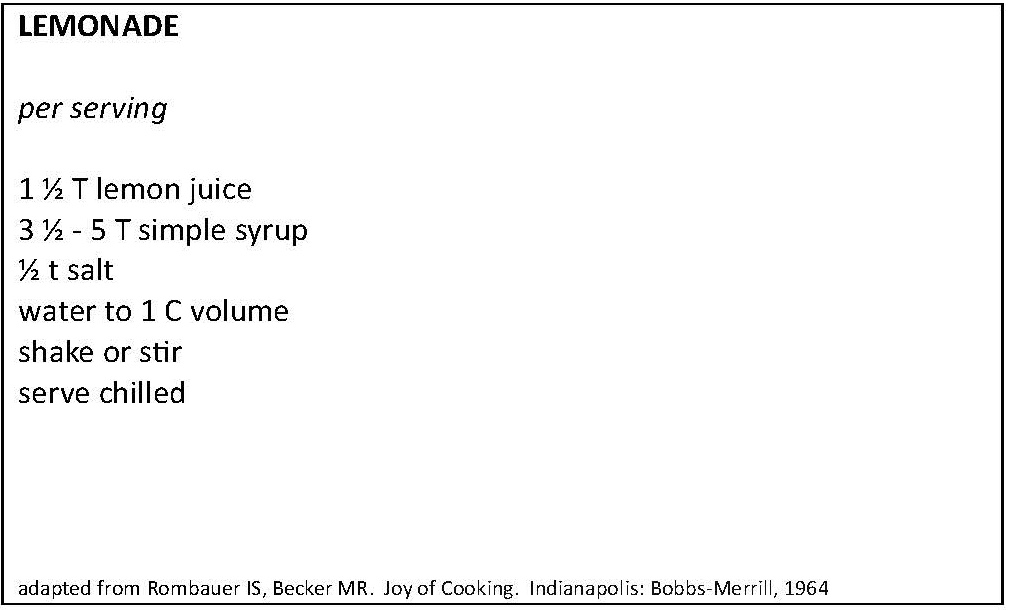
So, here from page 34 of my aunt’s book are not just one, but 3 recipes for lemonade.

Only the first is in my paperback. The extras could be helpful if you’re feeding a crowd or seeking convenience.
So how do these data translate to a better lemonade/Arnold Palmer experience? Below, I’ll show the several ways you can do this, accompanied by cost data so you can do it with thrift.
The key to the several recipes I’ll list below is the sweetener. Even that’s controversial, as some like their lemonade sweeter than others. That’s one beauty of making it yourself, as you can control the amount f sweetness.
The Joy of Cooking recipe calls for just plain sugar. But read the fine print and see you first must boil the sugar in water then let it sit to cool. Basically, you’re making “simple syrup” (16). This bartender’s staple is simply a 1:1 sugar:water mix boiled then set to cool, usually for a later day. It’ll keep for a month in the fridge. Since sugar in water takes up half the space it would as a solid, the resultant mix contains per volume an amount of sugar equal to about 1/3-1/2 more than a solid
measurement would yield. So, if you want 1T sugar, use 1 ½ T simple syrup. I’ve checked this out myself, on my own batches, and these proportions hold true.
The stevia is a little more complicated, as it is so potent. You never use much, and I recommend you titrate up. The nice folks who make Stevia Have provided a helpful conversion chart (17).
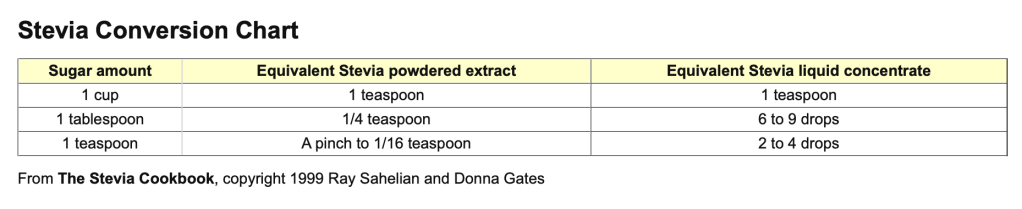
While Stevia come in a liquid form, mostly it is sold as granules, looking a lot like table sugar. A recipe for ginger ale at their site uses stevia to make a syrup, which is boiled then cooled, a lot like simple syrup (18). For fun, I also made the lemonade syrup recipe shown above, only with Stevia. Despite US approval, the World Health Organization frowns on stevia (and all artificial sweeteners), recommending consumption of no more than 4mg/kg/day (19). So, if you’re a typical 70kg (154#) American, you could throw back 58 of these stevia-laced 8 oz lemonades/day. As a supersized person (250#/114kg), I could look forward to a day with 91 quaffs. Remember, everything in moderation (including moderation, per Oscar Wilde).
It’s less complicated for the lemon juice, if not entirely so.
Calls for “juice of one lemon” don’t always denote size of lemon or volume of juice yielded. Lemons are characterized by a 3digit number, which denotes the number of lemons that size that fit into a shipping case: 240 to 540. Michigan State has produced a nice guide, which includes this illustration (20 (). The small print may be hard to read, but range of sizes is clear.

Dr. Google tells me from several sources that an “average lemon” yields 2-3 tablespoons of juice. If you’re fond of metric, here’s a nice thorough reference (21). In it, the author reminds you can increase the juice yield by gently rolling and/or briefly microwaving each fruit before squeezing. I’ve stuck with actual volumes of juice in my recipes. I got 135 ml of juice from my 2 larger lemons, which together weighed 14.3 ounces (450 gm). I juiced half my 8-bag of smaller lemons – which weighed 12.8 oz (363 gm) – and got 205 ml. So, on a juice/lemon weight, I got a better yield from the smaller ones, this time. So, with 45 ml/8 oz cup of lemonade, I’ve got enough for 7 ½ glasses. Note that the lemonade syrup uses some rind, so not all that precious zest flavor goes to waste. But do you really need to do all that squeezing when there’s ReaLemon? While bottled juices have most of that lemon flavor, they just don’t have the zest of fresh-squeezed (22). The author of that article reminds that leftover lemon juice can be frozen in ice cube trays for later use.
Now, first, the recipes, then the breakdown. No need to duplicate the recipes using straight sugar, but I do include those in which I used simple syrup.
First, the basic lemonade. Note there is no boiling involved, and the volume here is just one cup. Now, the basic recipe using Stevia. If you don’t have the liquid Stevia, you’ll need to go through a boiling step.
Finally, the syrup recipe using Stevia. Handy to have, as you can whip up fresh lemonade on demand in mere moments.

I like this for the convenience as well as the use of lemon rinds and of course the 3 calories per 8 oz serving. You can use it for an Arnold Palmer at least a couple ways. You can just make up the lemonade and mix it with tea, or you can pour the syrup right into the tea. I make mine in a half gallon jug. If lemonade should occupy half that jug, I’d pour in 4T of syrup to a jug half-filled with tea. After that, I can get a little creative, approaching the mix Arnie originally preferred (3 tea: 1 lemonade). Regardless of how you got there, that homemade Arnold Palmer can of course be adulterated further. Remember the John Daly? Just add 2 shots of vodka. Now with that stevia, haven’t we come up with a “diet” drink? With 12 oz of drink and 2 shots of 80-proof vodka, there’s 194 calories, add 5 for the lemon, packing a 24-gram alcohol punch. That’s about the same punch as my favored drink, a 12 oz 7% IPA. Remember, much of my motivation for this project was weight loss, and beer was a huge factor in my weight gain. Calories in that IPA? 220/can (23). Not much of a delta. And my carb-counting wifey tells me lemons have a glycemic index of 20. With each pound of fat accounting for 3500 calories, I’d have to quaff 167 John Daly’s in place of beer to lose a pound. That could take weeks! But every little bit helps. I could drink the Arnold Palmers without the vodka, but where’s the fun in that?
For those recipes in which you’re basically adding water, you can fancy things up by using something sparkling. If you don’t want to fuss with all those empty bottles and cans of club soda, La Croix, Perrier, or whatever , check out the SodaStream. This nifty Israeli product produces unlimited bottles of sparkling water provided you keep its CO2cannister filled (24).
Now, go whip up some so your kids can sell it from their stand out front! You can help them set their price point, using the data below. From what you get, you may want them to push it as a gourmet item. Would probably be a hit in Ann Arbor. Free range, organic, and sugar-free! Oh, and artisan!!
References
1. Arnold Palmer (drink). Wikipedia 3/19/25. https://en.wikipedia.org/wiki/Arnold_Palmer_(drink)
2. The Legendary Arnold Palmer Tea and Lemonade Beverage. arnoldpalmer.com. https://www.arnoldpalmer.com/beverages
3. Kelley B. The John Daly Drink: Recipes, and Why the Cocktail Is Named for the Golfer. About.com|about sports. 4/7/15 https://web.archive.org/web/20150407010827/http://golf.about.com/od/golfentertainment/a/john-daly-drink.htm
4. Arnold Palmer Spiked. https://www.arnoldpalmerspiked.com
5. Mayo Clinic Staff. Artificial sweeteners and other sugar substitutes. Mayo Clinic Healthy Lifestyle. Nutrition and healthy eating. https://www.mayoclinic.org/healthy-lifestyle/nutrition-and-healthy-eating/in-depth/artificial-sweeteners/art-20046936
6. Adams P. What exactly is Stevia? Ask Paul. America’s Test Kitchen 8/16/23. https://www.americastestkitchen.com/articles/7451-what-exactly-is-stevia-ask-paul?extcode=KGNAM0024&utm_medium=cpc&utm_source=google&utm_campaign=Non-Brand%7CArticles%7CDSA&utm_term=&utm_content=s%7Cpcrid%7C722241849592%7Cpkw%7C%7Cpdv%7Cc%7Cpmt%7C%7Cproductid%7C%7Cpgrid%7C168623015217%7Ccpgnid%7C21919947981%7Cptaid%7Cdsa-2398028914799%7Cadext%7C%7C&gad_source=1&gad_campaignid=21919947981&gbraid=0AAAAAD-Lx3oYZXtandg2Ngk2ti4s-MP3F&gclid=Cj0KCQjwotDBBhCQARIsAG5pinNlpyBCR6T7m1QwevoBiEIjI6_92J516Cu9W5sTnljtE8g3mOB5w0UaAlrDEALw_wcB
7. Momtazi-Borojeni AA, Esmaeili SA, Abdollahi E, Sahebkar A. A Review on the Pharmacology and Toxicology of Steviol Glycosides Extracted from Stevia rebaudiana. Curr Pharm Des. 2017;23(11):1616-1622. doi: 10.2174/1381612822666161021142835. https://pubmed.ncbi.nlm.nih.gov/27784241/
8. Drobberstein LG. Stevia – The Dark Side of the Natural Sweetener. Wellness resources 6/15/20. https://www.wellnessresources.com/news/stevia-the-dark-side-of-this-natural-sweetener?gad_source=1&gad_campaignid=21456989439&gbraid=0AAAAAD_p1BOSA-g3xE3m-GGe-AdSi7fCp&gclid=CjwKCAjwi-DBBhA5EiwAXOHsGbamh0VqU8NSoRh_QVrDwe5B0C8sB5MkbRM7ym57BJnwRdDTFTo0VxoCixwQAvD_BwE
9. bbiermanster. It’s not nice to fool Mother Nature! YouTube https://youtu.be/j12J3PCai5A?si=_sobZAJyUGuarEkC
10. Stevia. Amazon.com. https://www.amazon.com/s?k=stevia&crid=2VH13VHQQ4CFM&sprefix=stevia%2Caps%2C151&ref=nb_sb_ss_p13n-pd-dpltr-ranker_1_6
11. Rombauer IS, Becker MR. Joy of Cooking: Fully Revised and Updated. New York: Scribner 11/12/19 https://a.co/d/awwfZAP
12. Rombauer IS. 1931 Facsimile Edition: A Facsimile of the First Edition 1931. New York: Scribner 4/29/98. https://a.co/d/i6J4A4e
13. Gordon JS. The Back Story of “The Joy of Cooking”. American Heritage 49 (2): 4/98. https://www.americanheritage.com/back-story-joy-cooking
14. Moe A. Let them cook. The Atlantic 12/6/23. . https://www.theatlantic.com/family/archive/2023/12/gen-z-cooking-hobby-tiktok-pandemic/676214/
15. Rombauer IS. The Joy of Cooking. Indianapolis: Bobbs-Merrill, 1936 https://www.rarebookcellar.com/pages/books/322608/irma-s-rombauer/the-joy-of-cooking?gad_source=1&gad_campaignid=290956452&gbraid=0AAAAAD0VZQrMY3sOdfbHreos6teykbLJi&gclid=Cj0KCQjwotDBBhCQARIsAG5pinPR6l94GtYPiFunbTBdHfrP2TXdhFQNwnj6bflCqki-ta1pCLz2REoaAlh-EALw_wcB
16. Shaggy. Simple Syrup. Allrecipes 11/14/24. https://www.allrecipes.com/recipe/20216/simple-syrup/
17. Stevia Conversion Chart. STEVIA.NET https://www.stevia.net/conversion.html
18. Stevia Ginger Ale. STEVIA.NET https://www.stevia.net/morerecipes.html
19. World Health Organization. Use of non-sugar sweeteners: WHO guideline. 5/15/23. https://www.who.int/publications/i/item/9789240073616
20. Keep This Handy California Orange and Lemon Size Chart. MSU Libraries https://lib.msu.edu/sliker/load_object/8601/pdf
21. Hartleib A. Lemon juice – the all-rounder for the kitchen, bar & co. HONEST&RARE 4/3/24. https://www.honest-rare.de/en/magazine/lemon-juice-worth-knowing/#:~:text=On%20average%2C%20a%20lemon%20contains,to%20increase%20the%20juice%20yield.
22. Lemon Juice. Why fresh is best. Good Food for Good. https://goodfoodforgood.ca/blogs/recipes-with-simplicity/why-you-shouldn-t-buy-bottled-lemon-juice-fresh-is-always-better#:~:text=Fresh%20lemon%20juice%20offers%20a,lemons%20their%20distinct%20citrus%20aroma.
23. How Many Calories in a 12-oz IPA? Your Complete Guide to Beer Calories. New Trail Brewing. https://newtrailbrewing.com/how-many-calories-in-a-12-oz-ipa-your-complete-guide-to-beer-calories
24. Sodastream.com
Appendix
cost per batch – syrup
lemons: $2.99
stevia: 82¢
batch total: $3.81
16 servings/batch: 21¢/8 oz
 Bob Ike's blog