
That’s how Norseman Hrafna (Raven) Flóki (getting that nickname as he used ravens to find land from out at sea)) called it when in 868 AD he became the 3rd European to set foot on this little island in the middle of the Atlantic Ocean, sailing the 1300 km (800 mi) from the Faroe Islands by Scotland (1). Tho’ the two previous proposed different names, his stuck, inspired by all the ice he saw falling into the fiords.. Settlement began in 930 (there were no indigenous peoples to displace, only a few Irish monks) and over 1000 years later, the name has stuck. But Raven was unaware of the much larger land mass to the West, a slab of rock covered over 660,000 square miles with ice averaging over a mile thick, about 80% of its surface. Legend is that Viking Leif Erikson, credited with discovering the island, named it Greenland as a bit of false advertising to lure enemies to a certain demise in the desolate place. Unlike its 836,330 square miles neighbor, little 40,000 square mile Iceland floats on two tectonic plates (North American, Eursian) with local geologists recently discovering the island has a little middle plate of its own, as yet unnamed. And, if you recall your National Geographic specials, the magma on which those plates float escapes as lava between the rifts between the plates (2). So, despite the rain, snow, hail, and glaciers, the liquid shaping Iceland is that hot stuff seeping up. The rifts through which all that lava flows run through Iceland northeast to southwest in a big gash.
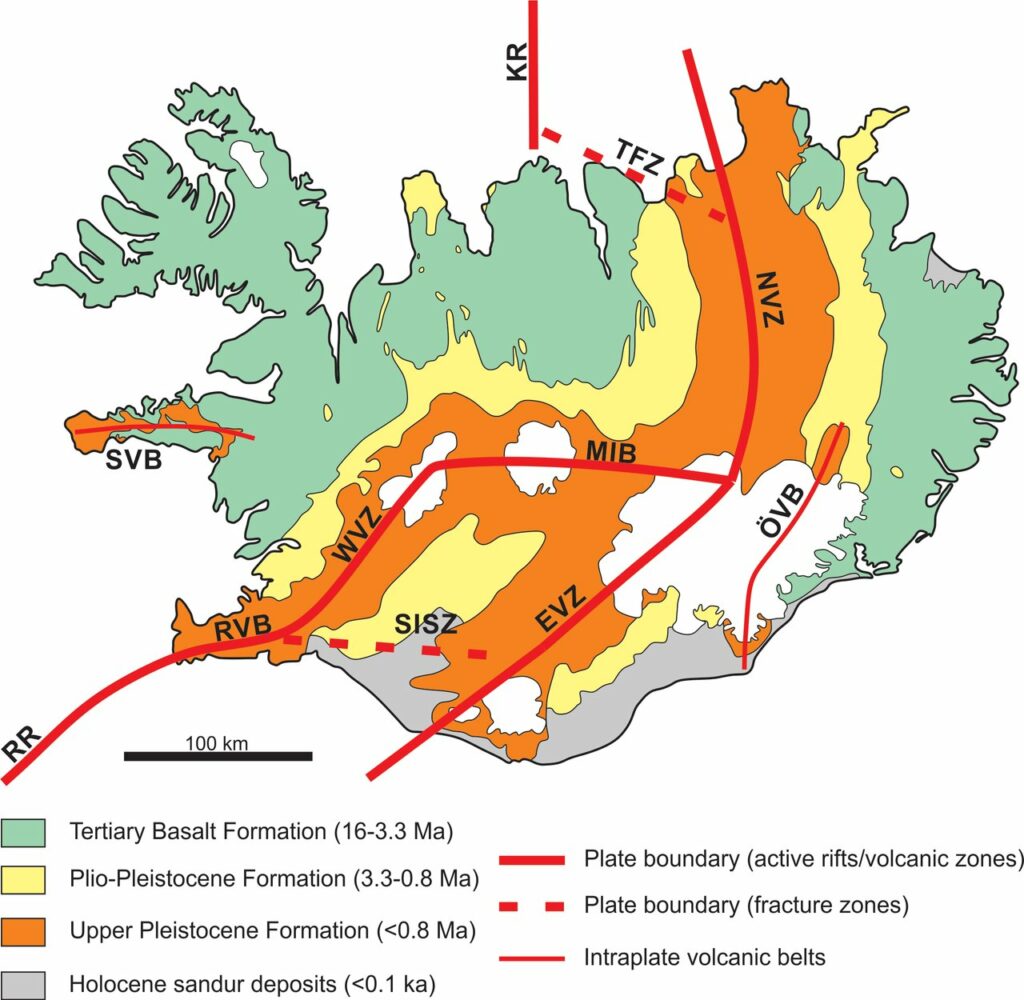
But Icelanders aren’t like Hawaiians with go bags packed lest the local volcano blows. There’s plenty of lava that flows here, but the best way to see it is in a Reykjavik restaurant that brings some inside for a hot floor show (3). Apparently, the glaciers dampen things down. But the Reykjavík paper runs with the weather report a daily tally of earthquakes detected on the island. As many as 18,000 quakes have been recorded in one week, although most are of low intensity (2 Richters or less) and hardly felt.
There are many ways to observe the interaction between these different liquids. The first is in your hotel room when you turn on the hot water tap. The local power company, produces almost all of the island’s electricity by geothermal steam, the rest hydroelectric. That steam that comes up is also a commodity used to heat water that is piped out to almost all civilized settlements. So, that water is pretty damned hot (and pure!), buildings are toasty warm against the arctic environment, and nobody owns a water heater. Electricity is not only green, it is very cheap, maybe the only thing that is here. 70% goes to local aluminum smelting plants. The undersea cables don’t exist to sell it to an energy-starved Europe, but this likely won’t happen as that sort of sale would put European prices on the juice, much higher than local prices. As of July 2024, Icelanders paid €0.1702/KwH, still way more than what DTE charges me at “peak”, equivalent of €0.038/KwH. To compare, water is separate. 90% of homes in Iceland heat with geothermal water. Water for drinking if free and hot water for heating is usually bundled into the rent. An owner of a 1080 sq foot apartment can expect to pay about €648 ($724) per year for heating, still less than one fifth what a neighbor in Helsinki can expect.
But the better way to appreciate this special association is to get out of town.
When that water gets heated up underground, pretty soon pressure builds and the stuff has to go somewhere. Of course, it’s quite a show when it blows. There are 20-30 geysers in Iceland, so the shows abound. The English word geyser derives from Geysir, which is derived from the Icelandic verb geyir. Here is Strokkur, which has its own park (and gift shop!), today and tomorrow..
Now the water itself doesn’t always need all that heat to move along. Sometimes gravity is just enough as that bit of melted glacier moves along over the jagged basalt. Here’s Gullfoss, one of 10,000 or so waterfalls to be had (4). Water doesn’t need that much gravity to move, and it tumbles over rocks everywhere, here with a waterfall and rocky stream.
They put the main power plant out in the country, partly because the higher elevation cuts down on distribution costs for the hot water. They’re so green here they scrub out the little bit of CO2 that trickles up with the harvested steam. They’ve made a tourist attraction out of the plant, complete with our handsome guide Olaf, a gift shop, and coffee service.
All that hot water bubbling to the surface makes for a lot of hot springs (5). Currently, 59 have been identified on the island, with numerous others either too small or too hot for human use. The biggest began as a mistake. On the site the Blue Lagoon now occupies, about halfway between the airport and Reykjavik, was going to be another geothermal power plant, built on an 800-year old lava field; in 1974, the drilling to find superheated water found a collection that could not be stanched. Engineers at the facility had expected the water to seep through the lava and return to the earth’s volcanic aquifers. However, owing to the fluid’s high concentration of silica, proper drainage did not occur and a beautiful body of water took shape. The authorities closed the project, but let the water flow, eventually filling an area of 9400 square feet to an average depth of 4 feet . Locals found the new pond welcoming, and in 1987, a doctor from Reykjavík—Grímur Sæmundsen—began to envision a more formalized future for the enchanting site. He imagined a place of health and wellbeing galvanized by the healing waters. What it became was Reykjavik’s biggest tourist attraction, one that has been designated a wonder of the world (6). Besides the 38-400C (100-1040F) water, the high concentration of silica, other minerals, and algae confer health and especially cosmetic benefits. A step into these blue waters (from all the silica) is an excellent way for a tourist to kick off an Icelandic excursion. It’s less crowded these days, as locals are shunning the place out of concern for a potential new eruption of a local volcano, from which new lava would take 10 minutes to reach the lagoon. Talk about a hot tub!
Above ground, the winds off the North Atlantic seldom let up, with every blustery day different from the day before. Sometimes the winds are strong enough to chase skiers off the slopes, concerned with being blown over. But the wind responsible for Iceland’s primo attraction comes from far, far, away – 93 million miles to be precise – when on the sun’s surface sunspots form and solar flares erupt, both flinging supercharged ions into space. This “solar wind” travels up to 60 miles/second and reaches Earth in 15-45 minutes. There, it interacts with the magnetic field of our planet, which directs the energies to the poles. Once there, it reacts with various gasses in the upper atmosphere, producing the dancing colors we know as the Northern Lights.
This show was given a more elegant name by the first man to describe them, none other than Galileo. In the early 17th century , he saw faint light on the northern horizon very early in the morning and thought it resembled an early morning sunrise, “dawn from the North.” Aurora was the Roman goddess of dawn, and Boreas was the Greek name for the north wind, thus aurora borealis. Given that the Northern Lights rarely show as far south as Italy, the great man had to be an astute observer. We learned all this from Professor Saever Bragason of Icelandic University. He’s written a guide to the night skies of Iceland (7) and maintains a web site (8) with all the data you need to chase the Northern Lights. That book is a beauty and sold everywhere (but not Amazon).
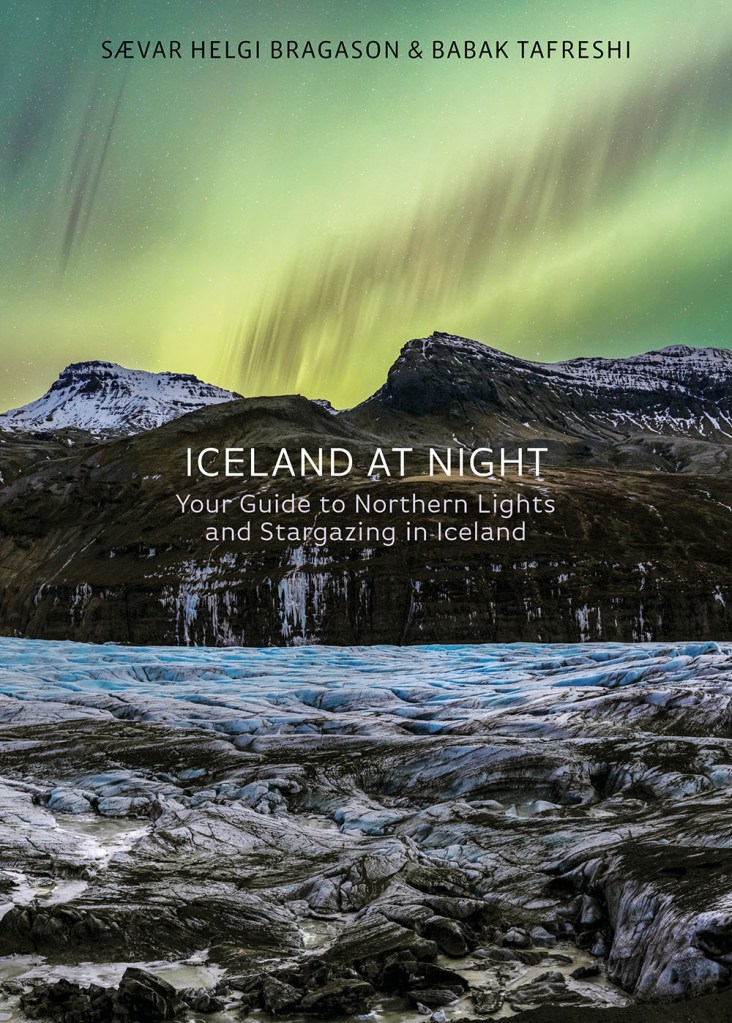
He said aurora conditions are excellent right now, but it’s been hard to see much because of the cloudy skies. Despite this, he said that Iceland was one of the best places in the world to see the Northern Lights. He also does eclipses, and says 2026 looks like a good year, but that’s a whole ‘nother story.
To see this celestial display was the main purpose of our trip (9). The pea soup cloud cover we encountered on Sunday’s arrival began to break up, and Tuesday afternoon’s partly cloudy was promising. Our bus trip west out of downtown past the airport to the Garoskagaviti peninsula, about an hour’s drive from our downtown hotel, parked on a rocky beach between two lighthouses (only one functional). There for half an hour we gazed upwards only to see that the partly cloudy sky contained little else but a full moon high in the sky and a bright Venus on the Northern horizon. Then, some of the ”clouds” began to assume a more wispy, convoluted shape. One of the more savvy members of our group mentioned that the colors of the Northern Lights are usually more intense viewed through a camera, including that of a cell phone. Up went the iPhones, quickly followed by collective gasps and oohs. There they were, in all their (mostly) green glory. They danced for us for at least an hour till we decided to pack it in. A single shot can’t capture the wonder of a sky full of aurora, but here are a couple examples.

Can it be that all these energies, coming together from nearly 100 million miles apart, can be but a random event? Maybe somebody is trying to talk to somebody?

We can hope they came in peace for all mankind.
Our afternoon skies as we drive north today to Akureyri in the North show only a few clouds. We’re going out again tonight. Maybe we’ll be able to pick up the conversation.
Reverences
1. Melton Z. The Discovery and Settlement of Iceland. What’s On. 2/27/ 23. https://www.whatson.is/the-discovery-and-settlement-of-iceland/
2. Volcano Lava | National Geographics. https://youtu.be/xExd/si=pNOIQPBKg1cGOylr
3. Lava show. www.lavashow.com
4. Iceland Like a Local. Discover the Icelandic waterfalls
5. Epic Iceland. List of all hot springs in Iceland. https://epiciceland.net/all-hot-springs-iceland/
6. Blue Lagoon. Iceland. https://www.bluelagoon.com/day-visit/the-blue-lagoon
7. Bragason SH, Tafreshi B. Iceland at Night:Guide to Northern Lights and Stargaziing in Iceland. Bókabúd Forlagid 2024. https://www.forlagid.is/vara/iceland-at-night/
8. Iceland at Night. Icelandatnight.is
9. Iceland at Night. Icelandatnight.is9. Gohagen & Company. Iceland and the Northern Lights. https://www.gohagantravel.com/programs/iceland-and-the-northern-lights
 Bob Ike's blog